 EN
EN




Iron Oxide Red: Properties, Applications, and What Buyers Should Verify Before Ordering
High‑quality iron oxide red pigment from China source factory. Excellent tinting strength, weather & alkali resistance for concrete, coatings, rubber, plastic. Bulk supply, samples available. Get your quote today.
Description
The red interlocking pavers outside a shopping mall, the terracotta-toned roof tiles on a suburban estate, the red-oxide primer on a steel bridge girder, the brick-red running track at a city school — four different industries, four different buyers, and one pigment behind all of them: iron oxide red.
Iron oxide red (α-Fe₂O₃) is the single most widely used colorant in the construction materials industry and one of the most consumed inorganic pigments in the world. For a buyer — whether you run a concrete products plant, a paint factory, or a plastics compounding line — understanding what this pigment actually is, where it performs well, and where it does not, is the difference between a smooth repeat-order relationship and a costly quality dispute.
This article covers the properties that matter in industrial purchasing, the main application sectors with their typical dosage ranges, the two honest limitations of iron oxide red that no supplier brochure will emphasize, and the specifications you should verify before signing a contract.
What Iron Oxide Red Actually Is
Iron oxide red is chemically iron(III) oxide, α-Fe₂O₃, the same mineral family as hematite. Commercial grades are almost entirely synthetic — produced either through the Penniman process (using iron scrap and sulfuric acid), the Laux process (a byproduct route from aniline production), or direct precipitation — because synthetic routes give manufacturers control over particle size and color consistency that natural ground hematite cannot match.
Why does this matter to a buyer? Because color in iron oxide red is a direct function of particle size:
- Fine particles (around 0.1 µm) give a light, yellowish red
- Medium particles (0.2–0.4 µm) give the classic bright, clean red used in most applications
- Coarse particles (above 1 µm) shift toward a dull, brownish purple-red
A supplier who cannot control particle size distribution batch-to-batch cannot deliver consistent color — and inconsistent color is the number-one cause of claims in pigmented concrete and coating production.
The Properties That Make Iron Oxide Red the Default Choice
Iron oxide red earns its dominant market position on five properties, each of which translates directly into a purchasing argument:
Weather and UV resistance. Iron oxide red does not chemically degrade under sunlight. A concrete paver colored with iron oxide red will look substantially the same after fifteen years outdoors, which is exactly why municipal and landscaping projects specify it.
Alkali resistance. Cement is strongly alkaline. Many organic pigments break down in a cement matrix; iron oxide red is fully stable in it, making it the only realistic red option for through-colored concrete products.
Heat stability. Red iron oxide withstands processing temperatures up to roughly 300 °C in most grades—comfortably above PVC processing windows and most coating bake schedules. (Note: this is a red-specific advantage. Iron oxide yellow begins converting to red above about 180 °C, which is a genuine selection constraint in yellow—not in red.)
Non-migrating and non-bleeding. The pigment is an inert mineral. It does not dissolve, migrate, or bloom in binders—important for layered coatings and food-contact-adjacent applications.
Cost per covering unit. On a cost-per-year-of-color basis, iron oxide red is nearly unbeatable for earth-tone and oxide-red shades. The pigment is abundant, the production routes are mature, and hiding power is high.
Where Iron Oxide Red Is Used — Sector by Sector
Concrete and Construction Products
This is the largest end market. Typical applications: paving blocks and kerb stones, architectural concrete, roof tiles, dry-cast and wet-cast precast elements, and mortars.
Typical dosage: 1–5% by cement weight for full through-color; below roughly 1%, color becomes visibly uneven because the pigment coating on cement particles is too thin to mask the grey base.
One practical note for concrete buyers: color consistency in concrete depends as much on the process as on the pigment—cement source, water-cement ratio, curing temperature, and efflorescence all shift the final shade. A supplier who only talks about pigment ΔE and never asks about your mix design is not a technical partner.
Paints and Coatings
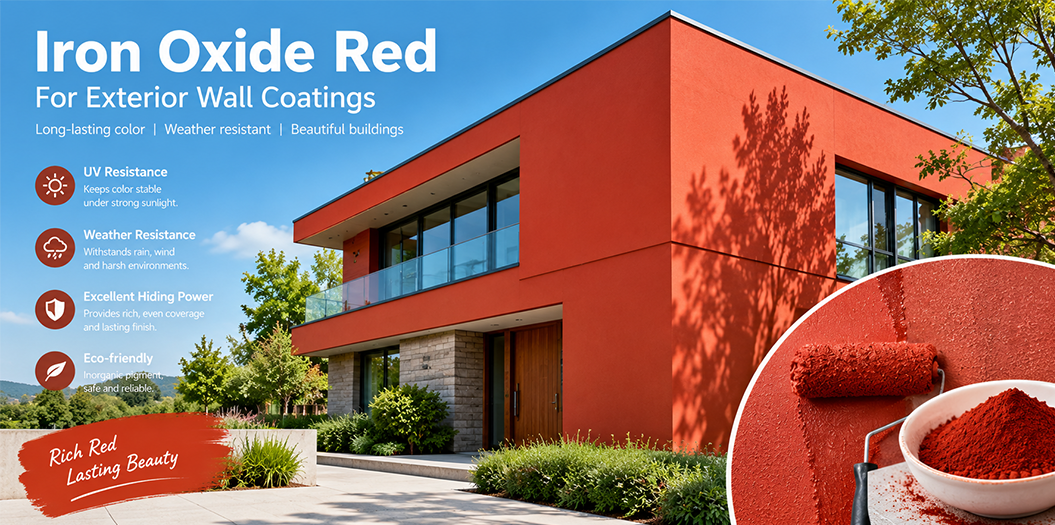
Iron oxide red serves in anti-corrosion primers (where red oxide primer remains a standard for steel protection), roof and facade coatings, floor coatings, and industrial topcoats in earth-tone ranges.
Typical dosage: 5–20% in primer systems, 2–10% in topcoats depending on hiding and shade targets. Key specifications for coatings buyers: oil absorption (affects binder demand and gloss), sieve residue (affects film smoothness in thin coatings), and moisture content (affects dispersion stability in waterborne systems).
Plastics
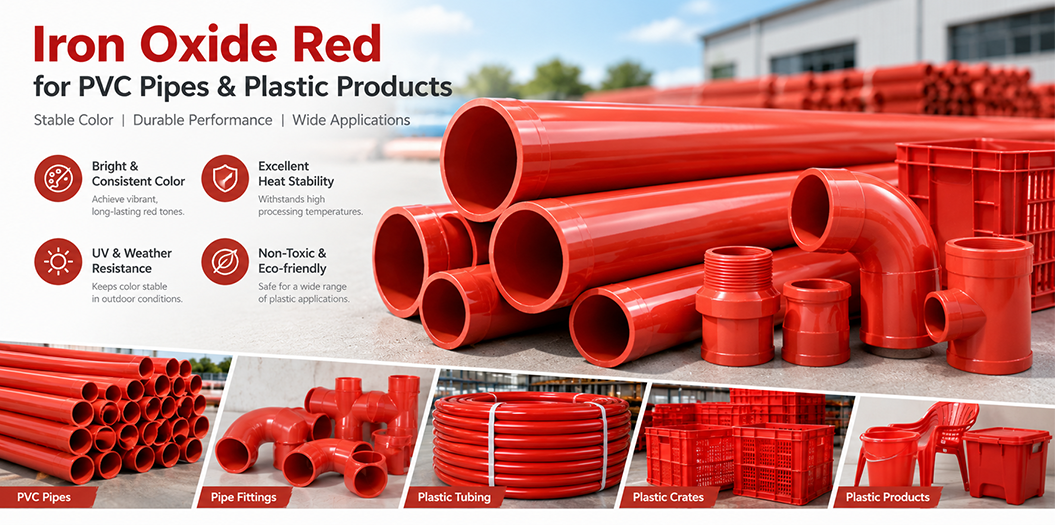
In plastics, iron oxide red is used in PVC profiles and pipes, masterbatch, artificial turf infill backing, and outdoor injection-molded parts. Typical dosage: 1–5%. The buying focus shifts to heat stability at processing temperature, dispersion behavior at low shear, and heavy-metal compliance for sensitive applications.
Rubber, Tracks, and Other Sectors
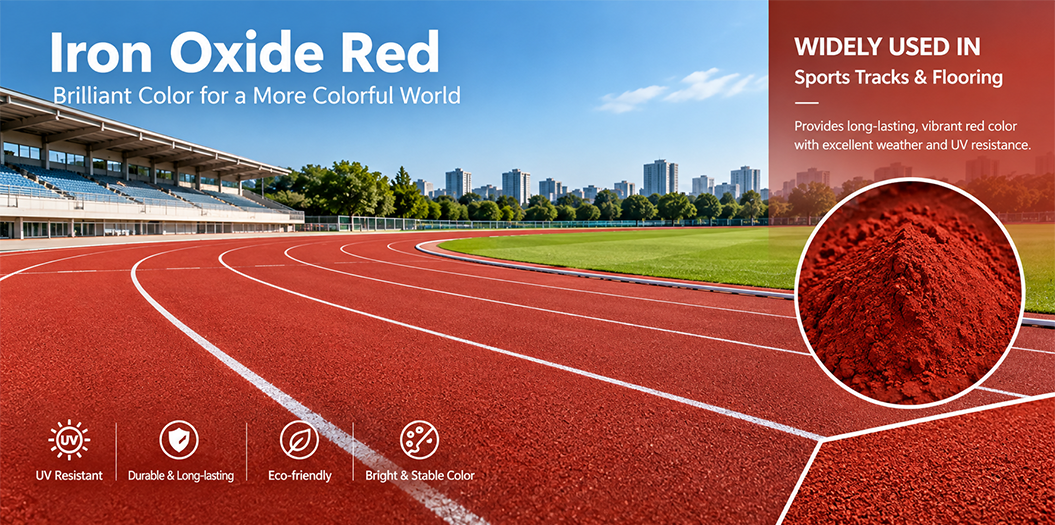
Rubber flooring and running tracks, colored asphalt, ceramics, and brake linings consume significant volumes of red. In rubber the focus is on dispersion and non-staining behavior; in asphalt, on thermal stability at mixing temperature.
Two Honest Limitations — What Iron Oxide Red Cannot Do
Most supplier pages list only advantages. Here are the two genuine limitations, because a buyer who discovers them after the first container has a much bigger problem than one who knows in advance.
Limitation 1: The color range is earthy, not vivid. Iron oxide red delivers brick red, terracotta, oxide red, and brownish reds. It cannot deliver a vivid scarlet or signal red—that chroma range belongs to organic pigments (azo, quinacridone), which cost more and weather worse. If your end product needs a bright "safety red" or fashion red, iron oxide red alone will disappoint. If it needs a natural, durable oxide red, nothing competes with it on cost.
Limitation 2: Thin films and white bases demand more from the pigment — and the process. In deep-shade coatings there is enough pigment to hide everything. But in a light base or a thin film, iron oxide red needs a higher loading and good dispersion to avoid a washed-out or streaky result. Its high density also means it settles faster in low-viscosity liquid systems, so anti-settling formulation matters. Practically: expect to run dispersion trials, and choose a supplier who provides grade options by particle size rather than one generic "red".
Neither limitation is a disqualifier—they are selection criteria. Knowing them upfront lets you specify the right grade and set the right expectations with your own customers.
What to Verify Before You Order
When comparing iron oxide red suppliers, ask for these parameters on every batch, not just the sales sample:
|
Parameter |
Why It Matters |
Typical Spec |
|
Color difference ΔE vs. standard |
Batch consistency — the claim-killer |
ΔE ≤ 1.0 (ab) |
|
Tinting strength (relative) |
Determines real dosage cost |
95–105% of standard |
|
Sieve residue (325 mesh) |
Film smoothness, concrete streaking |
≤ 0.3% |
|
Moisture content |
Dispersion stability, caking in bags |
≤ 1.0% |
|
Water-soluble salts |
Efflorescence risk, coating stability |
≤ 0.5% |
|
Heavy metals (Pb, Cr, Cd…) |
REACH, EN 71-3, food-adjacent compliance |
Per applicable regulation |
A supplier who can produce this table routinely, batch after batch, is structurally different from one who sends a beautiful sales sample and then disappears into the production schedule. Ask for a COA from a recent production batch—not a tailored sample—before you commit.
Compliant Iron Oxide Red Supply from Hebei Tianhuibao
Hebei Tianhuibao Technology Co., Ltd. produces iron oxide red across the main grade range—from fine, bright reds for coatings to standard concrete grades—with an annual capacity of 50,000 tons and exports to more than 150 countries.
For buyers, the working terms are straightforward:
- MOQ: 1 ton. Sample orders are welcome and are handled separately—samples do not count toward the minimum order quantity, so you can trial the material before committing to volume.
- Documentation: REACH and CE certification available; COA issued per production batch with ΔE, tinting strength, sieve residue, and moisture data.
- Grades: Multiple red grades by particle size and tinting strength, so the pigment can be matched to your matrix—cement, coating binder, or polymer—rather than forcing your process to adapt to one generic product.
- Application support: If you are converting a color formula from another pigment system, our technical team can advise on dosage and dispersion parameters based on your substrate.
To request a free sample or a production-batch COA—or to check which red grade fits your concrete, coating, or plastics line—contact our team. We reply within 24 hours with pricing and technical data.