 ×
×
To many procurement managers in the coatings, construction materials, and plastics industries, iron oxide pigments may initially appear to be standardized industrial commodities. On the surface, products such as iron oxide red, iron oxide yellow, or black pigments look similar across suppliers, and quotations may differ only slightly. However, experienced global buyers know that the apparent uniformity often hides significant performance differences between suppliers.
In practice, two shipments of pigment with the same color label may behave very differently during real production. Variations in heavy metal content, sieve residue, tinting strength stability, and particle size distribution can easily exceed 30% between different iron oxide pigment manufacturers. These hidden differences rarely appear in a laboratory sample but can create serious problems once a full container arrives at a production facility.
For example, unstable tinting strength may lead to color inconsistency in concrete blocks or roof tiles. Excessive sieve residue can cause dispersion problems in coatings, while fluctuating particle distribution may affect the mechanical properties of plastic compounds. In severe cases, entire shipments must be rejected or reprocessed, resulting in production delays and reputational damage.
The key lesson for procurement teams is clear: a qualified sample does not guarantee a qualified shipment. A product that meets specifications today may fail to meet the same standards next month if the manufacturing process lacks consistency.
This is why professional sourcing strategies increasingly rely on structured supplier audits. A systematic vendor audit allows buyers to evaluate not only the final pigment product but also the entire production ecosystem behind it. By conducting a focused 24-hour factory inspection using a standardized checklist, procurement teams can quickly determine whether a supplier is a reliable long-term manufacturing partner or simply a trading intermediary.
This guide introduces a practical audit framework used by experienced global buyers when evaluating iron oxide pigment manufacturers.
A successful supplier audit begins long before the factory visit itself. Careful preparation allows procurement teams to eliminate unsuitable suppliers early and ensures that on-site inspection time is used efficiently.
The first step is verifying qualification documents. Reliable iron oxide pigment manufacturers typically maintain internationally recognized management systems such as ISO 9001 for quality management and ISO 14001 for environmental management. When reviewing these certificates, buyers should pay close attention to the certification scope. Some companies possess certificates that cover only trading or distribution activities rather than actual manufacturing. The absence of production in the certification scope may indicate that the supplier operates as a trader rather than a manufacturer.
Technical documentation also requires verification. Buyers should carefully review the supplier’s Material Safety Data Sheet, product specification sheets, and third-party laboratory reports. Independent testing certificates are particularly valuable because they provide objective confirmation of pigment purity, heavy metal limits, and chemical composition. Cross-checking report numbers and issuing organizations can help confirm authenticity.
Another critical step is evaluating supply chain transparency. Procurement teams should ask suppliers to provide information about raw material sources. Some pigment manufacturers rely on natural iron ore, while others use recycled industrial iron materials or by-products. Understanding the upstream raw material chain helps buyers evaluate long-term supply stability and potential environmental compliance risks.
Modern procurement teams often conduct a preliminary facility assessment using satellite mapping tools. By examining the factory’s geographic location, surrounding infrastructure, and visible facility scale, buyers can estimate whether the supplier’s claimed production capacity is realistic. A large pigment manufacturing plant typically requires significant industrial space for raw material storage, reaction equipment, milling facilities, and finished product warehouses.
Completing these steps before visiting the factory allows buyers to focus their on-site audit on operational verification rather than basic document collection.
When visiting the facility, the goal is to evaluate the supplier’s production system rather than simply observing finished products. Each stage of the manufacturing process reveals information about product consistency and quality control discipline.
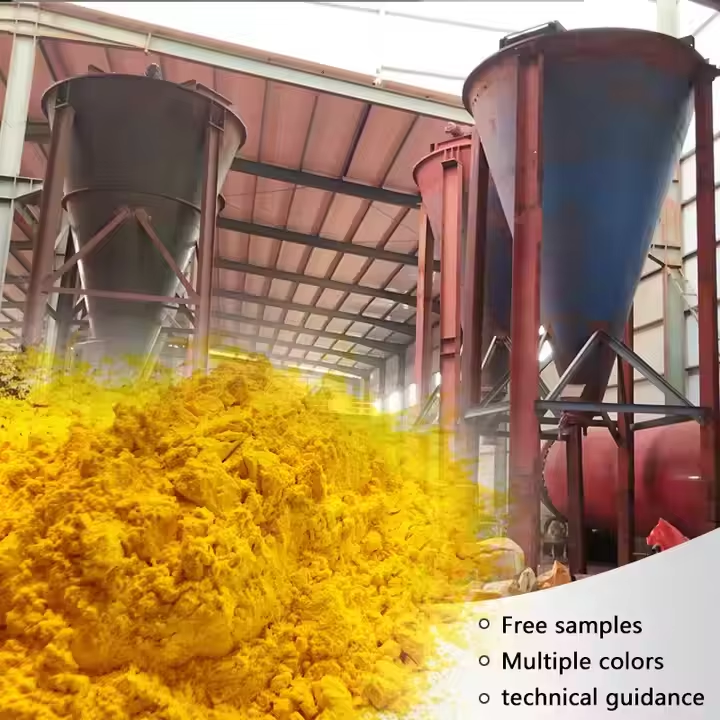
The raw material yard is often the most revealing part of the factory. Pigment production quality begins with raw material management. Buyers should observe whether the raw materials consist of natural iron ore, recycled iron sources, or other iron-containing materials. Each source affects pigment purity and final color stability.
A well-organized yard typically includes separate storage zones for different raw material batches, clear identification labels, and protective measures against rain and dust. Poorly organized raw material areas often indicate weak batch management practices. Since raw material purity directly influences pigment composition and heavy metal levels, inconsistent storage inevitably leads to unstable pigment quality.
The chemical synthesis stage is where the crystal structure of iron oxide pigments is formed. For example, the performance characteristics of iron oxide yellow or iron oxide red depend heavily on precise reaction conditions.
During an audit, buyers should examine the process control system used by the manufacturer. Modern facilities commonly operate distributed control systems that continuously monitor reaction temperature, pressure, and reaction time. These parameters are recorded for every production batch.
Accurate process control ensures that the pigment crystal structure remains consistent. This consistency directly affects weather resistance, dispersion behavior, and color stability in downstream applications.
After synthesis, pigments must be processed to achieve the desired particle size distribution. Milling technology plays a critical role in determining pigment performance.
During a factory inspection, buyers should observe the type of grinding equipment used. High-precision milling systems allow manufacturers to achieve uniform particle sizes with extremely low sieve residue levels. Additional systems such as magnetic separators or classification screens further improve pigment purity.
Particle size distribution influences several critical product characteristics, including oil absorption and dispersion behavior in coatings or plastics. Effective milling control ensures that pigments can be processed smoothly without clogging screens or causing dispersion defects.
A professional pigment manufacturer must operate a fully equipped quality control laboratory. Laboratory capabilities demonstrate whether the manufacturer truly controls product quality or simply relies on external testing.
Buyers should look for instruments such as color spectrophotometers, particle size analyzers, and weather resistance testing equipment. These tools allow manufacturers to verify tinting strength, color deviation, and durability performance.
Another key indicator of quality discipline is sample retention. Reliable manufacturers usually maintain archived samples for multiple years. These retained samples allow manufacturers to investigate quality concerns and verify batch consistency across shipments.
Packaging operations also affect pigment stability. In humid environments, improper packaging can cause pigments to absorb moisture and form lumps, which complicates downstream processing.
During the audit, buyers should observe whether the packaging process is automated or manual. Automated systems typically provide more consistent packaging weights and reduce contamination risks. Storage conditions are equally important. Warehouses should maintain dry environments and protect products from direct sunlight or excessive humidity.
Environmental compliance has become one of the most important evaluation factors when selecting iron oxide pigment manufacturers. Pigment production generates wastewater and gas emissions that must be properly treated before release.
Buyers should inspect wastewater treatment systems, emission control equipment, and safety infrastructure such as fire prevention systems. Factories that fail to meet environmental regulations face a high risk of operational shutdowns.
For buyers relying on stable supply chains, this risk is critical. A supplier that is forced to suspend production due to environmental violations may cause severe disruptions in downstream manufacturing operations.
The final checkpoint focuses on the manufacturer’s technical capability. Beyond producing pigments, reliable suppliers must understand how their products perform in real applications.
Buyers should examine whether the manufacturer maintains an application laboratory capable of performing coating tests or concrete color evaluations. Technical personnel should also be available to assist customers in optimizing pigment usage.
Manufacturers that provide application support demonstrate deeper industry expertise and are better equipped to solve customer problems.
After completing the factory audit, procurement teams should convert their observations into a structured evaluation system. A scoring matrix allows buyers to compare different suppliers objectively.
Quality control systems typically receive the highest evaluation weight because they directly influence product consistency. Production process control and environmental compliance also receive high scores because they determine operational reliability and regulatory stability.
Procurement teams should also define clear “red-flag” indicators that immediately disqualify a supplier. Examples include falsified laboratory data, refusal to disclose production records, or severe environmental violations. These issues indicate systemic risk that cannot be corrected through routine quality monitoring.
A structured evaluation framework allows buyers to move beyond subjective impressions and make evidence-based sourcing decisions.
Reliable manufacturers view customer audits as an opportunity to demonstrate operational transparency rather than as an inconvenience.
Hebei Tianhuibao Technology Co., Ltd. is a professional manufacturer specializing in the research, production, and global distribution of iron oxide pigments. The company supplies pigments for industries including coatings, construction materials, plastics, and infrastructure manufacturing. As one of the experienced iron oxide pigment manufacturers, the company has developed a comprehensive quality control system covering raw material sourcing, production monitoring, laboratory testing, and packaging management.
To ensure traceability, every shipment produced by the company carries a unique batch identification number. This system allows customers to trace each batch back to its raw materials, production parameters, and laboratory testing records.
The company actively encourages supplier audits from international customers. Procurement teams visiting the facility can review production records, observe quality control procedures, and evaluate the technical laboratory. In addition, the company’s technical team can provide formulation recommendations to help customers optimize pigment performance in their specific applications.
For long-term partners, the company also supports annual quality stability agreements that define acceptable tolerance ranges for key pigment properties. Such agreements help ensure consistent product performance across large-scale procurement cycles.
Selecting the right supplier among numerous iron oxide pigment manufacturers requires more than reviewing samples and comparing quotations. True procurement expertise lies in evaluating the entire manufacturing ecosystem behind the product.
A structured audit checklist allows buyers to assess raw materials, process control, quality testing, environmental compliance, and technical support capability within a short inspection period. By applying a systematic evaluation model, procurement teams can significantly reduce supply chain risk and establish reliable long-term partnerships.
Companies seeking dependable iron oxide pigment supply are encouraged to conduct a comprehensive vendor audit before committing to bulk orders. Buyers interested in working with Hebei Tianhuibao Technology Co., Ltd. may request a virtual factory audit, obtain a complete supplier qualification document package, or speak directly with the company’s quality management team to discuss technical requirements.
In global industrial sourcing, transparency, traceability, and consistent manufacturing discipline remain the most reliable foundations for long-term success.
 Hot News
2026-09-04
2026-01-03
2026-01-01
2026-01-07
 EN
EN