EN
EN




Inline Quality Testing for Iron Oxide Pigment in Paint
As someone who has spent years on the quality control side of iron oxide pigment supply, I can tell you that the difference between a reliable iron oxide pigment and a problematic one rarely shows up in a single lab test. It surfaces batch after batch, in the gap between what a certificate of analysis promises and what actually arrives at your production line. Inline quality testing for iron oxide pigment tends to get less attention than it should — which is usually noticed only after a batch problem surfaces.
If you source or use iron oxide pigment for paint, coatings, or concrete coloring applications, understanding what a well-run inline QC program looks like will help you evaluate iron oxide pigment suppliers more accurately and protect your own production quality.
What Is Inline Quality Testing and Why Does It Matter for Iron Oxide Pigment?
Inline quality testing refers to quality checks performed at multiple points during the manufacturing process — not just before a batch ships, but while it is being made. For iron oxide paint pigments, this means sampling and measuring key parameters at each stage: raw material intake, during synthesis or precipitation, after drying, and before final packaging.
The case for this approach in iron oxide pigment production is not complicated. If a manufacturer only tests finished iron oxide pigment product, defects discovered late can mean entire production runs must be reworked or scrapped. Inline testing catches deviations early, when corrections are still low-cost. That said, not every iron oxide pigment supplier has the process discipline or instrument infrastructure to run meaningful inline checks. Knowing what to look for will help you tell them apart.
Key Quality Parameters for Iron Oxide Pigment Tested at Each Stage
Stage 1: Raw Material Incoming Inspection
The quality of a finished iron oxide pigment is largely determined before any synthesis begins. Incoming iron sources used to manufacture iron oxide pigment — whether iron sulfate, scrap iron, or iron chloride — are tested for purity, heavy metal content, and moisture. Any contamination at this stage can propagate through the entire iron oxide pigment batch.
- Heavy metal screening: Limits for lead, cadmium, chromium, and mercury must comply with REACH and CE requirements for export markets. For iron oxide pigment shipped to Europe, REACH compliance is not optional — it is a market access requirement that every serious iron oxide pigment producer must meet.
- Moisture content: Incoming raw materials above specified moisture thresholds require pre-drying. Excess moisture at this stage increases energy consumption in downstream drying and risks introducing variability in the iron oxide pigment particle size distribution.
- Iron content purity: Higher purity iron sources yield more consistent iron oxide pigment chemistry and predictable color development across production batches.
Stage 2: In-Process Synthesis Control
During the synthesis or precipitation stage, reaction parameters — temperature, pH, reaction time, and agitation rate — are monitored continuously. Deviations in any of these variables shift the crystal structure and particle size of the resulting iron oxide pigment, which directly affects the final color and performance of the finished iron oxide pigment in paint applications.
This is where I have seen the most variation between iron oxide pigment suppliers. A facility running proper inline controls will track pH in real time during precipitation and take periodic particle size samples to confirm D50 values remain within target range — typically 0.3 to 0.5 μm for iron oxide pigment grades used in paint and coating applications. Oversized particles above 44 μm in iron oxide pigment act as stress concentrators in coatings and can cause surface defects.
Tinting strength is also evaluated at this stage using a drawdown test against a standard reference sample. A significant drop in tinting strength mid-batch indicates a synthesis parameter has drifted, and inline monitoring allows operators to correct course before the full iron oxide pigment batch is compromised.
Stage 3: Post-Drying Moisture and Volatile Content of Iron Oxide Pigment
After drying, the iron oxide pigment is tested for residual moisture and volatile content. This step cannot be skipped in paint and coating applications. Moisture content above 1% in iron oxide pigment causes problems in downstream processing — in aqueous coatings, excess moisture disrupts formulation stability; in solvent-based systems and high-temperature applications, it can cause bubbling or adhesion failures.
The method here typically follows ISO 787-2 (determination of matter volatile at 105°C). A well-equipped iron oxide pigment manufacturer runs this test on every production batch rather than on a sample-by-sample basis, ensuring consistent iron oxide pigment quality across all shipped lots.
Residual salt content is tested alongside moisture. Salt levels above 0.5% in iron oxide pigment indicate incomplete washing during synthesis and can cause pH drift, equipment corrosion, and color instability in paint formulations. Conductivity measurement provides a fast inline indicator of salt loading in iron oxide pigment before more detailed analysis.
Stage 4: Color and Tinting Strength Verification for Iron Oxide Pigment
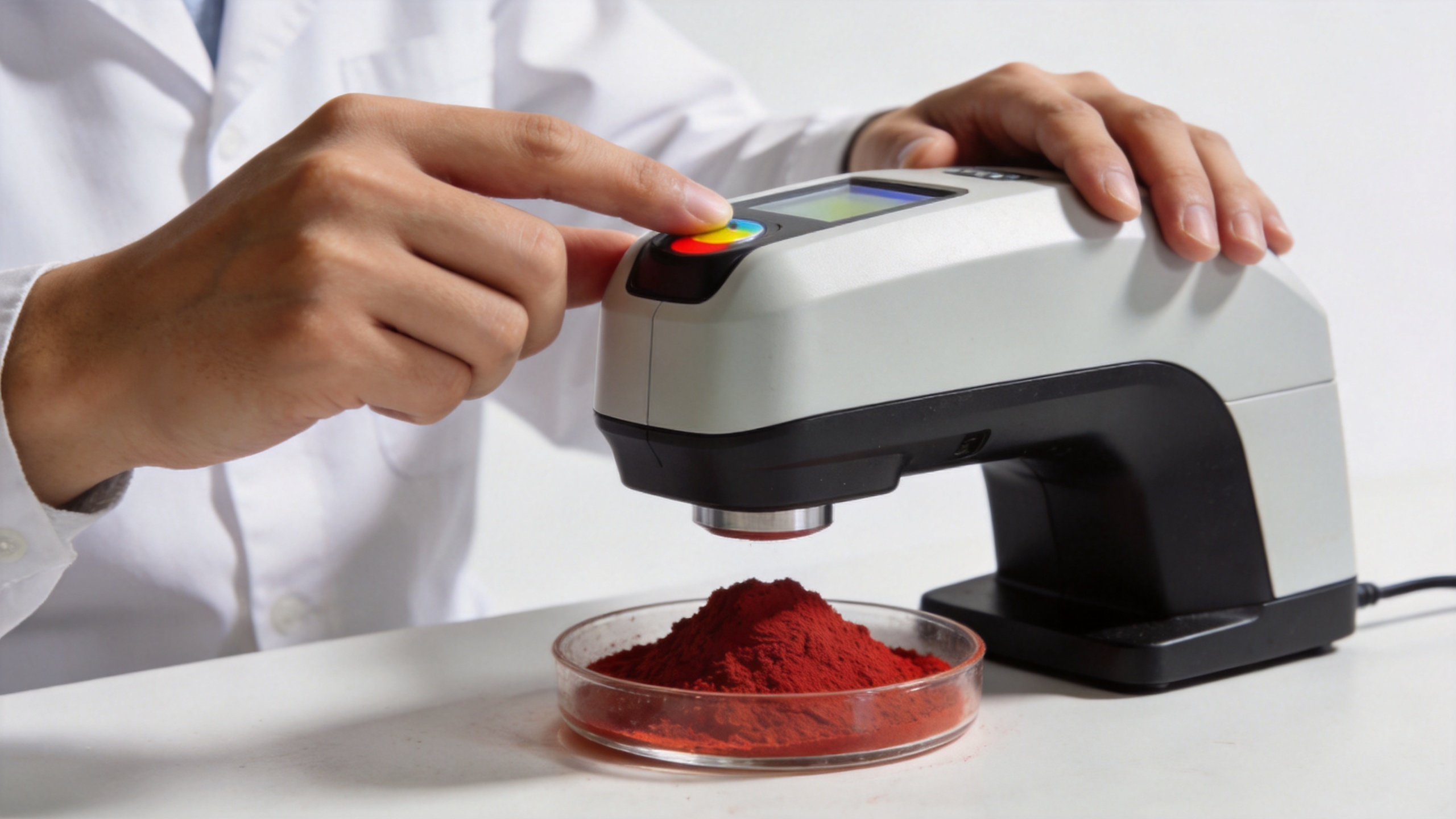
Color measurement is the most visible quality checkpoint for iron oxide pigment — and the one that procurement teams care most about when assessing batch-to-batch consistency. The standard metric is Delta E (ΔE), the numerical expression of color difference between two iron oxide pigment samples.
Single-batch tinting strength is actually not the hard part. What is actually difficult — and what separates a quality iron oxide pigment supplier from an average one — is keeping ΔE below 1.0 across consecutive production batches. A Delta E value below 1.0 is generally imperceptible to the human eye, which means colors in finished paint products remain visually consistent even when formulated with iron oxide pigment sourced from different production runs.
Iron oxide pigment color is measured using a spectrophotometer against a certified internal reference standard, following methods such as ISO 787-24 (tinting strength) and CIELAB color space protocols. Leading iron oxide pigment manufacturers maintain control charts that track both color coordinates and tinting strength over time, flagging any iron oxide pigment batch that falls outside the acceptable range before it leaves the facility.
Stage 5: Particle Size Distribution and Fineness of Iron Oxide Pigment
Iron oxide pigment particle size distribution (PSD) affects multiple downstream properties: dispersion behavior in paint, hiding power, and surface texture of coatings. D50 particle size and the presence of coarse particles (typically measured as the percentage of iron oxide pigment particles above 45 μm using a sieve test per ISO 787-7) are standard inline checks for every production batch.
For iron oxide paint pigment used in high-quality architectural coatings and industrial finishes, tight PSD control is essential. Batches with excessive coarse particle content in iron oxide pigment cause grit in finished paint, reduce opacity uniformity, and may create surface defects after application.
Stage 6: Oil Absorption and pH Testing of Iron Oxide Pigment
Oil absorption of iron oxide pigment (measured per ISO 787-5) determines how much binder or vehicle a pigment requires in a paint formulation. When oil absorption shifts between iron oxide pigment batches, formulators have to reformulate to maintain the correct paint viscosity and film properties.
pH testing on aqueous slurries of iron oxide pigment (ISO 787-9) confirms the acid-base balance, which affects compatibility with different binder systems. Neutral to slightly alkaline grades of iron oxide pigment are preferred for many paint and coating applications. Batches outside the accepted pH range indicate process anomalies that require investigation before release of the iron oxide pigment lot.
Documentation and Traceability: What Good Iron Oxide Pigment QC Looks Like from the Outside
Inline quality testing is only as useful as the documentation it generates. When evaluating an iron oxide pigment supplier, the documentation they provide is a practical indicator of whether their iron oxide pigment QC is active or largely ceremonial.
A supplier running a genuine inline iron oxide pigment QC program should be able to provide:
- Certificate of Analysis (CoA) per batch: Including tinting strength, moisture content, pH, oil absorption, particle size D50, and color coordinates (L*, a*, b*, ΔE versus reference) for each specific iron oxide pigment lot.
- REACH compliance documentation: Confirming heavy metal limits for the specific iron oxide pigment batch being shipped, not just a general product statement.
- Safety Data Sheet (SDS): Current and in the language of the destination market for the iron oxide pigment being exported.
- Batch traceability records: Linking the shipped iron oxide pigment lot to production date, raw material lots, and in-process QC results.
If an iron oxide pigment supplier cannot produce batch-specific CoA data that includes color measurement results, that is a signal worth taking seriously. Generic documentation that applies to an entire iron oxide pigment product line — rather than the specific batch you are receiving — provides no real quality assurance.
The Practical Takeaway for Iron Oxide Pigment Procurement Teams
When you are evaluating iron oxide pigment suppliers, you can ask directly: what inline quality checkpoints do you run for your iron oxide pigment, at which production stages, and how is that data documented and retained? A supplier with a mature iron oxide pigment QC system will have a clear, specific answer. One relying primarily on end-of-line testing or third-party lab reports alone may not catch production-stage variation in iron oxide pigment before it reaches you.
That shift in mindset — from viewing iron oxide pigment QC documentation as a cost to viewing it as a risk management tool — tends to happen after the first time a batch causes a production problem. Working with an iron oxide pigment supplier who has already built this into their process saves you from discovering these gaps the hard way.
Hebei Tianhuibao Technology operates a quality system covering every stage from raw material inspection to finished iron oxide pigment testing, with batch-specific CoA documentation, REACH and CE certification, and color measurement data available per shipment. For procurement teams looking to verify iron oxide pigment consistency standards before placing an order, sample requests and technical documentation are available through our contact page.
 Hot News