 ×
Colored concrete rarely fails because the wrong pigment was ordered. It fails because the dose was wrong for the mix, or because the dose that worked in a laboratory bucket was never translated correctly onto the batching plant. A pavement that reads pale and washed out at handover, a precast element that is rejected for color variation against the approved sample, a paver order where two consecutive production days produce visibly different reds — in most cases the pigment performed exactly as specified. The dosage rate did not.
Two things have to be settled before the first cubic meter is placed. The first is the dosage rate, expressed in a unit the batching plant can actually weigh out. The second is the trial protocol that proves that rate produces the specified color in the specified mix. This guide covers both, plus the documentation that procurement teams are asked for when the project is specification-driven.
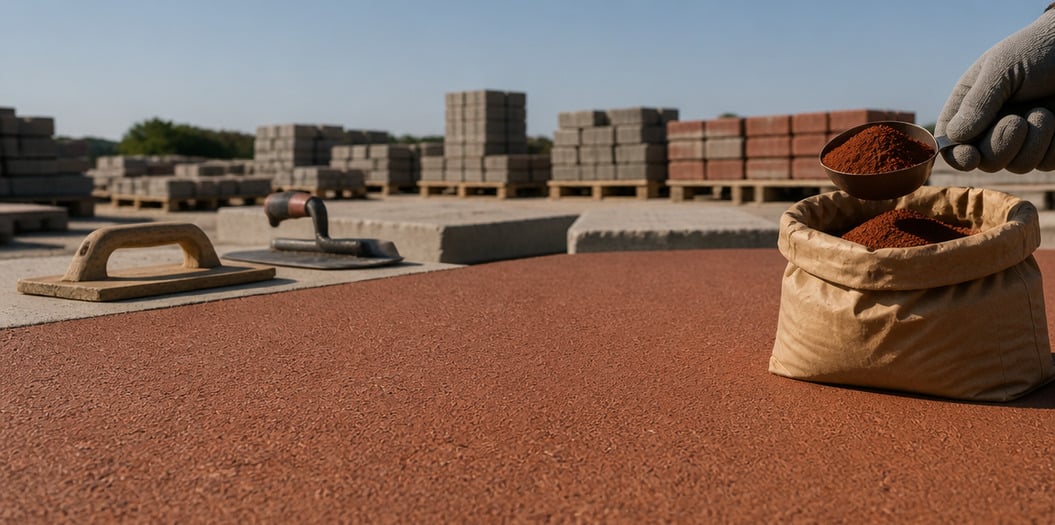
Dosage for iron oxide pigment in concrete is expressed two ways, and confusing them is one of the most common sources of disagreement between a specifier and a batching plant.
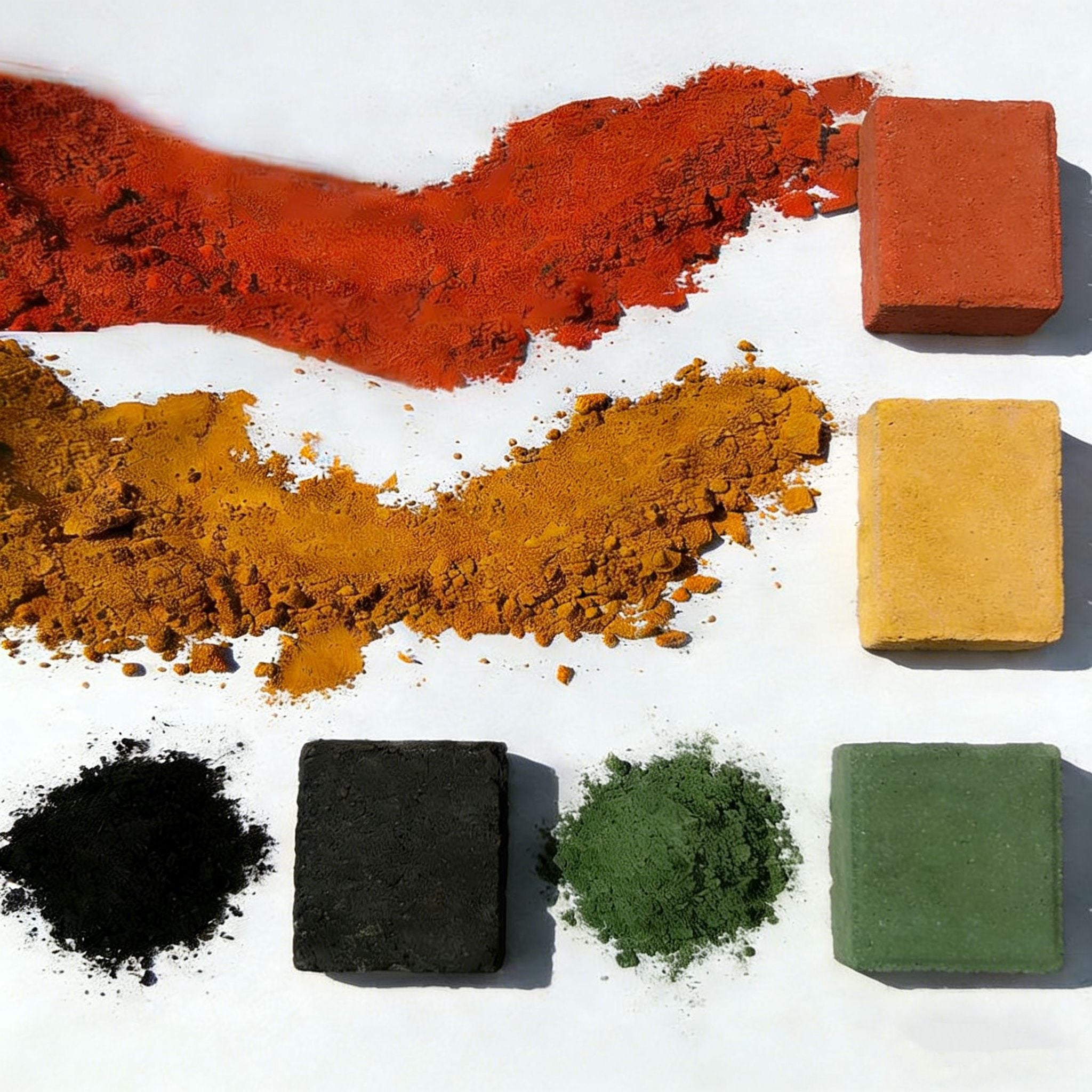
By weight of cement. Most specifications for integrally colored concrete express the iron oxide dosage as a percentage of the cement content in the mix. Common industry practice sits in the range of roughly 2% to 5% by weight of cement, with a large share of architectural, paving and precast work landing between 2% and 3%. The lower end of that band produces muted, sandy and pastel tones — buffs, pale ochres, soft terracottas. The upper end produces saturated, deep tones where the color is meant to be a defining feature of the surface rather than a tint.
By weight of concrete. Batching plants usually work in kilograms per cubic meter, because that is what the batching controller dispenses. Converting from a cement-based percentage is simple arithmetic, but it has to be recalculated every time the cement content of the mix changes.
| Cement content | 2% of cement | 3% of cement | 5% of cement |
|---|---|---|---|
| 250 kg/m3 | 5.0 kg/m3 | 7.5 kg/m3 | 12.5 kg/m3 |
| 300 kg/m3 | 6.0 kg/m3 | 9.0 kg/m3 | 15.0 kg/m3 |
| 350 kg/m3 | 7.0 kg/m3 | 10.5 kg/m3 | 17.5 kg/m3 |
| 400 kg/m3 | 8.0 kg/m3 | 12.0 kg/m3 | 20.0 kg/m3 |
These figures are a starting point for a trial, not a substitute for one. They assume a normal-density mix, a mid-strength pigment grade, and gray cement. Change any of those and the number moves.
One distinction worth writing into the specification explicitly: integral coloring and surface-applied dry-shake hardeners are dosed on completely different scales. An integrally colored mix carries the pigment through the full depth of the concrete, dosed per cubic meter. A dry-shake hardener is broadcast onto the fresh surface and dosed per square meter of surface area, at a substantially higher rate per unit of material. Specifications that mix the two units produce either a badly under-colored slab or a hardener budget with no relation to the actual work.
A dosage rate that produced the specified red in one plant can produce a different red in the plant next door, with the same pigment from the same batch. Six variables account for most of the difference.
1. Cement content and cement color. This is the largest single factor. Cement is the light-colored matrix the pigment has to tint, so more cement means more pigment is needed to reach the same depth of tone. The base color of the cement matters just as much: the same dose of iron oxide red in gray cement and in white cement gives two clearly different results, and a mix design that switches from one to the other requires a new trial.
2. Sand and aggregate color. Concrete is roughly three-quarters aggregate by volume. Sand that is darker, more iron-rich, or locally quarried with visible color variation shifts the cured result even when every other parameter is held constant. A plant that changes sand source mid-project should expect a color shift and plan a re-trial rather than assume continuity.
3. Pigment grade and tinting strength. Iron oxide pigments are not interchangeable across grades. A high-strength grade and a standard grade of the same nominal color will deliver different color depth at the same dose. Substituting one grade for another without adjusting the dose — or without re-trialling — is a frequent cause of batch-to-batch variation complaints. If a grade must change, treat it as a mix redesign, not a like-for-like swap.
4. Water-cement ratio. Higher water content dilutes the color in the cured surface, increases the risk of surface porosity, and makes efflorescence more likely. Where a project is already fighting efflorescence or surface bloom, part of the answer is usually in the water-cement ratio and the curing regime rather than in the pigment dose.
5. Surface finish and curing. A troweled surface, a broomed surface and a washed exposed-aggregate surface present the same concrete very differently. Curing method and duration also affect how much of the pigment-rich surface layer remains intact. Two slabs with identical mix designs and doses can read as different colors purely because one was cured under plastic sheeting and the other was left exposed.
6. The reference the color is judged against. Color complaints are frequently traceable to the comparison standard rather than the concrete. A master sample board that has been sitting in sunlight for six months is not a valid reference. Retain a protected physical standard, agree in writing how it will be stored, and photograph it under consistent lighting alongside every production sample.
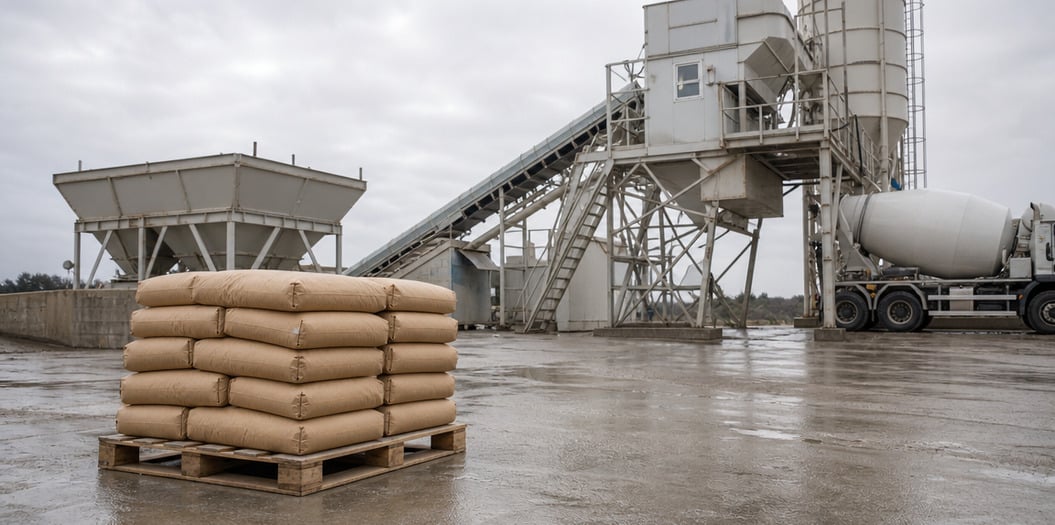
A dosage rate is a hypothesis until it has been tested in the materials that will actually be used. The verification runs in three stages, and skipping the second one is the most common and most expensive shortcut.
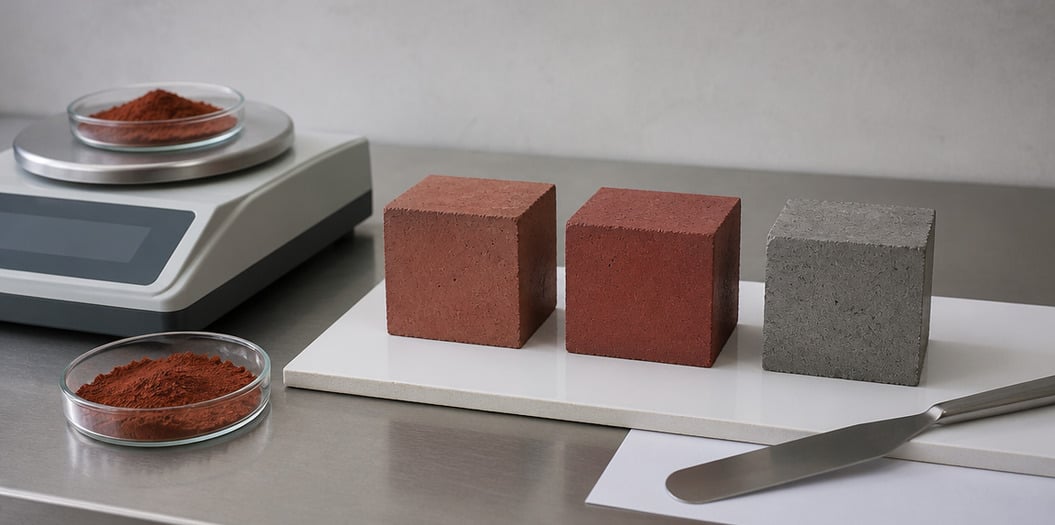
Stage 1 — Laboratory trial. Build small batches using the exact cement, sand, aggregate, admixture and mix proportions from the production mix design. Run at least three doses: the target, one about 20% below, and one about 20% above. Cast cubes or small slabs from each, cure them under the same conditions, and compare them side by side. The purpose of the three-point trial is not only to pick a dose but to establish how sensitive the mix is to dosage error — which tells the plant how tight its batching tolerance needs to be.
Stage 2 — Plant trial. Reproduce the selected dose at production scale. Mixer efficiency, batching accuracy, mixing time and order of addition all differ between a laboratory mixer and a production unit, and any one of them can move the result. Draw samples from the start, middle and end of the load rather than from a single point, because the first and last portion of a discharge can differ. This is the step that converts a laboratory result into a production dose.
Stage 3 — Cured evaluation. Judge the color at 7 and 28 days, not at demoulding. Concrete continues to change as it dries and cures, and the wet color at demoulding is not the delivered color. The 28-day evaluation is the one that matches what the client will see at handover, so it should be the one that closes the approval.
Alongside the trial, keep the paperwork that makes the result reproducible: a batch-specific certificate of analysis for the pigment used in the trial, the mix design revision the trial was run against, dosage records from the plant trial, and a retained reference sample from each pour. When a color question comes up three months into a project, these records answer it in minutes instead of weeks.
For specification-driven projects, the dosage is only half of what a procurement team has to produce. The other half is the compliance file, and a pigment that performs perfectly but arrives without documentation creates a problem at handover regardless of its color.
The documents worth requesting before a supplier is qualified:
One operational point that matters as much as the documents themselves: sample performance and bulk performance are not automatically the same thing. A supplier whose samples pass but whose production batches drift has a process control problem that documentation alone will not fix. Ask how color consistency is measured in routine production, not only what it measures in a sample submission.
Iron oxide pigment dosage for concrete is a small number with a disproportionate effect on whether a colored concrete project is accepted. The rate has to be stated in the unit the plant can weigh, tied to the cement content of the actual mix design, and confirmed by a three-stage trial in the materials that will be used in production. Done properly, that work takes a few weeks and costs a few trial batches. Done badly, it costs a re-pour, a rejected precast delivery, or a color dispute at handover.
At Hebei Tianhuibao Technology Co., Ltd., iron oxide pigments for concrete and industrial coloring are built on 26 years of production experience and supplied with the documentation that specification-driven projects require. Our grades are REACH, RoHS, CE and ISO compliant, and we additionally hold IATA DGR and IMDG Code compliance for the air and sea transport of classified pigment cargo — so documentation does not become the bottleneck when a shipment has to move. Every shipment is supported by batch-specific COAs, SDS/MSDS documentation and third-party test reports. With 50,000 tons of annual production capacity and export operations serving customers in more than 150 countries, we support both bulk programs and evaluation work.
The minimum order quantity for bulk grades is 1 metric ton, and standardized 25 kg woven bags ship ex-stock. Small samples for testing and evaluation are supplied separately and do not count toward the MOQ, so a formulator or batching plant can verify color depth and dispersion in its own mix design before committing to production volume. Customized color matching, particle size adjustment and packaging customization are available on request, and many of our customers have been placing repeat orders for years.
To discuss a specific mix design, request color consistency data, or order evaluation samples of our red, yellow, black, brown, green or blue iron oxide grades, contact our technical team or browse the full product range.
 Hot News
2026-10-10
2026-10-08
2026-09-17
2026-09-11
2026-09-10
2026-09-04
 EN