 ×
×
A ship's hull sits in seawater for years without returning to dry dock. A container crosses the ocean a hundred times and is repainted, not replaced. A steel bridge stands over a river estuary for half a century. None of this is accidental—all of it is built on coating systems, and inside nearly every one of those systems, at the primer and intermediate layers where corrosion protection is actually won or lost, the same family of pigments is doing the work: iron oxide pigments.
For pigment buyers supplying marine paint manufacturers, protective coating producers, or industrial maintenance formulators, understanding why iron oxide pigments are so deeply embedded in this industry—which sub-sectors they serve, how the coatings are applied, and which standards the pigment itself must meet—is the difference between supplying a commodity powder and supplying a specification material.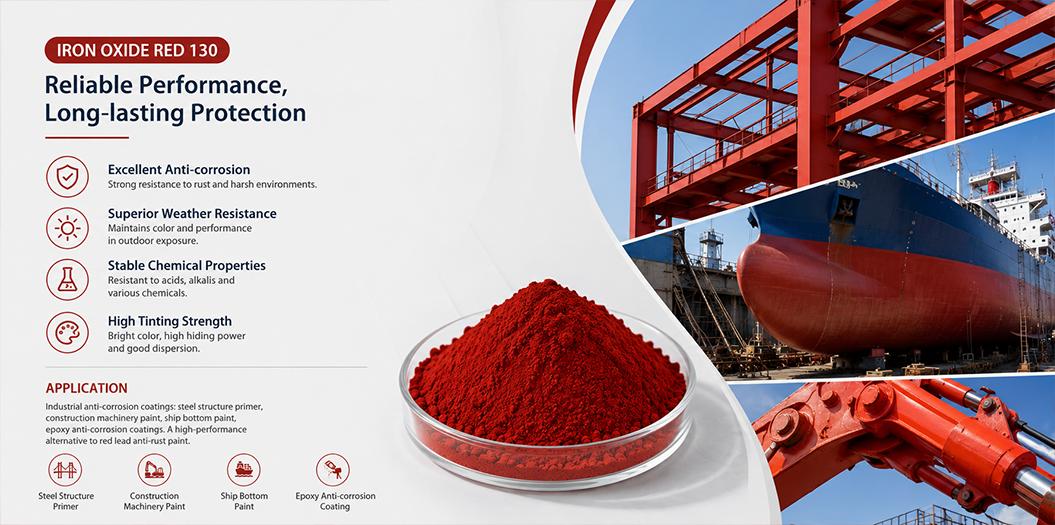
Marine and offshore environments combine almost every corrosion and degradation driver at once:
This is why marine coatings are the most demanding segment of the paint industry—and why the raw materials inside them, pigment included, are audited more closely than almost anywhere else.
Iron oxide pigments earned their position in marine and protective coatings on four grounds:
One more factor is purely economic: iron oxide pigments deliver this performance profile at a cost level that volume coatings can sustain. A hull primer is applied by the ton; pigment economics matter at scale.
Marine is the flagship segment, but iron oxide pigments serve the protective and industrial coatings industry across several distinct sub-sectors:
Marine coatings. Anti-corrosive hull primers (typically epoxy, pigmented with red iron oxide and MIO), intermediate builds with high MIO loading, ballast tank and bilge coatings, boot-top and deck systems. Black and brown iron oxides serve dark-toned decks and machinery-area finishes.
Protective and industrial maintenance coatings. Bridges, steel structures, containers, storage tanks, and cranes—the same chemistry as marine primers, applied to atmospheric and immersion service. Container shop primers are one of the highest-volume iron oxide applications in industrial coatings.
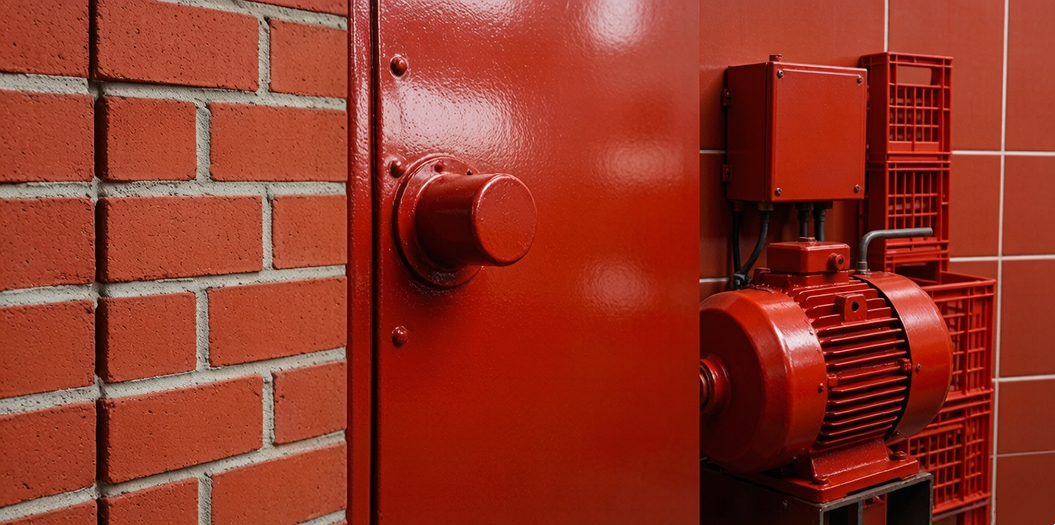
Architectural and masonry paints. Waterborne exterior wall paints and masonry coatings use red, yellow, brown, and black iron oxides for colorfast facades—the same lightfastness logic as a ship's topsides, at residential scale.
Wood and furniture coatings. Transparent and semi-transparent wood finishes, furniture lacquers, and stains use micronized iron oxide grades for warm, UV-stable tones.
Powder coatings and printing inks. Thermoset powder coatings (epoxy, epoxy-polyester hybrid) and packaging inks use iron oxides where heat-stable, heavy-metal-free color is required—with one temperature caveat covered below.
Hull anti-corrosive primer (epoxy + MIO). The workhorse system: a two-pack epoxy primer pigmented with red iron oxide and micaceous iron oxide, applied after abrasive blasting, forming the base of a multi-coat system rated for C5-M or immersion service. The MIO platelets reinforce the film mechanically and slow chloride diffusion; the iron oxide red provides opacity and UV shielding for the layers above.
Ballast tank coating. Ballast tanks are Im2 immersion environments under ISO 12944 — cyclic wetting, restricted access, and inspection-driven maintenance. Pigment specifications here prioritize low water-soluble salt content: soluble chlorides carried in by the pigment become osmotic blistering sites under immersion.
Container shop primer. Container lines run high-speed shop primers where pigment dispersion consistency decides film uniformity at line speed. Batch-to-batch tinting strength and sieve residue are the specifications that keep the line stable.
Exterior masonry repaint system. The same red and brown iron oxides specified on a hull appear in waterborne facade paints, where alkalinity of fresh cementitious substrates does the screening: only alkali-stable pigments survive.

Understanding the application process clarifies which pigment parameters actually matter on site:
1. Surface preparation. Steel is abrasive-blasted to Sa 2.5 (ISO 8501-1) and the salt-contamination of the surface is measured. This is the foundation the coating system builds on. 2. Primer application. Primers are applied by airless spray, with brush application for stripe coating of welds, edges, and hard-to-reach geometry—the corrosion initiation points. Pigment dispersion quality and fineness of grind directly affect whether the primer film seals this geometry. 3. Intermediate coat with MIO loading. High-build epoxy intermediates carry high MIO loadings to build film thickness (DFT) per the system design in ISO 12944-5. MIO's oil absorption and particle shape influence the rheology and the achievable build per coat. 4. Topcoat. Polyurethane or polysiloxane topcoats provide color and gloss. Where black or dark tones are specified, black iron oxide grades bring UV stability that carbon-black-loaded systems sometimes lack in chalking resistance terms. 5. Curing and inspection. DFT checks, adhesion tests, and holiday detection close out the system.
Three pigment-level parameters decide whether a batch performs through this process:
Marine and protective coatings are system-certified, not raw-material-certified—but pigment is one of the inputs coating manufacturers must document, and buyers should expect the following:
System-level context (what your customer's coating must pass): ISO 12944 for corrosion protection of steel structures — durability ranges and corrosivity categories C1–C5, CX, and Im1–Im4 — with ISO 12944-9 covering offshore environments. A pigment supplier who understands these categories can speak to what their documentation supports; one who cannot is telling you which segment they serve.
Pigment-level documentation (what you must supply):
As across every pigment application, one operational note applies: samples and bulk cargo can differ in quality. Production-scale quality controls —not sample performance alone—are the relevant compliance indicator for coating manufacturers running continuous production.
Hebei Tianhuibao Technology Co., Ltd. supplies iron oxide for marine coatings, protective systems, and industrial paint applications with compliance documentation built in from the outset. Our iron oxide pigment grades are REACH and CE certified, and every shipment is supported by batch-specific COAs, SDS/MSDS documentation, and third-party test reports. With 50,000 tons of annual production capacity and established export operations across 150+ countries, our supply chain is designed for coating manufacturers whose production lines cannot tolerate batch surprises.
Our red, brown, and black iron oxide pigment grades are produced with batch-to-batch color consistency maintained within controlled tolerance limits, and low water-soluble salt and moisture specifications suitable for high-durability coating systems. The minimum order quantity starts at 1 metric ton, while samples for evaluation are provided separately and do not count toward the MOQ — allowing formulators to run the pigment through their own millbases and application trials before committing to production volumes. Third-party factory or port-of-loading inspections are supported for buyers requiring additional quality assurance.
To review our iron oxide pigment range for marine, protective, and industrial coating applications, or to request compliance documentation and samples, explore our product pages or contact our team directly.
There is a certain symmetry in the fact that the pigment protecting steel from rust is itself iron's most stable state. Iron oxide pigments protect because they have already completed the reaction corrosion wants to drive — chemically inert, UV-stable, and, in lamellar grades, physically structured to block what attacks the film. That is why they are specified from container shops to hull primers to bridge maintenance systems.
For buyers, the practical takeaway mirrors the rest of professional pigment procurement: qualify the supplier on documented parameters — soluble salts, moisture, heavy metals, batch consistency — not on color chips. In marine and protective coatings, the pigment is a specification input, and the suppliers who treat it that way are the ones whose documentation still holds up at the fifth year of the coating's service life.
 Hot News
2026-10-10
2026-10-08
2026-09-17
2026-09-11
2026-09-10
2026-09-04
 EN
EN