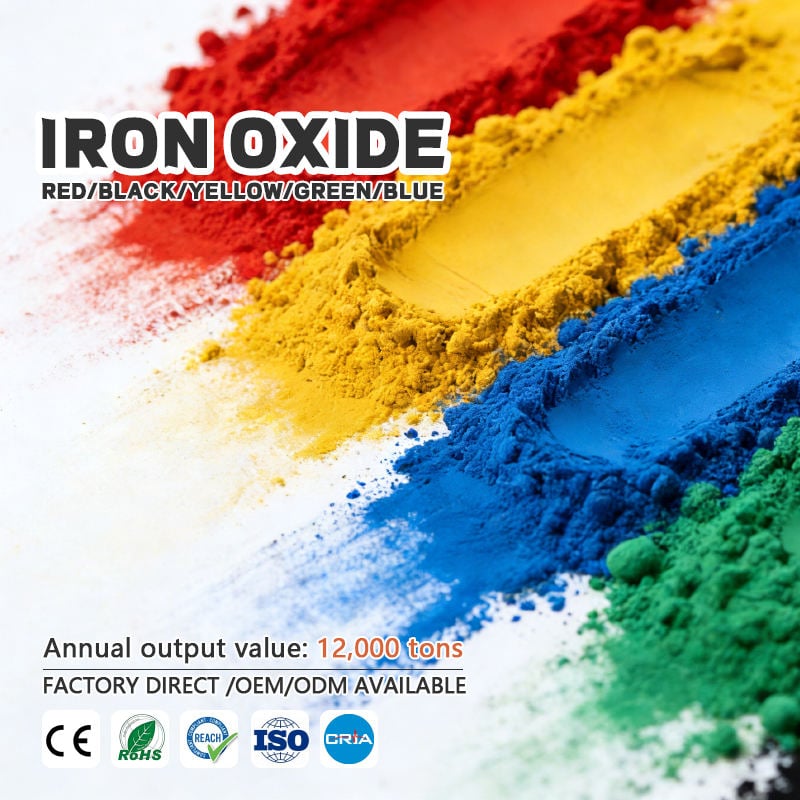
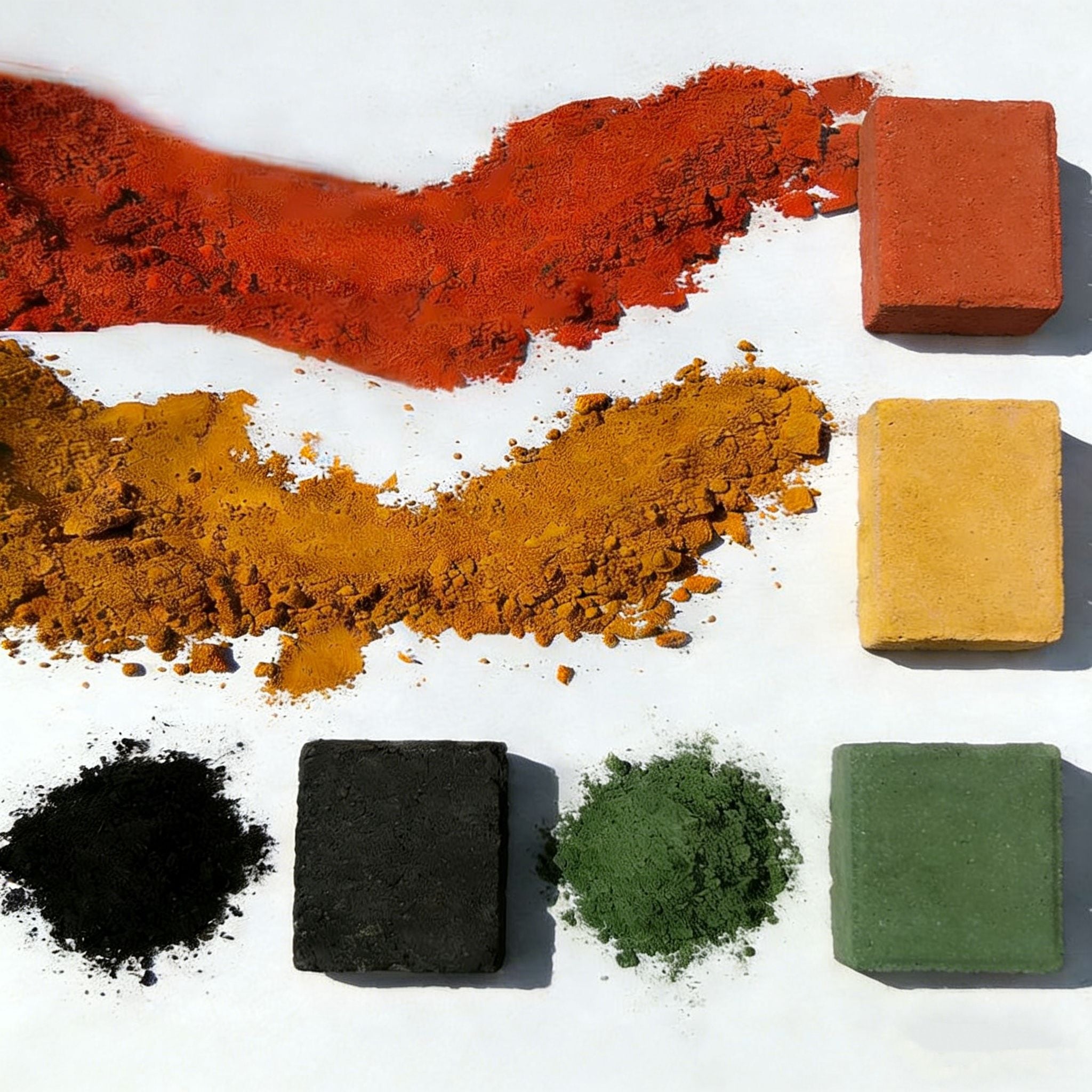
 ×
×
Three industries that barely share a supply chain — concrete production, industrial coatings, and polymer processing — have independently converged on the same colorant chemistry. Walk a building site, a paint line, and a rubber goods factory, and you will find the same family of pigments doing the heavy lifting in each: iron oxide pigments. Red, yellow, black, and brown iron oxides are not simply available in all three sectors; they are the default. Understanding why — and what separates a compliance-grade iron oxide pigment from a commodity one — is a practical sourcing skill for procurement teams that serve any of them.
This article covers the three core industrial application sectors for iron oxide pigments: construction and building materials, coatings and printing inks, and plastics and rubber goods. For each sector, we outline the main applications, the compliance documentation buyers should expect, and the questions that separate prepared suppliers from the rest.
Construction, coatings, and plastics impose very different processing conditions on a colorant. Concrete is intensely alkaline. Paint films face years of direct UV exposure. Polymer melts run hot. Yet iron oxide pigments pass all three tests, for four structural reasons:
The commercial consequence: across all three sectors, color specification has effectively standardized on iron oxide. The procurement question is no longer "which pigment chemistry" but "which supplier's iron oxide pigment can document the compliance its destination market requires."
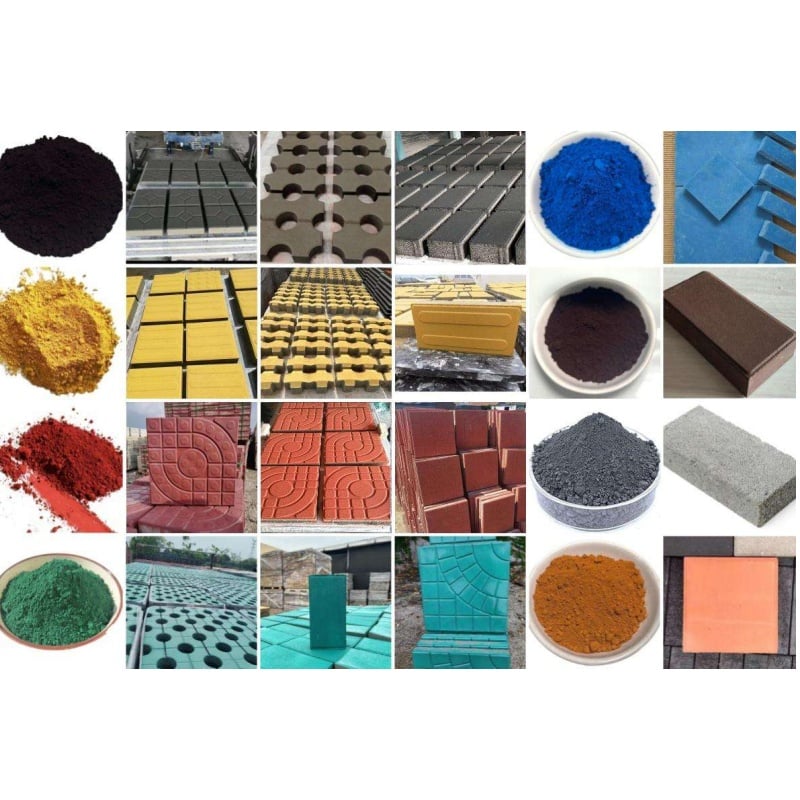
Construction is the largest single market for iron oxide pigments, and the application list is broad: integrally colored concrete for facades and precast elements, colored concrete pavers and tiles, terrazzo, artificial stone, colored mortar, colored asphalt, and cement-based products of nearly every kind. Black, red, yellow, and brown iron oxide grades produce the deep architectural tones — charcoal pavements, brick-red facades, sand-colored mortars — that have become specification items in residential and municipal projects worldwide.
Two additional points matter in construction procurement. First, iron oxide pigment also functions as a protective component in anti-corrosion coatings applied to metal structures — the same Fe₂O₃ chemistry that colors construction products also builds the barrier layer in many primers. Second, construction is the most specification-driven of the three sectors: European buyers reference EN 12878 for pigments used in cement and lime-based building materials, and North American buyers reference ASTM C979 for integrally colored concrete. A supplier of iron oxide pigments for construction should be able to document conformity with the standard referenced by your project's specification, not just claim "high quality."
The compliance dimensions to verify are the familiar ones for concrete-bound pigment: heavy metal content within destination-market thresholds, soluble salt content controlled (excess soluble salts drive efflorescence — the white surface bloom on improperly specified colored concrete), and batch-to-batch color consistency, because a paving or precast contract is won or lost on matching shades across pours.
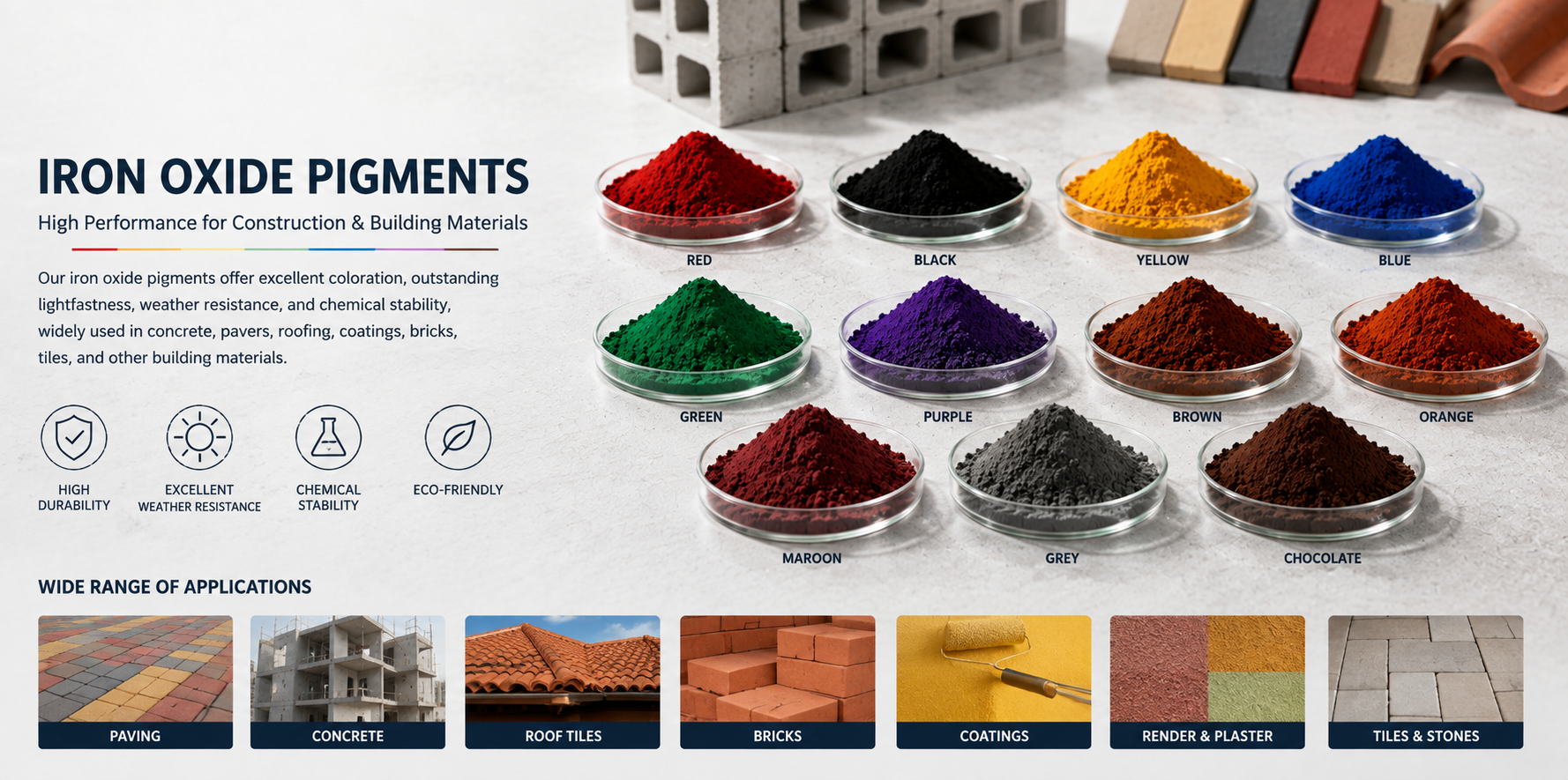
Iron oxide pigments are a workhorse of the coatings industry, specified across waterborne exterior paints, powder coatings, epoxy and alkyd systems, amino resins, electro-deposition coatings, and enamels. Red and black iron oxides are the classic choices for anti-corrosive primers and industrial maintenance paints; yellow and brown grades deliver the warm architectural tones of exterior facades; and the full palette serves decorative, furniture, and toy coatings.
In printing inks, iron oxide pigments offer the properties ink formulators care about: high tinting strength, clean dispersion, and environmental acceptability. The same chemistry that survives a concrete pour at pH 13 performs cleanly in waterborne ink systems, where heavy-metal-free raw materials are increasingly a compliance precondition for packaging and label work.
Buyers in this sector should look for three documents specifically. The first is a batch-specific Certificate of Analysis (COA) confirming pigment content, moisture, pH, and sieve residue — dispersion behavior in a coating or ink line depends on these numbers. The second is third-party heavy metal test data, because coatings end up on toys, children's furniture, and food-adjacent products: EU buyers will reference EN 71-3 migration limits for toy applications, and REACH for general EU-bound supply. The third is multi-batch color consistency data, because an automotive or appliance coating is matched to a standard chip that cannot drift from batch to batch.
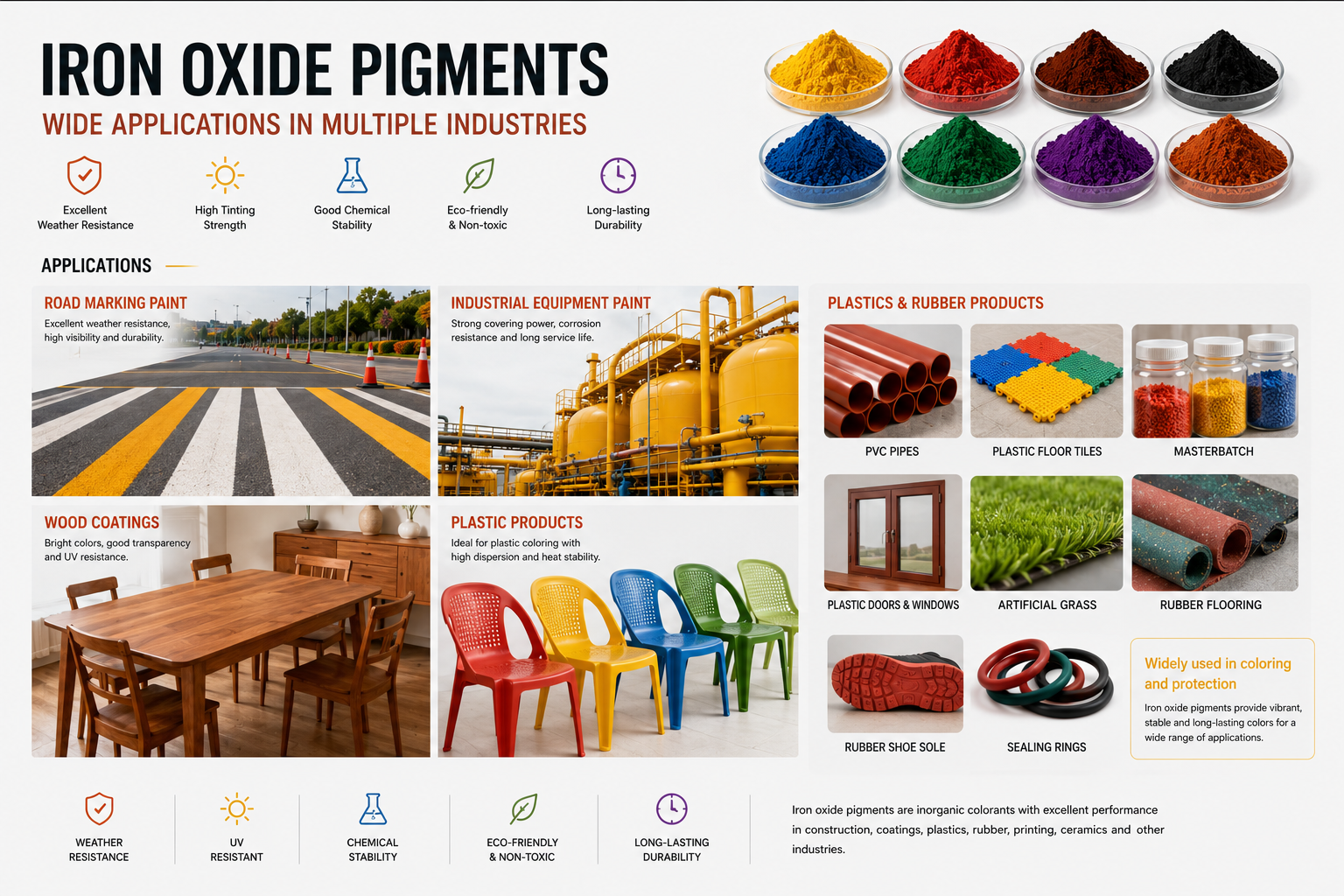
Iron oxide pigments color both thermosets and thermoplastics — PVC, PE, PP, and engineering compounds — and they serve double duty in rubber: as colorants and as reinforcement for heat and light resistance in tires, rubber hoses, seals, and gaskets. Black iron oxide in particular is specified in rubber compounds where the pigment contributes to the part's durability profile, not just its appearance.
Plastics and rubber is the sector where processing temperature discipline matters most, and this is where a prepared supplier earns trust. Two facts are worth remembering:
The compliance layer in plastics differs from construction: this sector's documentation frequently centers on food contact and consumer safety. EU buyers reference the Plastics Regulation (EU) 10/2011 for food-contact applications, and toy and consumer-good applications reference EN 71-3. A compliance-grade supplier of iron oxide pigments for plastics should be able to produce the heavy metal and migration data their customers' final-product certifications require — without making the buyer chase it.
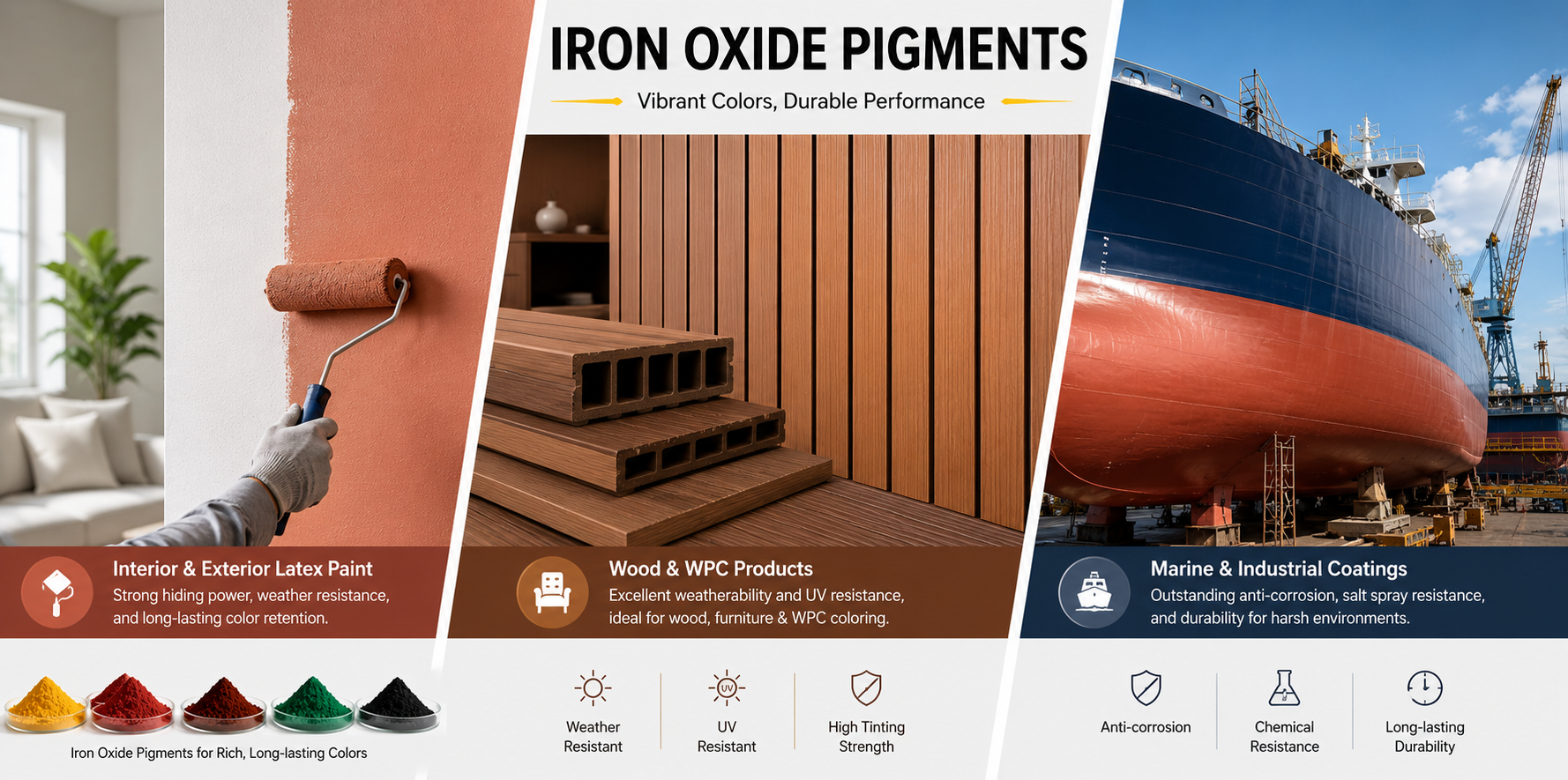
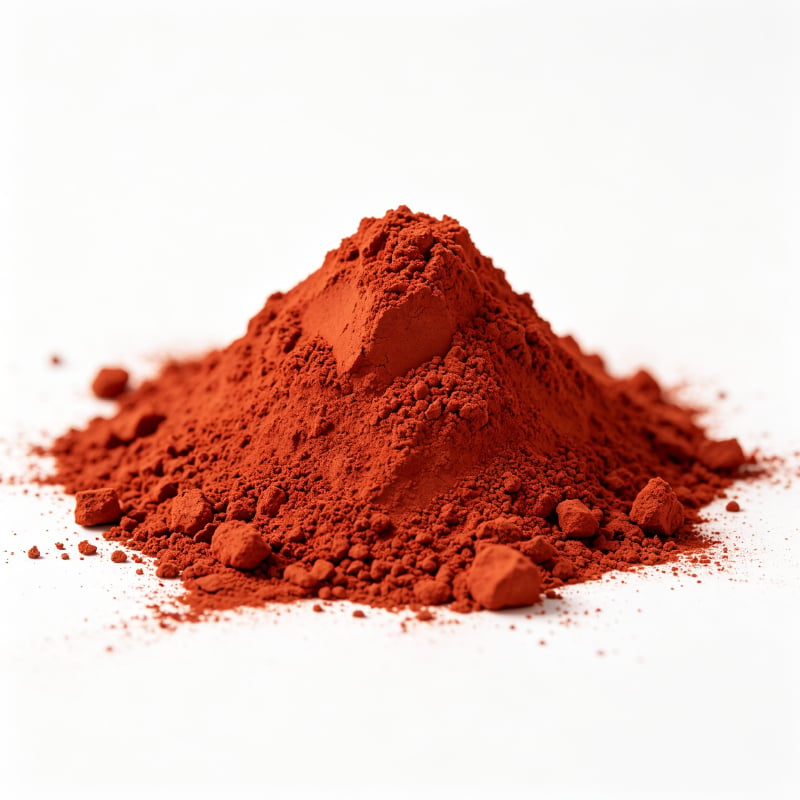
Red Iron Oxide (Fe₂O₃): The volume leader in all three sectors — integral concrete, anti-corrosive coatings, and high-temperature polymer applications. Red iron oxide is thermally stable well beyond construction and plastics processing temperatures, chemically inert in alkali and binder systems, and the most thoroughly documented grade available from established manufacturers. Compliance focus: purity, absence of restricted heavy metals, and consistent tinting strength across batches.
Yellow Iron Oxide (FeOOH): The color of sand, ochre, and buff — specified for architectural concrete, exterior paints, and light-toned plastic and rubber goods. Compliance focus: documented thermal behavior (conversion to red above approximately 180°C) and clean heavy metal profile. For standard ambient and low-temperature processes, yellow iron oxide is a standard, reliable choice across all three sectors.
Black Iron Oxide (Fe₃O₄): The source of charcoal, graphite, and deep neutral tones in concrete, coatings, and rubber. Black iron oxide carries a favorable compliance profile — low heavy metal content, high chemical stability, and no known restricted-substance concerns in standard applications. Compliance focus: moisture content for storage and dry-mix handling, and temperature behavior in polymer processing.
Whether your application is concrete, coatings, or plastics, the same audit discipline applies. A supplier who claims full compliance for iron oxide pigment products should be able to produce, on request:
One operational note applies across all three sectors: samples and bulk cargo can differ in quality. Sample-approved iron oxide pigment that does not perform consistently in production batches is a known supply chain problem — and in construction, coating, and plastics lines alike, there is no room to re-qualify a supplier mid-production. Production-scale quality controls, not sample performance alone, are the relevant compliance indicator for volume procurement.
Hebei Tianhuibao Technology Co., Ltd. supplies iron oxide pigments across construction, coatings, and plastics applications with compliance documentation built in from the outset. Our iron oxide pigment grades are REACH and CE certified, and every shipment is supported by batch-specific COAs, SDS/MSDS documentation, and third-party test reports. With 50,000 tons of annual production capacity and established export operations across 150+ countries, our iron oxide pigment supply chain is designed for continuous production lines that cannot tolerate batch surprises.
Our red, yellow, and black iron oxide pigment grades are produced with batch-to-batch color consistency maintained within controlled tolerance limits, supported by multi-batch comparison data on request. The minimum order quantity starts at 1 metric ton, while samples for evaluation are provided separately and do not count toward the MOQ — allowing buyers to run the pigment through their own mix designs, paint systems, or polymer compounds before committing to production volumes. Third-party factory or port-of-loading inspections are supported for buyers requiring additional quality assurance.
To review our iron oxide pigment range for construction, coatings, and plastics applications, or to request compliance documentation and samples, explore our product pages or contact our team directly.
Three industries converged on iron oxide pigments for the same reason: it is the colorant chemistry that survives the jobs those industries do. But surviving the chemistry is only half of the procurement decision. The other half is documentation — proof, batch by batch, that the pigment meets the standards, thresholds, and consistency tolerances your destination market and end application require.
Buyers who treat iron oxide pigment as a commodity line item get the price. Buyers who treat it as a specification input — and audit their suppliers accordingly — get the color, the compliance, and the service life their contracts assume. In construction, coatings, and plastics alike, that is the difference that shows up in the finished product, years after the order.
 Hot News
2026-10-10
2026-10-08
2026-09-17
2026-09-11
2026-09-10
2026-09-04
 EN
EN