 ×
Red asphalt is routine. Yellow asphalt is a project. The difference is not marketing, and it is not the price of the pigment — it is the temperature of the mixer. Hot-mix asphalt is produced somewhere in the region of 150–165 °C, and some polymer-modified mixes run hotter still; iron oxide yellow is a hydrated pigment that begins converting to red hematite as it passes roughly 180 °C. Put a standard yellow into a hot-mix plant and part of the pigment you paid for is no longer yellow by the time the paver arrives. Iron oxide red has no such problem. That single fact explains most of what the colored asphalt market looks like: red lanes, red bus corridors, red cycle tracks, and comparatively few yellow ones. The rest of this article is about what else changes when the binder is bitumen instead of cement, and how to write a specification that survives the plant.
Most of the pigment advice written for concrete does not transfer cleanly to asphalt, because almost nothing about the matrix is the same.
In concrete, the pigment is dispersed in a cement paste that hydrates, cures and lightens as it dries. In asphalt, there is no hydration and no curing color development at all. The color is fixed the moment the mix leaves the plant, and what happens afterwards is weathering, wear and dirt. That removes one class of problem — there is no "measure it at 28 days" — and adds another: there is no second chance to correct a shade once it is on the road.
The second difference is the binder. Bitumen is black to dark brown, and it coats every aggregate particle in a film a few microns thick. That film is what you actually see. A pigment has to make its presence felt through a black matrix, which is why colored asphalt usually requires a decolorized or synthetic binder — sometimes called clear binder — rather than ordinary penetration-grade bitumen. Even then, the result is rarely a pure hue. It is a muted, slightly smoked version of the target color, and clients who approve a pigment drawdown on a white card are frequently surprised by the pavement.
The third difference is loading. Because the pigment sits in a thin binder film rather than a thick cement paste, the addition rate needed to reach a given color depth is generally higher than in concrete, and the exact figure is a trial result, not a catalogue constant. Any supplier quoting a fixed percentage for asphalt without knowing your binder, your aggregate grading and your mixing temperature is guessing.
This is the part worth understanding before any color is chosen.
Hot-mix asphalt is produced in a narrow band. Published mixing temperatures for conventional hot mix sit around 150 °C, with laydown somewhat below that; polymer-modified binders and some specialty mixes push production into the 175–185 °C region. Warm-mix technologies deliberately pull the whole process down to roughly 130–135 °C. So the pigment in a colored asphalt mix sees something between about 130 °C and 185 °C, for a period measured in minutes to tens of minutes, and then cools slowly in the mat.
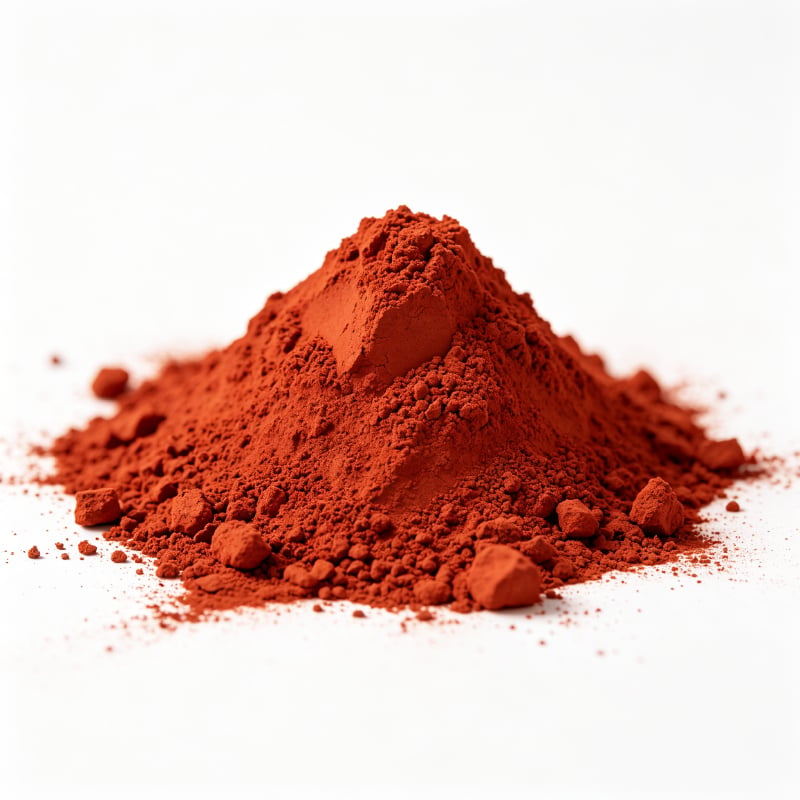
Iron oxide red is hematite, Fe₂O₃. Within that window it is inert. Its color does not depend on crystal water because it has none, and it comes out of the plant the same red it went in.
Iron oxide yellow is goethite, α-FeOOH — a hydrated iron oxide. Heat drives off that water and the crystal structure rearranges toward hematite. The conversion is not a sharp switch at one temperature; it proceeds with temperature and time. What matters commercially is where it becomes visible: past roughly 180 °C, a standard yellow grade will have shifted measurably toward orange-red, and the shift is not reversible. Heat-stable yellow grades exist and are quoted for short-term exposure beyond 200 °C, but they cost more and they are not what arrives if you simply order "yellow iron oxide".
That is the whole reason yellow pavement is difficult. It is not that yellow pigment cannot be made. It is that the standard grade and the standard mixing temperature are on the wrong sides of each other.
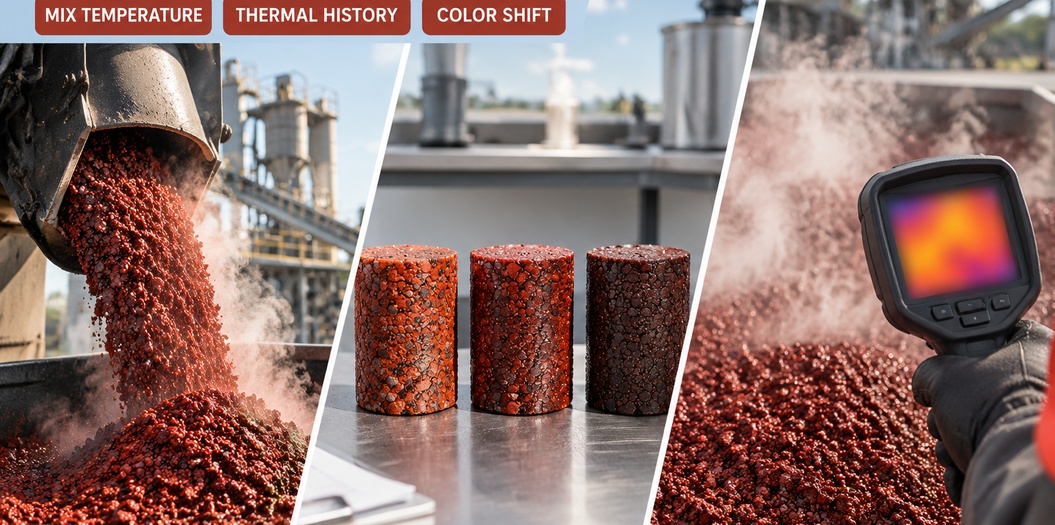
Given the thermal facts, red's dominance is easy to explain, and it is reinforced by traffic engineering rather than chemistry.
Red is thermally safe across the entire hot-mix and warm-mix range, so it imposes no constraint on the plant. It has high opacity and reasonable tinting strength, so it can impose a color on a dark binder without needing an extreme loading. It is available in grades that are already used across construction, coatings and plastics, which means the supply chain and the price are familiar. And red carries a traffic meaning that regulators and road authorities have already accepted for bus lanes, cycle facilities, school zones, junction approaches and priority areas — a semantic advantage no other color has.
There is a fourth, less discussed advantage: red is forgiving of dirt. A red pavement that has accumulated tire rubber, brake dust and road film still reads as red. A yellow or light-colored pavement in the same condition reads as dirty. Anyone who has specified a light-colored surface and then been asked why it "looks bad after a winter" has met this problem.
None of that makes red the right answer for every project. It does mean that when a client asks for yellow, the honest response is not "we can supply that" but "we can supply that if you accept these four changes".
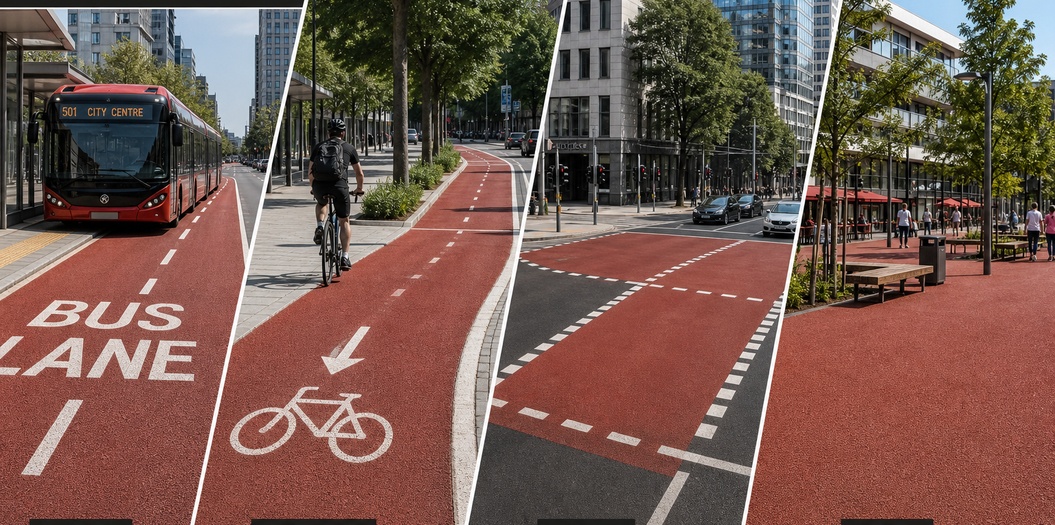
Colored asphalt in anything other than the red-to-brown family is achievable. It is a specification problem with four levers, and a project usually needs at least three of them pulled at once.
A heat-stable yellow grade, or a pigment that was never hydrated. Heat-stable yellows are engineered so that the color survives a short excursion past the temperatures that would shift a standard grade. They cost more per kilogram than the standard product, and the premium has to be carried in the project budget from the start rather than discovered at the plant.
A decolorized binder. Ordinary bitumen will drag any hue toward brown. For a true yellow or green, the binder has to be low-color, which is a materials cost and often a supply-lead-time cost as well.
A lower production temperature. Warm-mix technology is the strongest single lever available, because it moves the process from the 150–185 °C band down to roughly 130–135 °C — below the point where a standard yellow begins to suffer. This is a genuine technical argument for warm-mix on colored projects, independent of the usual emissions and fuel reasons.
A higher pigment loading, agreed by trial. There is no way around the fact that more pigment is needed to overcome a dark binder. The number has to come from a plant trial with the actual binder and aggregate, not from a supplier's data sheet for a different system.
Green and blue pavements add a further constraint. Those hues are usually reached with organic pigments or with composite inorganic pigments rather than with iron oxide alone, and organic pigments have their own, often lower, heat ceilings. A green asphalt project therefore needs its pigment selected against the same temperature question, and the answer will not come from the iron oxide family.
A colored asphalt specification should be short and specific. The items below are the ones that decide whether a delivered mix matches an approved panel.
| Item | Why it matters | How to verify |
|---|---|---|
| Pigment grade and its heat stability, stated as a temperature | A standard yellow and a heat-stable yellow are different products at different prices; leaving the grade unnamed invites substitution | Supplier's technical data sheet naming the grade and its short-term temperature limit, checked against your actual mixing temperature |
| Binder type: conventional or decolorized | Determines whether the target hue is reachable at all, and how much pigment is needed | Binder specification from the mix design; confirm the color of the binder film, not just its grade |
| Pigment loading, expressed against binder or total mix | Without a stated basis the number is meaningless and cannot be checked on delivery | Mix design document, with the basis named explicitly; verify on a plant trial |
| Color acceptance criteria and method | "Match the approved panel" is enforceable only if the measurement is defined | Retained physical panel plus a ΔE limit measured under ASTM D2244 conditions |
| Production temperature range | The single variable most likely to destroy a yellow | Plant records for mixing and discharge temperature, per batch |
| Aggregate and filler source | Filler color and fines content shift the finished tone, and a source change mid-project shows on the road | Nominate the sources in the mix design and treat any change as a re-approval |
| Reference panel and retention | The physical arbiter when a dispute arises | Sealed, dated panels held by both parties |
Two of these deserve emphasis. The first is the heat-stability figure — if the data sheet does not state a temperature, the claim is not usable in an asphalt context. The second is the color acceptance method. Colored pavement is judged in daylight at a distance, not in a laboratory, so the measurement conditions in the acceptance clause should resemble the viewing conditions on site as closely as the instrument allows. The general method for setting a tolerance that both sides can enforce is covered in Iron Oxide Pigment Color Matching, and it applies to asphalt with the substrate swapped.
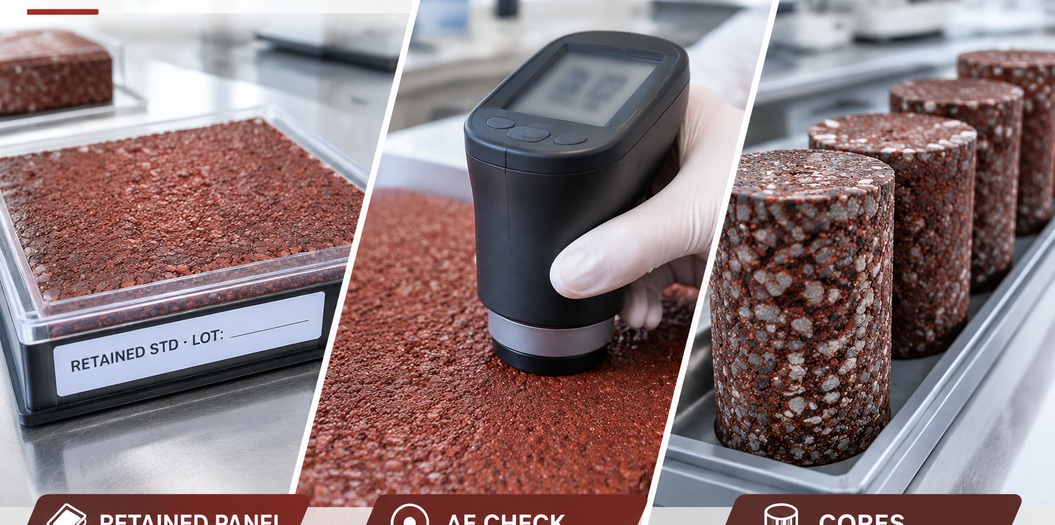
When a colored pavement loses its color, the pigment is usually the last thing to blame. The common mechanisms are physical and environmental.
Ultraviolet exposure. Pigments differ in lightfastness, and yellow and organic hues are generally more vulnerable than red. A road that fades over two summers in strong sun is showing a pigment selection issue as much as a pigment quality issue.
Abrasion and studded tires. The color lives in the binder film at the surface. As that film wears, aggregate is exposed and the surface lightens toward the stone's own color. Heavily trafficked lanes therefore go pale faster, and no pigment can prevent it.
Snow ploughs and mechanical damage. Blade contact scrapes the mortar-rich surface layer away in patches, producing exactly the patchiness that gets reported as "uneven color".
Fuel and oil spillage. Bituminous binders soften and dissolve in contact with fuels and some oils. A spill lifts the binder and its pigment together, leaving a pale scar.
Patching and reinstatement. A repair carried out months later, with a different pigment batch or a different plant, produces a visible patch. This is a project-management failure rather than a materials one, and the fix is to require a retained panel and a nominated pigment batch for the whole contract.
Efflorescence-like bloom. Asphalt does not effloresce the way cement does, but soluble material can migrate to the surface on some mixes and produce a pale haze that is mistaken for fading.
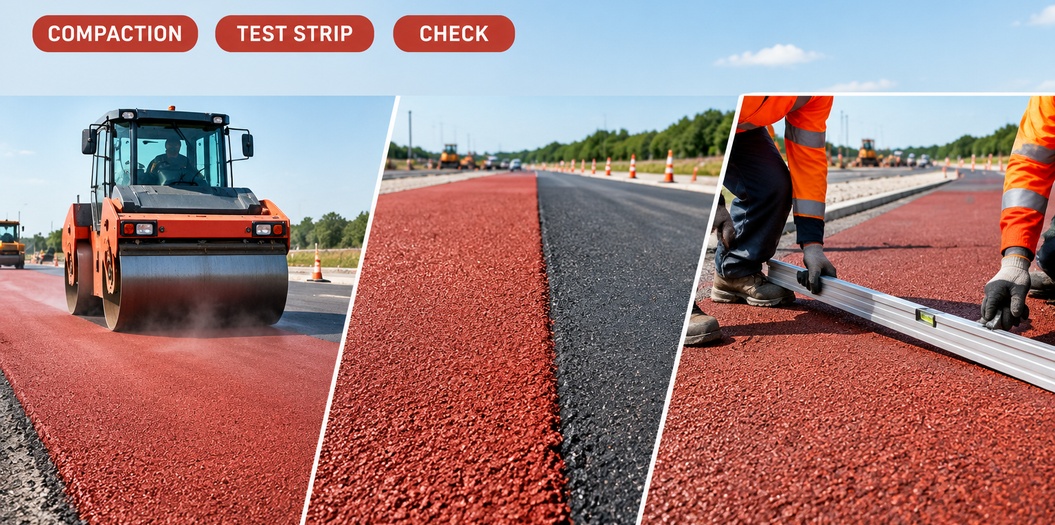
A trial is cheaper than a failed lane, and it is the only way to get a loading figure that means anything.
The last step is the one that gets skipped, and it is the one that turns a successful trial into a successful contract.
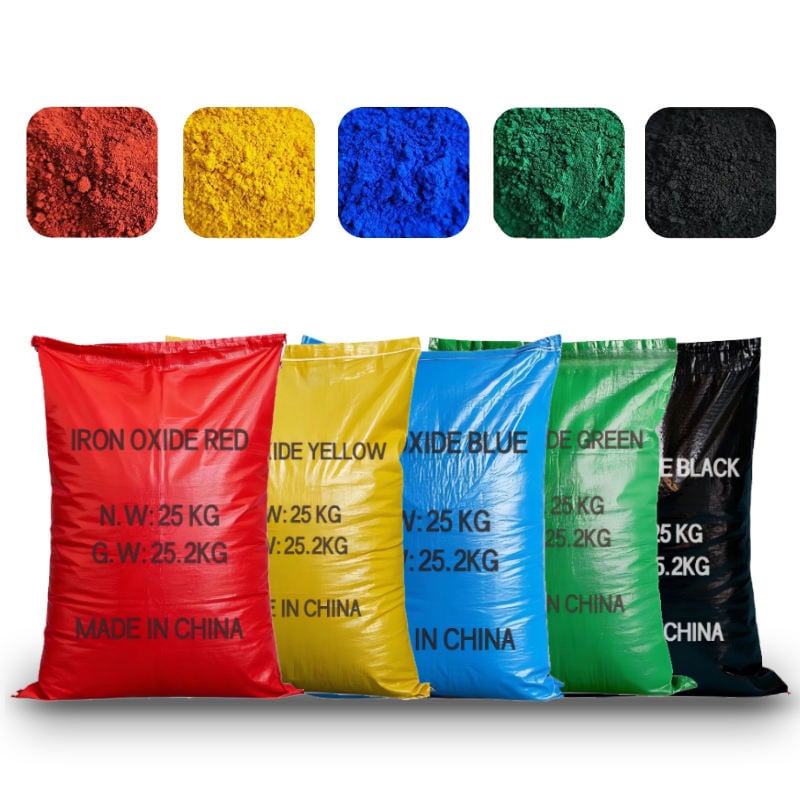
Hebei Tianhuibao Technology Co., Ltd. has manufactured iron oxide pigments for 26 years, with an annual production capacity of 50,000 tons, and supplies customers in 150+ countries and regions. The range covers the Iron Oxide Red Series (including grades 110, 130 and 190, plus nano, ultra-fine, easy-dispersing and acid- and alkali-resistant grades), the Iron Oxide Yellow Series (313 and 920 grades), the black and brown series, and composite blue (886) and green pigments, with factory-direct color matching, particle size adjustment and packaging customization through Custom Services. Certifications held include REACH, RoHS, CE and ISO. Minimum order quantity is 1 metric ton (1,000 kg); stock items ship in 3–5 working days and customized items in 7–15 working days. Quality control runs from raw material testing through to finished product inspection, and heat-stability data for the yellow grades is available on request.
If you are specifying a colored pavement, send us the target color, the binder type, the production temperature your plant will run, and the aggregate and filler sources. We will come back with the grade that survives that temperature, its expected color position against your standard, and a trial sample. Contact: [email protected] / +86-13400211655.
For the underlying thermal behavior of the yellow grades, see Iron Oxide Yellow Heat Stability.
 Hot News
2026-10-10
2026-10-08
2026-09-17
2026-09-11
2026-09-10
2026-09-04
 EN