 ×
A colour match is not a description — it is a number, and it only exists once you have written down how it will be measured. "Match RAL 3009" or "match our last shipment" tells a pigment supplier what you are aiming at, but nothing about when a delivered lot is acceptable and when it is a claim. The decisions that prevent a colour dispute are made before the purchase order: the measurement, the conditions it is taken under, and the tolerance both sides sign. The short version is worth stating up front — specify the colour as a retained physical standard plus a ΔE limit measured under ASTM D2244 conditions, check the tint and not only the masstone, and ask for the lot's ΔE and tinting strength against that standard with every delivery. The rest of this article explains why those three things decide the outcome, and what to put in the documents.
Two suppliers can each "match" the same sample and both be wrong, because colour is measured in coordinates, not in adjectives. A colour that a buyer calls "a bit darker and warmer" is a lightness error plus a hue error of a stated size, and without a number there is no way to settle which of two submissions is closer, or whether either is close enough.
A workable colour specification carries five items, and a specification missing any of them will be argued about:
There is a sixth item that is easy to forget: the substrate and the binder. A pigment that matches perfectly in a lab drawdown on a white card can read wrong on a grey cement surface or under a clearcoat of different gloss. If the colour matters on a wall, a paver or a moulded part, the reference has to be on that substrate.
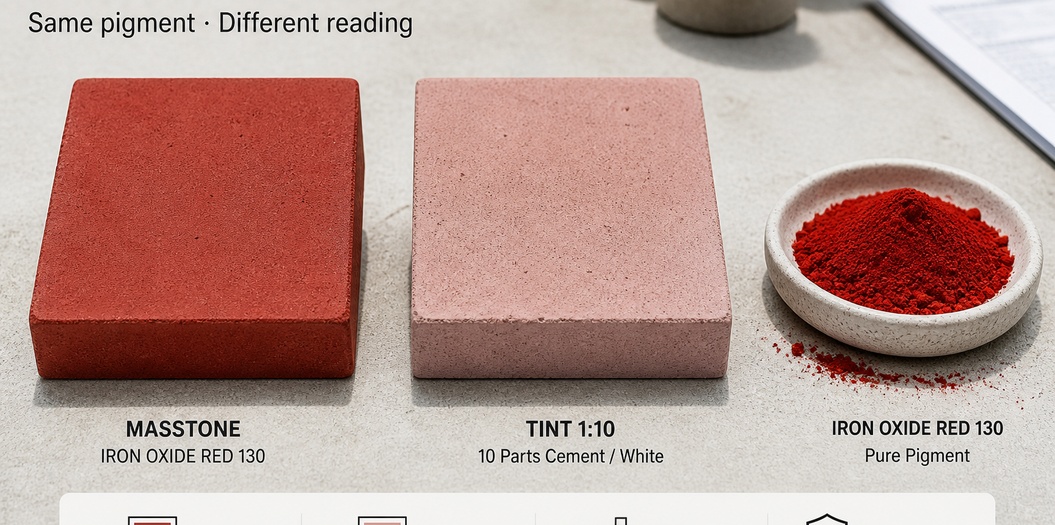
Almost every colour argument that survives the first exchange is a masstone-versus-tint confusion.
Masstone is the pigment read at, or near, its production loading — the way a dark red paver or a black pipe fitting presents itself. It is what people compare by eye, and it is the least sensitive to the properties that cost money, because a full-shade film can hide a weak pigment behind its own opacity.
Tint is the pigment let down with white, commonly in the region of one part pigment to five or ten parts white. In tint, the pigment's contribution is stretched across a much larger volume of white, and the differences that masstone concealed become visible: a lot with lower tinting strength reads paler, and often duller, in tint while looking entirely acceptable in full shade.
That is where the commercial damage sits. A weaker lot is not simply "a slightly different red". If the buyer compensates by increasing the addition rate, they pay more per tonne of coloured product and move closer to the upper end of the dosage range; if they do not compensate, the finished units come out lighter than the approved sample and the argument moves from the pigment to the finished goods. Tinting strength is a cost parameter as much as a colour parameter, and it is measured at the same time as colour.
The third measurement worth naming is undertone. Two lots can sit inside a tight ΔE limit and still show different undertones when let down — one leaning yellow, one leaning blue — because the pigment behind them was produced on a different route or blended from a different mix. Undertone is what buyers describe as "dirty" or "cold", and it is the reason a tint check belongs in the written agreement rather than in informal quality control.
ΔE is the total distance between two colours in a three-dimensional colour space: how far apart the sample and the standard sit when lightness, red-green and yellow-blue are considered at once. It is a magnitude, which is what makes it usable as a tolerance — but the plain numbers need translating before they mean anything on a production line.
The scale most commonly quoted in colour quality control runs roughly like this:
| ΔE*ab | How it usually reads | Where it is typically used |
|---|---|---|
| under 1.0 | Not distinguishable to the unaided eye under controlled light | Tightest work: parts placed directly against each other in one visible run |
| 1.0 – 2.0 | Visible on close, side-by-side inspection | The normal working band for coloured concrete, coatings and plastics |
| 2.0 – 3.5 | Visible at a glance when compared directly | Tolerable for large-format or heavily textured products, or where batches are screened from each other |
| above 3.5 | Reads as a different colour | Complaint territory — expect a concession or a return |
Two cautions. First, ΔE is one number hiding three directions, so a ΔE of 1.4 made almost entirely of a lightness error looks different from a ΔE of 1.4 made almost entirely of a hue error. Where hue drift is the specific risk, tighten the hue component or use a formula with hue weighting instead of shrinking the overall limit for everything. Second, ΔE describes two physical samples measured under the same conditions. It says nothing about how the colour will look three years outdoors — that is lightfastness and weather resistance, a separate property and a separate line on the technical data sheet.
A tolerance is only as good as the conditions it is measured under, and those conditions need to be written down, not assumed.
The formula. ASTM D2244 covers the calculation of colour differences from instrumentally measured colour coordinates — the arithmetic that turns instrument readings into a ΔE. It is worth naming in the specification, because ΔE*ab, ΔE CMC and ΔE CIEDE2000 applied to the same two samples give different numbers, and a supplier and a buyer using different formulas will disagree about the same panel.
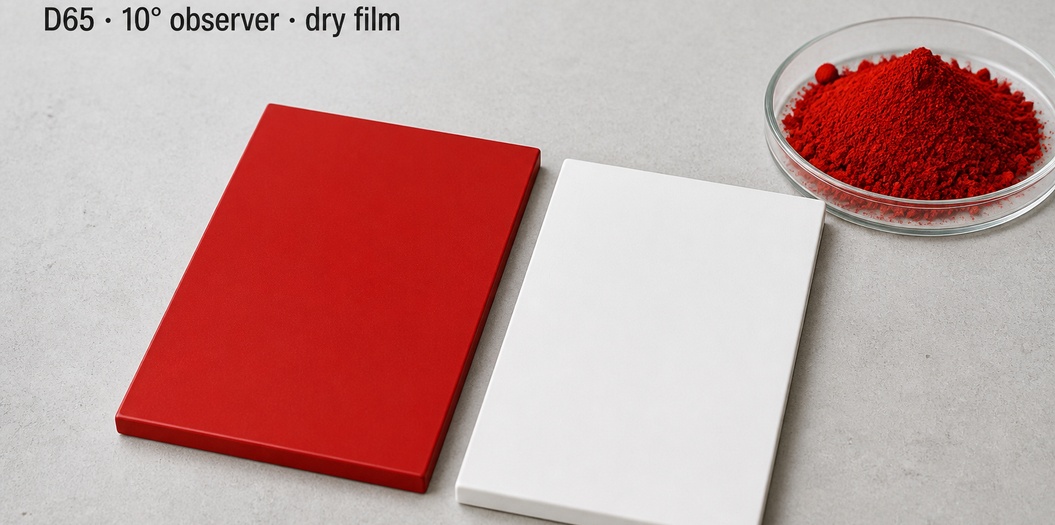
The light source and observer. Colour is a measurement of reflected light, so the light matters. The industrial default is daylight D65 with a 10° observer, and it should be stated rather than left to the instrument's memory. Instruments also differ in geometry: a sphere instrument in specular-included mode and a multi-angle instrument do not report the same numbers on the same brushed or textured sample.
The sample. Same film thickness, same application method, dry rather than wet, and the same gloss. A matte surface scatters light and reads lighter than a gloss surface carrying identical pigment — a pigment change is often blamed for what is in fact a sheen difference.
Cure and time. In concrete, colour develops as the material cures, so a reading taken at demoulding is not the reading that matters. Measure against the retained standard at agreed intervals — checking at 7 days and again at 28 days, in the same light, is the common arrangement — rather than once, early, on a wet surface. In plastics and powder coatings, measure after the material has been through its real heat history, because processing shifts colour: iron oxide yellow is a hydrated iron oxide and shifts toward red once it is taken past its temperature limit, which is why processing temperature is a specification input and not a processing detail.
The colour specification tells the supplier what to make. The documents below tell both sides whether the lot that arrived is the lot that was ordered.
| Item | Why it matters | How to verify |
|---|---|---|
| ΔE against the retained standard, on masstone and on tint | Lets you accept or reject on a number before the material reaches the mixer | Reported per lot on the certificate of analysis, measured under the agreed conditions |
| Tinting strength relative to standard | A weaker lot raises cost per tonne of coloured product | Drawdown or instrumental comparison against the retained standard |
| Water-soluble matter | Caps the soluble salt load the pigment adds to a cementitious or masonry system | Lot certificate of analysis; for integrally coloured concrete the test sits in ASTM C979 / C979M, Standard Specification for Pigments for Integrally Colored Concrete |
| Sulfate content | Sulfates are a component of many surface bloom deposits | Lot certificate of analysis |
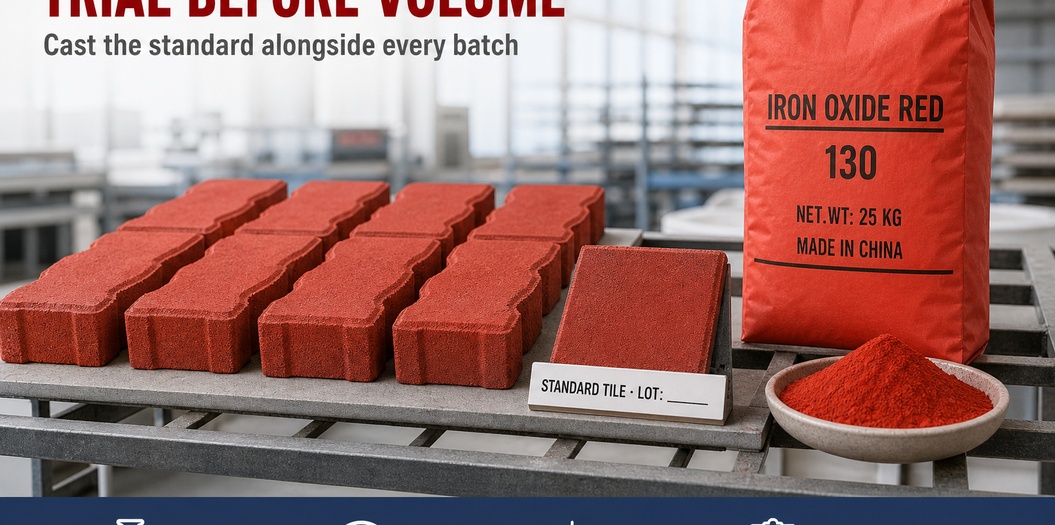
| Performance in your own system | A pigment can match dry and shift once it is in a cementitious matrix | Trial with your own cement, sand and curing cycle; for pigments used in cement- and lime-based building materials, EN 12878 sets out the requirements and test methods, including for pure lime mortar |
| Retained reference sample | The physical arbiter if a dispute reaches the point where numbers are not believed | Sealed, dated, held by both parties |
| Lot traceability | Makes a repeat order reproducible, or makes the change visible when it is not | Lot numbers on the bags and on the certificate |
Two of these are worth separating. Colour match of shipment and colour stability in service are different claims: the first is a commercial agreement about a delivered bag, the second is a material property. A supplier can be perfectly inside tolerance on the first and still have the second fail, which is why both belong on the data sheet rather than in a conversation.
When a delivered lot measures inside tolerance against the standard and the finished product still looks wrong, look at the process before renegotiating the pigment. The pigment is one input among several that move the final colour:
If the dosage itself is in question — how much pigment per cubic metre, and how to verify a change against your own materials rather than a supplier's typical figure — that has its own worked method in Iron Oxide Pigment Dosage for Concrete.
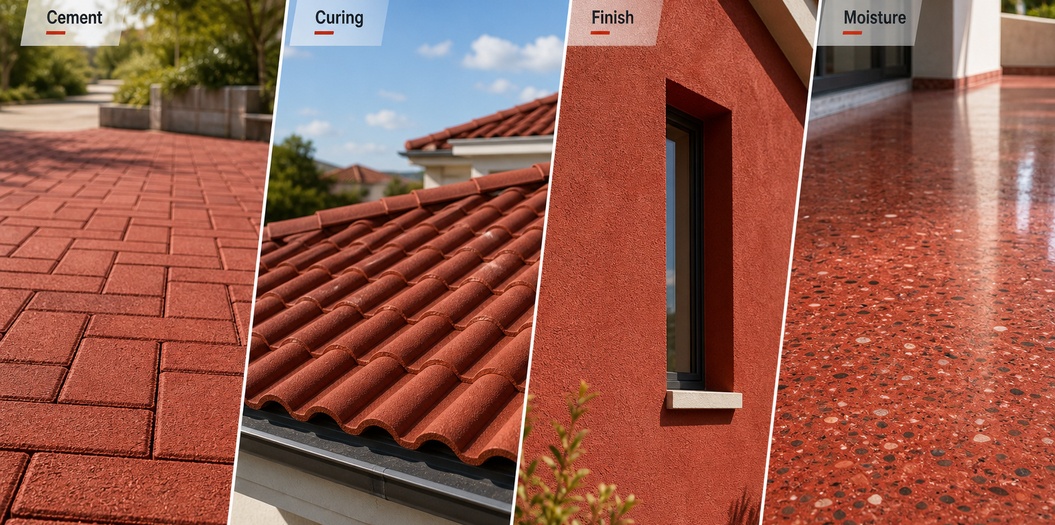
The point of all of this is not administrative tidiness. Colour is the one property of a pigment that a buyer will always notice, that a supplier cannot inspect on your behalf, and that turns into an argument only when nobody wrote down how it would be measured.
Hebei Tianhuibao Technology Co., Ltd. has manufactured iron oxide pigments for 26 years, with an annual production capacity of 50,000 tons, and supplies customers in 150+ countries and regions. The range covers the Iron Oxide Red Series (including grades 110, 130 and 190, plus nano, ultra-fine, easy-dispersing and acid- and alkali-resistant grades), the Iron Oxide Yellow Series (313 and 920 grades), the black and brown series, and composite blue (886) and green pigments, with factory-direct colour matching, particle size adjustment and packaging customisation through Custom Services. Certifications held include REACH, RoHS, CE and ISO. Stock items ship in 3–5 working days; customised items in 7–15 working days. Quality control runs from raw material testing through to finished product inspection, and colour data (ΔE against a retained standard) is available on request.
If you want a colour you can enforce rather than a colour you have to argue about, send us your target standard, the substrate and binder it will be used in, and the measurement conditions you work to. We will come back with the grade, its ΔE position against your standard, and a trial sample. Contact: [email protected] / +86-13400211655.
 Hot News
2026-10-10
2026-10-08
2026-09-17
2026-09-11
2026-09-10
2026-09-04
 EN