 ×
Iron oxide yellow heat stability is not a single figure you copy from a data sheet into a process specification. Iron oxide yellow is goethite — a hydrated iron oxide, α-FeOOH — and the yellow exists only for as long as the water held inside that crystal structure stays there. Give the pigment enough temperature for long enough, and the water leaves, the crystal becomes hematite (α-Fe₂O₃), and the hue moves from yellow through orange toward red. So the useful question is never "is this pigment heat stable", but "at what temperature, for how long, and against which colour tolerance".
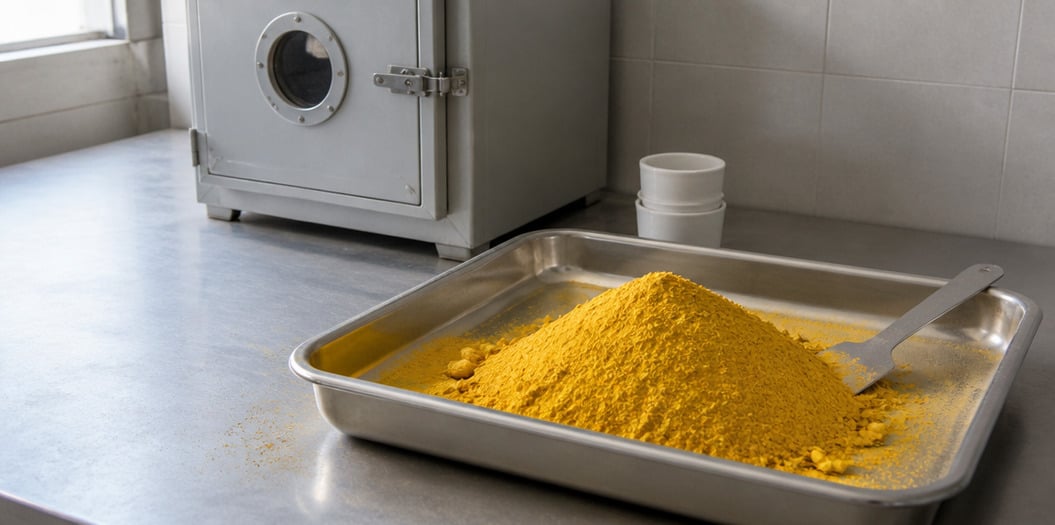
Goethite and hematite are the same iron and the same oxygen in two different crystal arrangements. Goethite carries hydroxyl groups in its lattice; hematite does not. That difference is the mechanism, written in one line:
2 FeOOH → Fe₂O₃ + H₂O
In mass terms: two moles of goethite weigh 177.7 g (2 × 88.85 g/mol), and the water released weighs 18.0 g. Roughly 10.1 g of every 100 g of stoichiometric yellow iron oxide therefore leaves the crystal as water when it converts to hematite. That 10.1% is structural water in the lattice, not free moisture sitting on the particle surface — the two are measured differently and behave differently in a process.
The reaction is thermally activated and, at processing temperatures, effectively irreversible: once the lattice water has left, cooling and re-heating do not put it back. The transformation is documented outside the pigment trade as well. Pomiès, Morin and Vignaud studied it directly by X-ray diffraction and describe yellow goethite dehydrating and transforming to red hematite on heating (XRD study of the goethite–hematite transformation, 1998).
For a synthetic pigment the onset of that dehydration is commonly reported in the region of 180–200 °C, with the shade shifting faster as the temperature rises. Where a given grade starts to move depends on its crystallinity, particle size and surface treatment, which is why the class does not have one number. Treat any single figure from a supplier as a starting point for your own trial, not as a property of the family.
A heat-stability claim of "180 °C" on its own is not a specification, because dehydration is a rate process: temperature and dwell time trade off against each other. A specimen held for a few minutes at a high temperature can end up in a state similar to one held much longer at a lower temperature. A figure quoted without its dwell time cannot be compared with another supplier's figure, and it cannot be transferred to your process.
The second number is the colour tolerance. Heat stability is normally expressed as a colour difference between a heat-exposed specimen and an unexposed control — ΔE measured on a spectrophotometer in CIELAB, with the direction of the shift visible in a\ (red–green) and b\ (yellow–blue). A yellow that is dehydrating toward red shows b\ falling and a\ rising. The pass limit itself is a project decision: colour-critical work commonly runs to a tighter ΔE than decorative products do. Until the triplet is complete — temperature, dwell, and the ΔE limit that was applied — two suppliers' heat-stability figures cannot be lined up against each other.
The third number is how the pigment was tested. A moulded plastic chip and a dried drawdown film of the same pigment, held at the same temperature, do not give the same ΔE, and the pigment loading plus any co-pigment in the formula changes both the size and the direction of the shift. The test medium and the loading therefore belong in the claim as much as the temperature does.
| Application | Temperature the pigment sees (typical industry practice) | What it means for iron oxide yellow |
|---|---|---|
| Integrally coloured concrete, paving tiles, blocks — ambient or steam cured | Ambient; steam curing commonly up to about 80 °C | Well below the dehydration band. Heat is not the limiting property here — light fastness and alkali resistance are, and both are covered by the test schedule in ASTM C979 / C979M-16 |
| Autoclaved (high-pressure steam) products | Commonly around 180–200 °C | Inside the dehydration band; a yellow hue is the wrong specification for this route |
| Ambient-cure and force-dry architectural coatings, inks, paper | Below about 60 °C | No heat constraint on the pigment |
| Powder coatings and stoving enamels | Object temperature commonly 170–200 °C for 10–20 minutes | At or above the boundary; specify a heat-stable grade and verify, or shade the formula after the bake |
| PVC compounds — dry blend, extrusion, calendering | Commonly 160–200 °C | Near the boundary, and at the top of the window the matrix contributes its own colour change on top of the pigment's |
| Polyolefins — extrusion and injection moulding | Commonly 180–260 °C | Above the boundary for an unmodified yellow; where the hue must stay yellow, a heat-stable yellow chemistry is the usual answer |
| Engineering thermoplastics (PA, PBT, PC) | Commonly 240–300 °C | Iron oxide yellow is not the appropriate colorant for these windows |
| Ceramic bodies | Firing above 1,000 °C | The goethite structure does not survive; hematite reds and spinel-type pigments are used instead |
Every temperature in that table is a typical industry processing range, not a measurement from our plant. Your set points, screw geometry, section thickness and cycle time decide what the pigment actually experiences, and a thick section can sit above the set point for longer than a thin one.
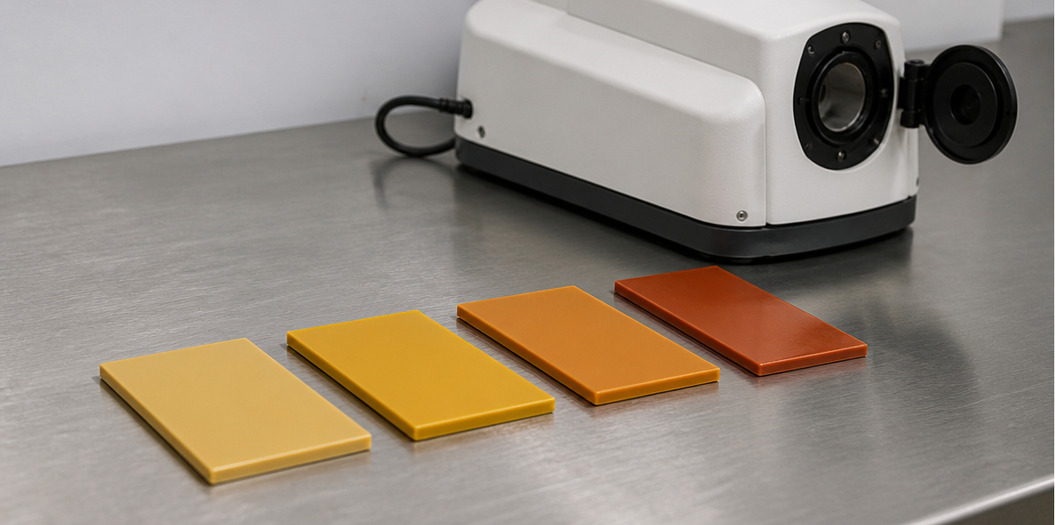
Six steps, in this order, produce a number that means something for your line rather than for a data sheet:
Two limits are worth stating. In a thermoplastic, the ΔE you measure includes the polymer's own yellowing or darkening at the same temperature, so the pigment's contribution has to be separated by comparing against an unpigmented specimen run the same way. In a PVC compound, the stabiliser package is doing part of the work, and a change of stabiliser can move the result more than a change of pigment supplier.
There are four honest routes, in rough order of cost:
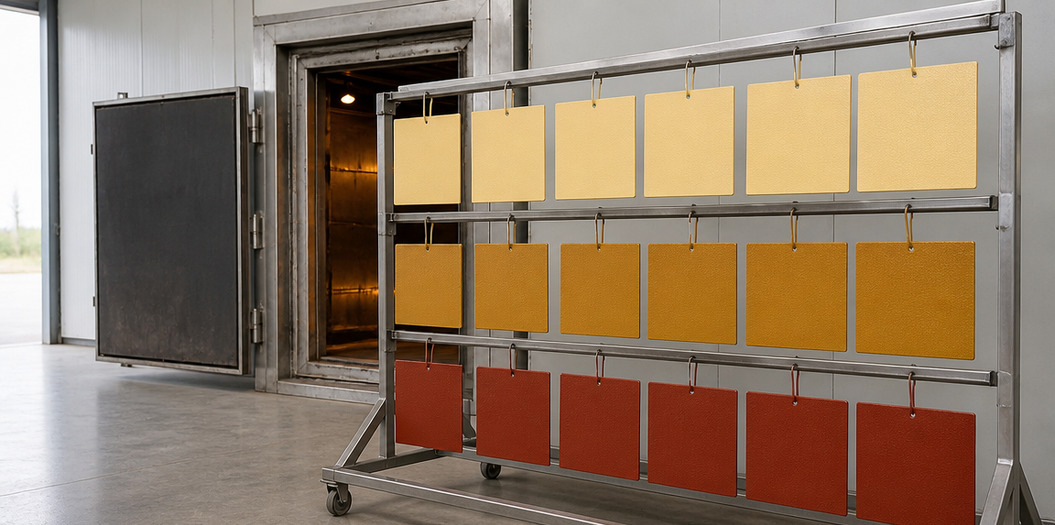
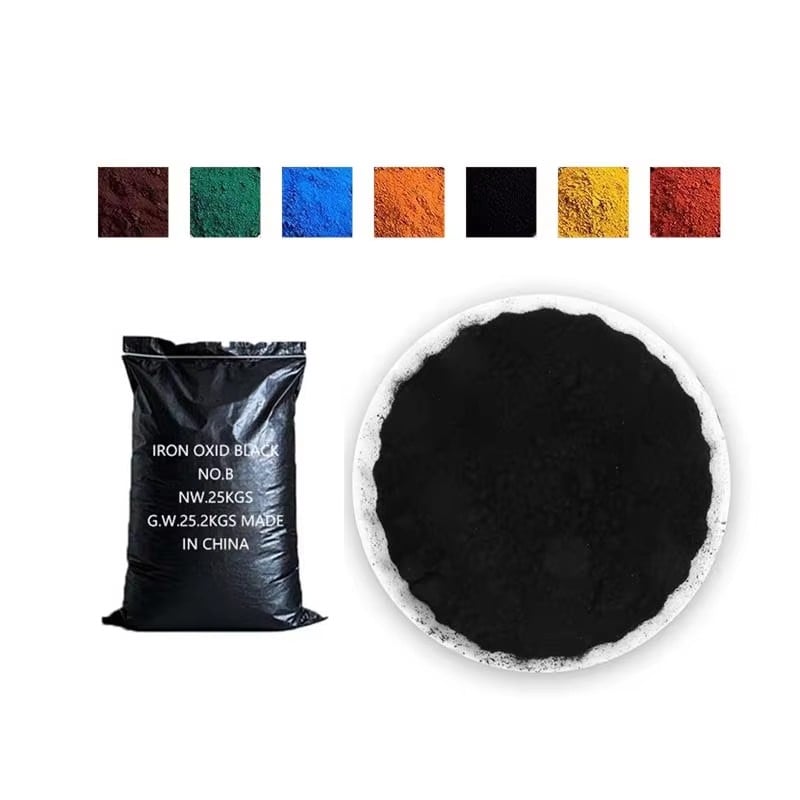
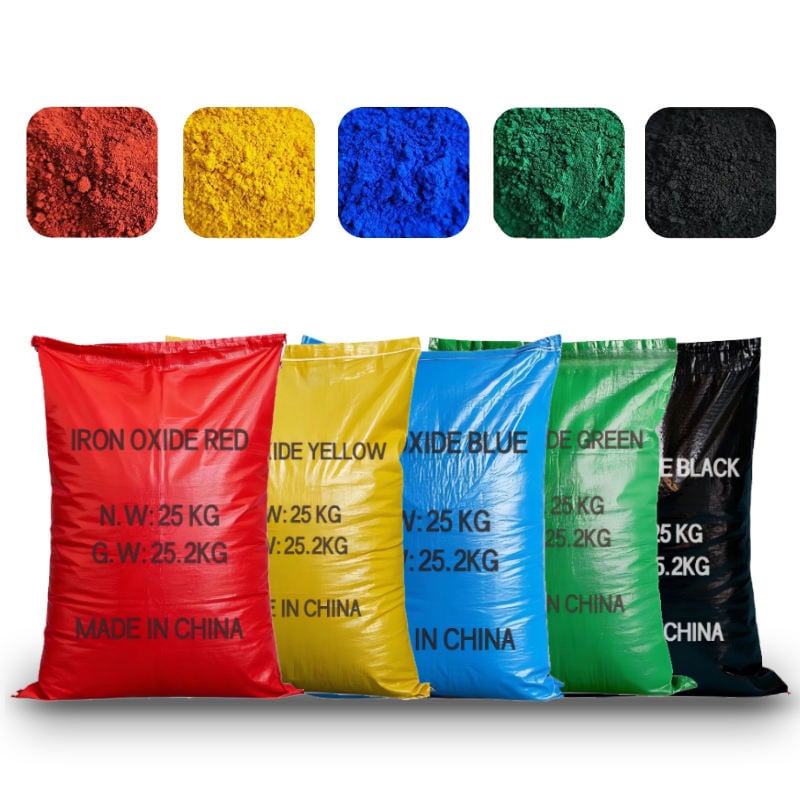
We supply iron oxide yellow in grades 311 and 313, alongside the red, black, brown, green and blue series. What we can hand over with a quotation is the grade identity, the batch number, the volatile-matter figure, and multi-batch colour consistency data in ΔE on request. What we cannot give you is a heat-stability number for your polymer, your bake schedule or your ceramic firing curve, because that number is produced by your process and your matrix — it is measured in your plant, on your material, at your dwell.
Iron oxide yellow heat stability is decided by your process, not by a data sheet. Hebei Tianhuibao Technology has produced iron oxide pigments for 26 years, with an annual capacity of 50,000 tons, and exports to 150+ countries and regions. Pigments are supplied in 25 kg woven bags from stock; stock items ship in 3–5 working days and customized orders in 7–15 working days. The company holds REACH, RoHS, CE and ISO, and moves classified pigment cargo under IATA DGR by air and IMDG Code by sea. Minimum order quantity is 1 metric ton. If you are specifying a yellow into a process that runs hot, send us your temperature, dwell and colour tolerance — we will tell you what the grade can and cannot be expected to do, and supply a sample for your own trial. Contact: [email protected] / +86-13400211655.
 Hot News
2026-10-10
2026-10-08
2026-09-17
2026-09-11
2026-09-10
2026-09-04
 EN