 ×
In short: Iron oxide pigment does not go bad the way a resin or a food additive does. What fails in a warehouse is dispersibility, and moisture is what makes it fail. Three checks catch nearly every problem before it reaches the mixer: moisture content against the certificate, lumps against a squeeze and a sieve, and a drawdown against your retained sample. Run those on receipt and the date printed on the bag stops being the thing you argue about.
Ask a pigment supplier how long the material lasts and you will get a number. Ask what the number is based on and the answers get vaguer. That is not because suppliers are hiding something. It is because the honest answer is unhelpful: the pigment is fine, and the bag it is sitting in may not be.
Buyers ask this question most often after a bad experience rather than before one. A lot that ran perfectly in March comes back as specks in September. Nobody changed the formula. The bags sat through a wet summer on a concrete floor, and the only thing that changed was how easily the powder let go of itself.
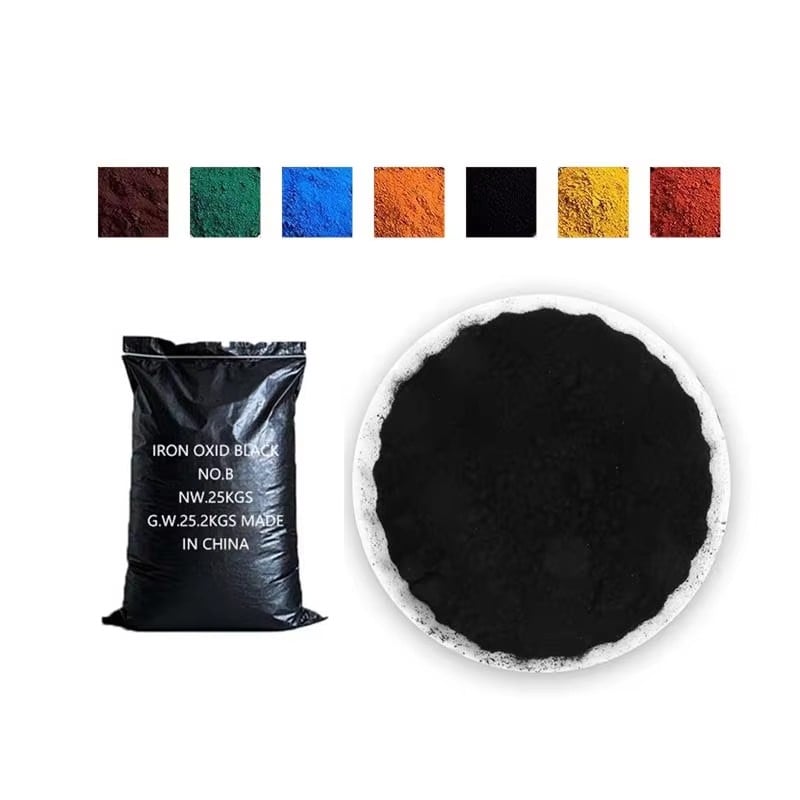
Iron oxide red (Fe2O3), black (Fe3O4) and yellow (α-FeOOH, a hydrated iron oxide) are manufactured minerals. There is no organic fraction in the bag to rot, no binder to crosslink in storage, nothing for mold to eat. A bag kept dry and cool for five years is, chemically, the same material that went into it. The industry has been digging iron oxide out of the ground and using it on walls for a very long time, and the mineral does not care how long it waits.
What changes is physical. Particles that were separate start touching each other and stay touched. That is the whole failure, and it is worth being precise about it, because "expired" sends people looking for the wrong thing.
The date on the bag is usually a production date plus a storage period the supplier sets. ISO 1248 covers the specification and test methods for these pigments. It does not set a shelf life, because shelf life is a property of the bag and the building, not of the chemistry.
So ask what the interval came from. A supplier who says "we retest at two years, and that is the interval we print" is telling you the truth, and you can plan around it. A supplier who says "two years, guaranteed" and has no data behind it is reciting a number, and the number will not help you when a lot cakes in month fourteen.
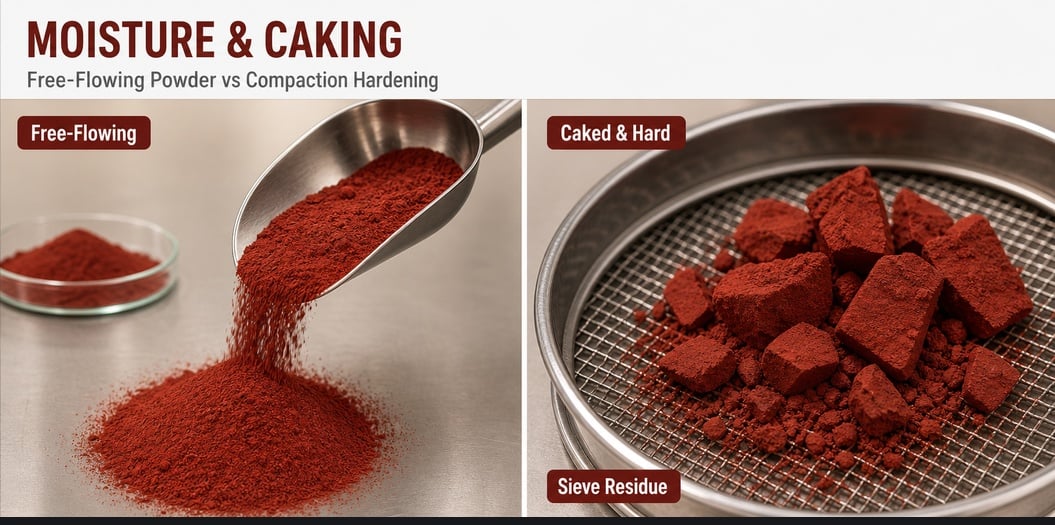
Pigment powder has an enormous surface area per kilogram. Once relative humidity climbs, every particle carries a thin film of adsorbed water. Where two particles touch, that film meets and forms a liquid bridge. As the water later dries, the bridge pulls the two particles together and sets. This is capillary bridging (particles held at their contact points by water that has since dried out), and it is the mechanism behind almost every hard lump you have ever found in a bag.
A lump that will not break down is color you paid for and never delivered. In a coating it shows as a speck. In concrete it shows as a dark fleck in a pale field. In a plastic part it shows as a streak that follows the flow line. And in all three it shows up as tinting strength below what the certificate said (tinting strength being the color a pigment develops per unit of weight once it is let down into white).
The plant's response is predictable and expensive. The mixer operator sees a weak batch, so the next batch gets more pigment. Nobody flags it, because each individual increase is small. Two quarters later the color is on target and the cost per ton has crept up by a few percent, and the cause is a pallet that spent the summer against a wall. If you already measure color with a tolerance, the drift is in your color matching data long before anyone thinks to look at the warehouse.
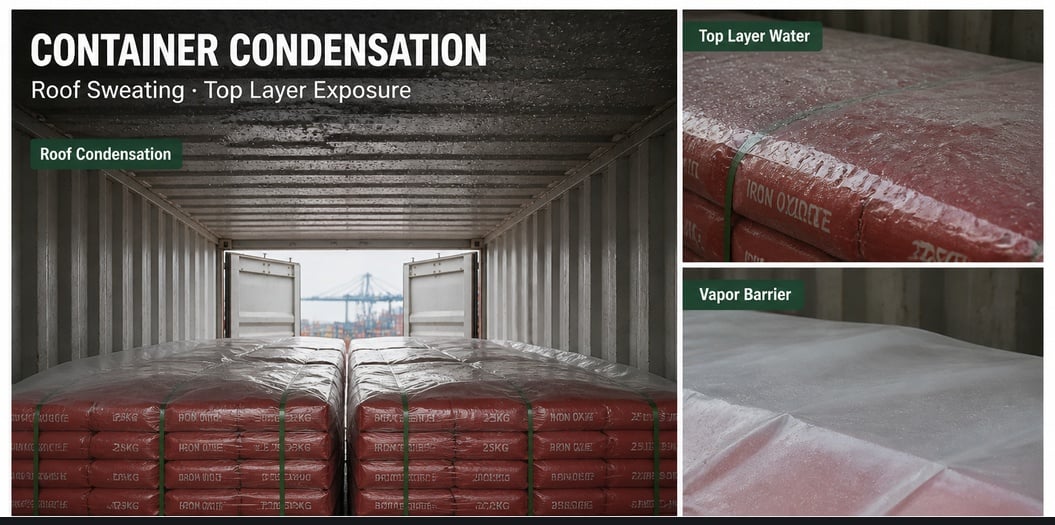
Before a bag reaches your racking it crosses an ocean, and a shipping container is a moisture machine.
The steel roof cools faster at night than the cargo stacked under it. Air inside the container holds water vapor, the roof drops below the dew point (the temperature at which air has to be cooled before water condenses out of it), and water forms on the underside of the roof. Then it drips. The trade calls it container rain, and it lands on the top layer of the top pallet, which is the one nobody inspects.
Desiccant bags (pouches of absorbent material that pull water vapor out of the container air) reduce the effect, but only if enough of them were specified and only if they were still dry when the container was closed. A container that sat on a dock for three weeks waiting for a vessel has spent a good part of its protection before it ever sailed.
What a buyer can actually control is small and specific. Ask for container liner and desiccant in the purchase order. Ask for loading photos. Then look at the top layer of the top pallet on arrival, before signing anything, because that is where the water went. A buyer who has been caught once always asks. A buyer who has not, usually does not, and that is how the story starts.
The second moisture event happens after the container, and it happens in your own building.
Picture a January delivery into an unheated warehouse, then the pallet moved into a plant running at 25 °C and 70% relative humidity. The pallet is at 2 °C. The air around it is warm and wet. Water condenses on the outside of the bags. If the bag has a sealed polyethylene liner, the water sits on the liner and the pigment never knows. If the bag is woven polypropylene with no liner, or the liner was perforated by handling, the water goes in and stays in.
The number that decides this is the dew point, not the weather report. A cold pallet in a warm humid room is the worst combination available, and it costs nothing to avoid: let it come up to plant temperature, still wrapped, before anyone opens a bag. A day is usually enough. Floor space is expensive, and a rejected lot is more expensive.
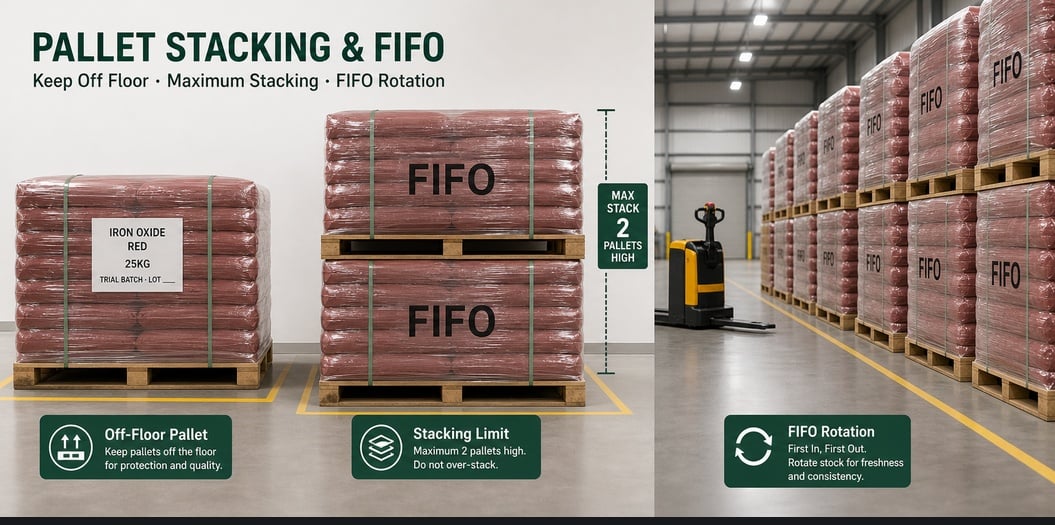
Concrete floors deserve their own line. A slab draws moisture and stays cold, and the bottom layer of a floor-stacked pallet is the first place caking appears. Keep stock on pallets, not on the floor, even when the pallet is only going to be there a fortnight.
If you only have time to sample one grade after a wet season, sample the black.
Black is usually sold into tints, and tints amplify small changes. In masstone (the pigment at full strength, with nothing added) a shift of a couple of ΔE units can disappear, especially under plant lighting. The same pigment let down at one to twenty with white shows that shift plainly, because the eye is far better at catching a hue change in a pale gray than in a near-black.
The usual report is an undertone change. A black that read neutral against the retained sample now reads slightly brown beside it. Neutral is the property customers pay for, and a brown cast in a light gray is the kind of thing that gets a batch rejected on a decorative job and accepted without comment on an industrial one.
There is a mechanism story about mixed-valence iron oxides and moisture that gets repeated a lot, and some of it is probably right. On a warehouse floor you cannot separate that from ordinary caking, and it does not change what you do about it. Sample the lot, compare it to the jar, and decide on the comparison. The Black 11 specification guide covers what to write into a purchase order; this is about what to check when the bag is already open.
Whether you will ever see it depends entirely on your batch plant. A plant coloring concrete roof tiles will not notice a two-unit undertone shift in a year of production. A plant tinting architectural coatings to a tight tolerance will notice it in a week, and will blame the pigment, and will be half right.
Every few months somebody asks whether yellow pigment degrades sitting in the warehouse. Almost always they are remembering a heat problem from somewhere else in the plant.
Iron oxide yellow (α-FeOOH, a hydrated iron oxide) holds water inside its crystal structure. Heat drives that water off. Past roughly 180 °C the change becomes significant, it does not reverse, and the shade moves toward orange-red. That is a dryer problem, an extruder problem, an oven problem, a kiln problem. At 30 °C on a shelf, nothing of the kind happens.
The storage risk for yellow is the same as for red: moisture, caking, and the strength loss that comes with them. Same symptom in the mixer, completely different mechanism.
Which means the common fix is the wrong one. Moving yellow into a climate-controlled room and leaving the reds on the floor solves nothing, because both are damaged by the same thing. Keep every grade dry, and spend the air-conditioning budget on the resin instead.
Five checks, all of them cheap, none of them requiring new equipment beyond a balance and an oven.
| Check | What it catches | How to run it |
|---|---|---|
| Moisture content | Water taken up in transit or in storage | Oven-dry a sample at 105 °C and compare against the certificate figure for that lot |
| Lumps | Caking that will not break down in the mixer | Squeeze a handful through the bag, then sieve a sample and weigh the residue |
| Drawdown vs retained sample | Shade and undertone drift | Spread a thin film beside your sealed standard and measure per ASTM D2244 |
| Tinting strength | Loss of color development per kilogram | Same let-down ratio as the original approval, run side by side |
| Bag and liner condition | Where the water got in | Look at the top layer and the bottom layer of the pallet, not the front one |
The drawdown is the one people skip, and it is the one that answers the real question. A moisture reading tells you the bag is wet. A drawdown tells you whether the customer will see it. Those are not the same thing, and a lot that is slightly damp but still disperses cleanly is a lot you can use, provided you use it soon.
Keep the retained sample (a sealed jar of each lot, labeled with lot number and receipt date) for as long as you keep the product in your own warehouse. It is not there for the supplier's benefit. It is the only object in the building that can settle an argument eighteen months after everyone who ran the batch has changed jobs.
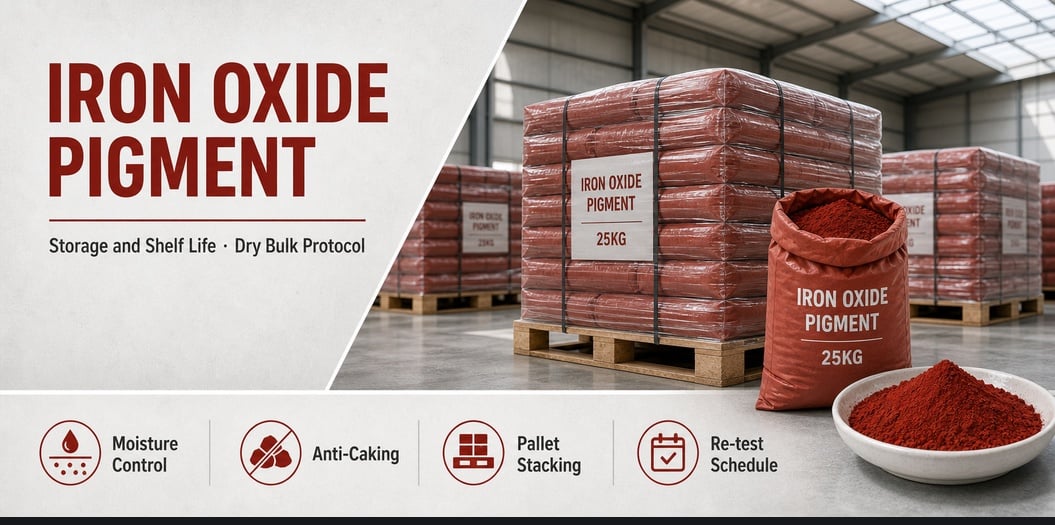
The first mistake is stacking too high. A woven bag has a seam and a liner, and both are the weakest point under load. Stack eight bags where the bag was designed for five and the bottom one takes the weight of the seven above it, the liner creases at the fold, and a crease becomes a pinhole. Nothing looks wrong from the aisle.
The second is first-in-first-out that only exists on paper. Rotation fails when the pallet label faces the wall, because the person with the forklift is not going to walk around it. Writing the receipt date on the stretch wrap in marker, large, takes ten seconds and works better than any system field.
One more, and it is a small one until it is not: keep pigment away from solvent drums and anything else with a strong smell. Powder has a lot of surface, a bag is not airtight, and a customer who opens a bag of red and smells thinner will send it back regardless of what the certificate says.
Hebei Tianhuibao Technology Co., Ltd. has manufactured iron oxide pigments for 26 years, with an annual production capacity of 50,000 tons, and supplies customers in 150+ countries and regions. The range covers the Iron Oxide Red Series (grades 110, 130 and 190, plus nano, ultra-fine and easy-dispersing types), the Iron Oxide Yellow Series (313 and 920), and the black and brown series, with custom packaging through Custom Services. Certifications held include REACH, RoHS, CE and ISO. Stock items ship in 3–5 working days; customized items in 7–15 working days. Minimum order is 1 ton (1,000 kg).
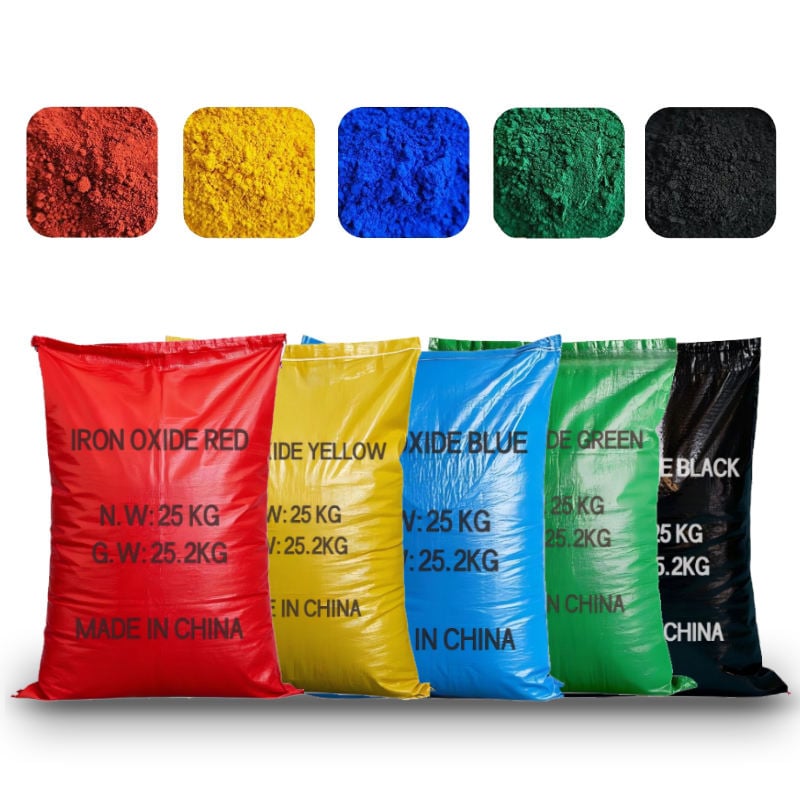
Packaging is where most storage problems are decided before the pigment leaves the plant, so it is worth specifying rather than accepting the default. We can supply lined woven bags, paper bags, and jumbo bags with a sealed liner, and we will tell you which one suits a humid destination rather than which one is cheapest. Every lot ships with a certificate stating moisture content, residue on sieve and tinting strength, so your receiving check has a number to compare against instead of a guess.
If you are working out how much stock to hold through a wet season, send the grade, the monthly consumption and the conditions in your warehouse. We will tell you what to order and what to keep out of the bottom layer.
Contact: [email protected] / +86-13400211655.
 Hot News
2026-10-10
2026-10-08
2026-09-17
2026-09-11
2026-09-10
2026-09-04
 EN