 ×
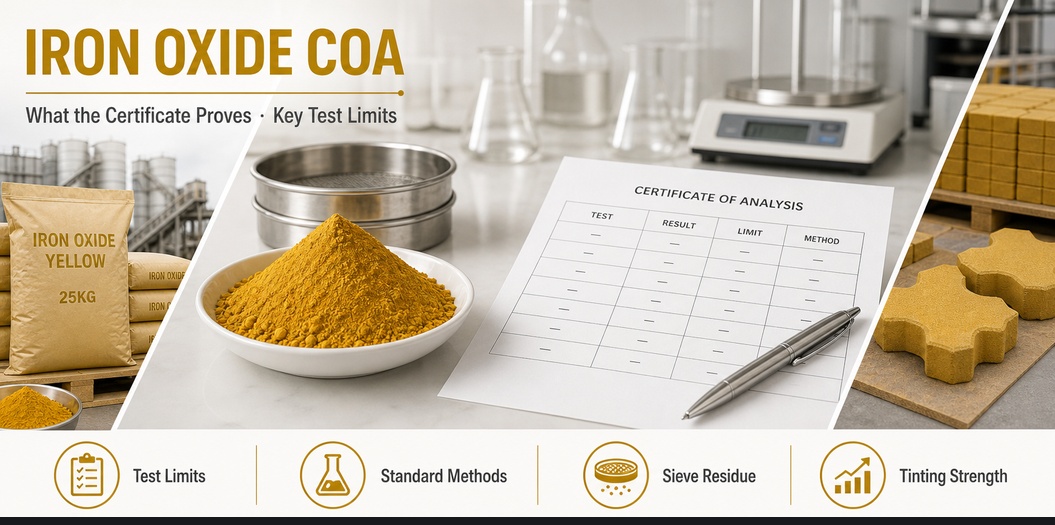
In short: A certificate of analysis is a lab report for one lot, and it is only as useful as the specification it is measured against. Before you file it, check three things: every result carries a limit rather than a bare number, every test names the method it used, and the tinting strength names the standard it was measured against. Do that and the certificate becomes a receiving tool. Skip it and you are filing paper.
Most buyers read a COA the way they read a delivery note. Scan the lot number, check the color looks right, sign, file. That works until a batch fails in the mixer and somebody opens the folder to find out why. What they usually find is a sheet of numbers with nothing to compare them against.
The certificate is not the problem. How it gets written is.
A pigment plant issues a COA for every lot it ships. The good ones are built so that a stranger can read them and decide. The bad ones are built so that the plant can prove it ran the tests. Those two goals produce very different documents.
Worth separating the two documents people confuse.
A specification says what the material must do. A certificate says what this lot did. One is an agreement, the other is a measurement. When a supplier sends a COA with no reference to a specification, you are holding a measurement with no pass or fail attached to it.
That is not a small gap. A reading of 0.4 percent volatile matter means one thing against a limit of 0.5 and something else entirely against a limit of 0.3. Same number, opposite conclusion. If the sheet does not state the limit, the number is decoration.
The old way of handling this was to keep a supplier's technical data sheet on file and assume the COA sat inside it. Data sheets are written for a product family. Certificates are written for a lot. The family can be perfectly in order while a particular lot sits outside it, and the only document that would tell you is the one with the results on it.
So the first thing to look for is not a number. It is a column heading.
Iron oxide certificates vary in length, but the same handful of lines turn up on nearly all of them. What changes is how much they tell you.
| Line on the certificate | What is actually being measured | Method that should be named | Why it matters downstream |
|---|---|---|---|
| Iron content, as Fe2O3 or as Fe3O4 | The iron-bearing fraction of the pigment, on a stated oxide basis | ISO 1248 sets out specifications and test methods for iron oxide pigments | Tells you what basis the purity claim is on, and whether black and red are being reported the same way |
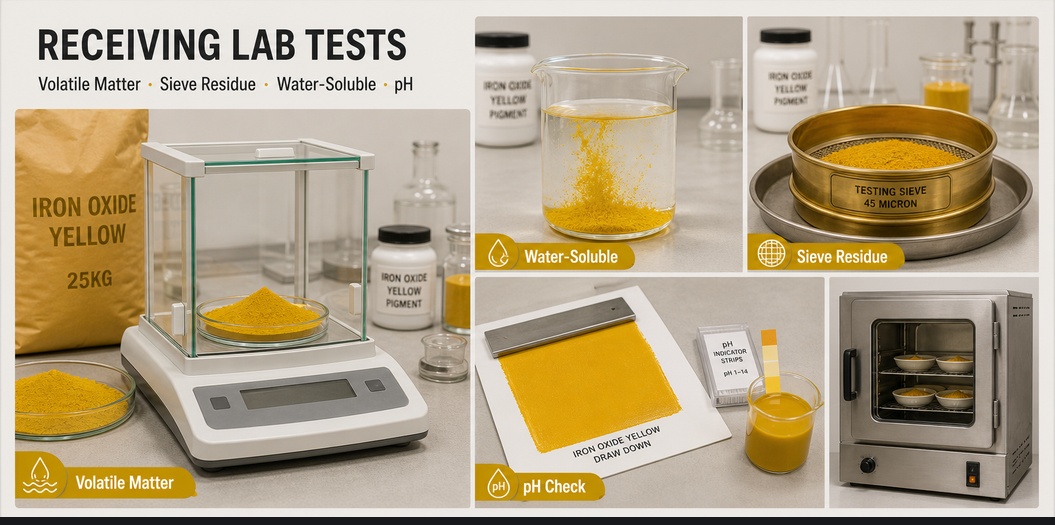
| Matter volatile at 105 °C | Water and anything else that leaves at that temperature | ISO 787-2 | A high figure is water you paid freight on, and water that foams or pinholes in a pre-mix |
| Matter soluble in water | Soluble salts, extracted hot | ISO 787-3 | Salts migrate to the surface in cementitious systems; ASTM C979/C979M carries requirements for pigments in integrally colored concrete |
| Residue on sieve | Coarse particles left on a stated mesh | The test method named in ISO 1248 | Coarse particles read as specks in a film and drag tinting strength down |
| pH of aqueous suspension | Acidity or alkalinity of the pigment in water | ISO 787-9 | Matters where the pigment meets a binder that is sensitive to pH, and flags a changed wash or precipitation route |
| Tinting strength | Color developed per unit weight, against a stated standard | Drawdown or instrumental comparison, commonly read per ASTM D2244 | A weak lot costs real money, because the mixer adds more to hit the same shade |
Six lines. Not one of them is exotic, and all six are cheap to run.
Notice what the table does not contain: a target. That belongs in the specification or the purchase order. What the certificate has to carry is the limit next to the result, and the method next to the test.
This is the single most common defect in certificates that cross my desk, and it is almost never deliberate.
A lab runs the test, writes down the result, and passes the sheet to the office. The office formats it. Somewhere between the bench and the PDF, the limit column disappears, because the person building the template did not know which limits applied and left them out rather than guess.
Ask for a corrected certificate. A supplier who cannot tell you the limit for moisture on the grade you bought has not published a specification, whatever the data sheet says.
There is a second version of the same problem, and it is more subtle. Some sheets report a range instead of a limit. A result of 0.3 against a stated range of 0.1 to 0.8 looks like a comfortable pass. It is, but a range that wide also tells you the process is not tightly controlled, and a buyer who needs consistency should be asking a different question: what is the lot-to-lot spread, not what is the window.
Moisture gets checked because everyone understands water. Residue on sieve gets skipped because it sounds like a formality.
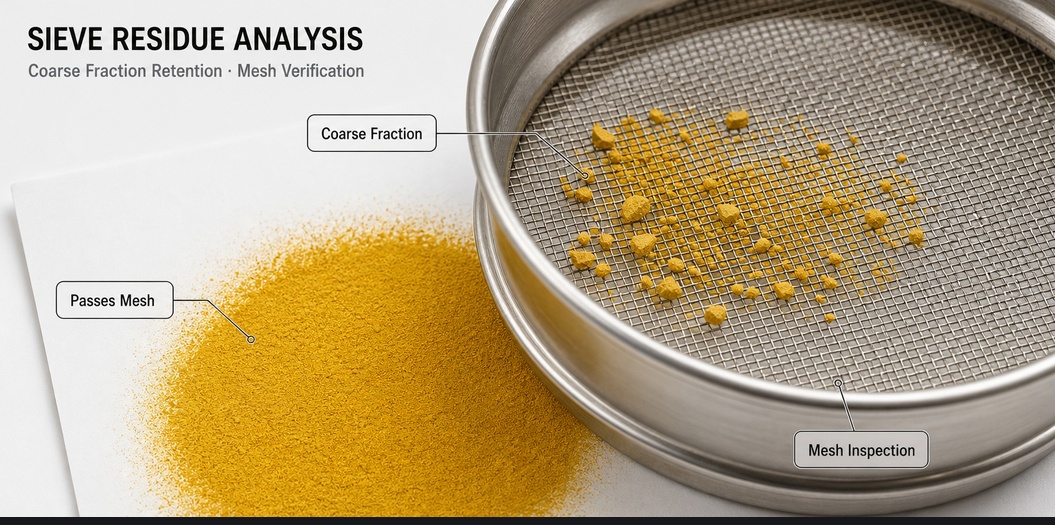
It is not. Residue on sieve is a crude but honest measure of how much of the lot is coarser than it should be, and coarse particles are the ones that survive mixing. A film with coarse pigment shows specks under a low-power microscope. A molded part shows them as a dull streak along the flow line. In a tint, the coarse fraction develops less color per gram, so the batch reads weak even when the certificate's iron content looks normal.
Sieve test results also move when a mill is wearing. A plant that has been running the same grinder for years will see residue creep upward before it sees anything else change, and it will show up on the certificate first if anyone is reading it.
Which brings up the mesh. Residue on sieve means nothing unless the sheet names the sieve, because 45 µm and 150 µm are different questions. If the certificate says "residue: 0.1%" and stops there, ask for the mesh. This is not pedantry. It is the difference between a dispersion problem and a paperwork problem.
Here is a conversation that happens most weeks somewhere in this trade.
The supplier's certificate says the lot is dry. Your lab says it is not. Both labs are competent. Both ran a test called moisture. The numbers differ by a margin that matters.
Nearly always, they ran different tests. One dried the sample at 105 °C to constant mass, which is what ISO 787-2 describes. The other put it on a halogen moisture balance set to 130 °C and read the display after five minutes, because that is fast and it is what the bench has. The second method drives off more than water, and it reports a number that is real and not comparable.
Neither lab is lying. The certificate just did not name the method, so nobody could tell that the two figures were answers to different questions.
The fix costs nothing. Require the method on the certificate. Then, when your lab checks a lot, run the same method. If you cannot run ISO 787-2 exactly, say so, and treat your own number as a trend rather than an absolute. A trend is still useful. It tells you a lot changed. It just cannot tell you the lot breached a limit.
A COA describes the powder that left the pigment plant. It is measured on a sample of that lot, under the plant's conditions, before anything happens to it.
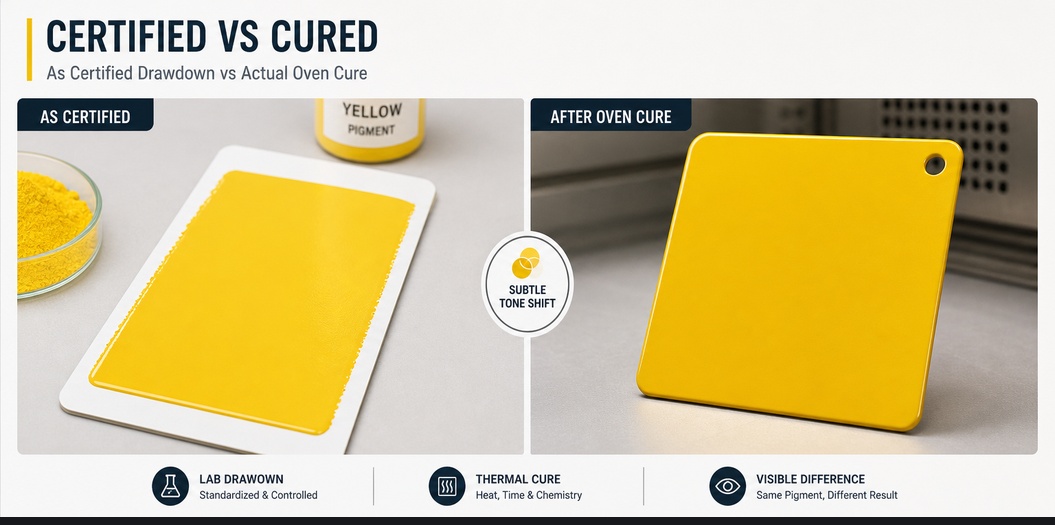
It cannot tell you how the pigment will disperse in your extruder, how it will read after your cure schedule, or how it will look on a wall in three years. Those are properties of your process as much as of the pigment. A powder coating line that under-extrudes will produce specks from a lot with perfect sieve residue, and an oven that overshoots will shift a yellow that arrived exactly on specification. The certificate was never covering that ground, and a buyer who assumes it does will spend a long time arguing with the wrong document.
For the process side there is a separate article on what the extruder and the oven do to iron oxide pigments. For the color side, the tolerance and measurement conditions belong in a written agreement rather than a certificate, and setting a ΔE tolerance you can enforce covers how to write one.
One more limit worth naming. A certificate is issued once. Material that sat in a warehouse for two years and picked up moisture is the same lot with a different history, and the COA in the folder still describes the day it was made. That gap is what storage and shelf life is about, and it is the reason a receiving check on arrival still earns its keep.
Say the certificate is clean and the batch still fails. What you do next decides whether you get a replacement or a month of email.
Do not start by sending a photo of the finished part. Start by preserving the evidence. Keep a sealed sample of the lot as received, labeled with the lot number and the date it arrived, and keep it unopened until somebody needs it. A sample that has been through the plant is not evidence of what arrived.
Then re-test on the methods named on the certificate, not on whatever your bench prefers. If you cannot match the method, say which one you used when you report the result. Suppliers get defensive when a claim arrives without a method, and they get cooperative when it arrives with one.
If the two sets of results still disagree, ask for the raw data behind the certificate, not a second copy of the summary. A lab that ran the test has the weighing and the drying times. A lab that copied a number from an earlier lot does not.
The last resort is a split sample to a third lab both sides accept. It is slow and it costs money, and it settles the question in a way that no amount of correspondence will.
None of this is adversarial if it is set up before the first dispute. 100% traceability in iron oxide quality control is the internal version of the same discipline, and it only works if the lot number on the bag matches the lot number on the sheet. Check that on arrival. It takes ten seconds and it is the one link in the chain that buyers can verify without any equipment at all.
A short set of clauses turns a COA from a formality into something you can act on.
None of those clauses cost a supplier anything except the effort of writing an honest certificate. That is also a useful filter. A supplier who resists clause two is telling you something about how the sheet is produced.
Hebei Tianhuibao Technology Co., Ltd. has manufactured iron oxide pigments for 26 years, with an annual production capacity of 50,000 tons, and supplies customers in 150+ countries and regions. The range covers the Iron Oxide Red Series (grades 110, 130 and 190, plus nano, ultra-fine and easy-dispersing types), the Iron Oxide Yellow Series (313 and 920), and the black and brown series, with custom packaging through Custom Services. Certifications held include REACH, RoHS, CE and ISO. Stock items ship in 3–5 working days; customized items in 7–15 working days. Minimum order is 1 ton (1,000 kg).
Every lot ships with a certificate that states the result, the limit it is measured against, and the method used, including the sieve mesh on the residue line. If you have a certificate from another supplier that you cannot interpret, send it over and we will tell you which lines are missing rather than which lines are wrong. Batch-to-batch data on volatile matter, water-soluble matter and tinting strength is available for any grade you are qualifying.
If you are rewriting a receiving specification, send the application, the grade and the limits you already work to. We will come back with the methods that match and a sample lot with its full certificate, so your first comparison is against a document you can actually audit.
Contact: [email protected] / +86-13400211655.
 Hot News
2026-10-10
2026-10-08
2026-09-17
2026-09-11
2026-09-10
2026-09-04
 EN