 ×
In short: Iron oxide survives a powder coating line better than most organic pigments, but the line still decides your final color. Three things matter more than the grade you buy: how well the pigment is dispersed in the extruder, whether your cure schedule sits above the point where yellow pigment starts to shift, and whether your gloss target leaves any room for pigment loading. Fix those three and the pigment stops being the variable. This article walks the process stage by stage and ends with the items worth writing into a purchase order.
Powder coating is a dry paint, applied as a powder and melted into a film. That sounds like a small difference from liquid paint. On the plant floor it changes almost everything about how a pigment behaves, because the pigment now has to survive being melted, squeezed, ground and baked rather than simply being stirred into a liquid and left to dry.
Iron oxide is a common choice here for good reasons. It is opaque, it is cheap per unit of hiding, and it holds its color through heat that would destroy many organic pigments. What it will not do is rescue a bad extrusion run or an oven that overshoots.
A powder coating line has five stages, and the pigment passes through all of them.
The pre-mix is a dry blend of resin, curing agent, filler, pigment and additives, tumbled together in a high-speed mixer. Nothing melts yet. This stage only has to get the pigment evenly distributed through the powder, and it is surprisingly easy to get wrong, because a pigment that is wetted by the resin will disperse later while a pigment that stays dry and clumped will not.
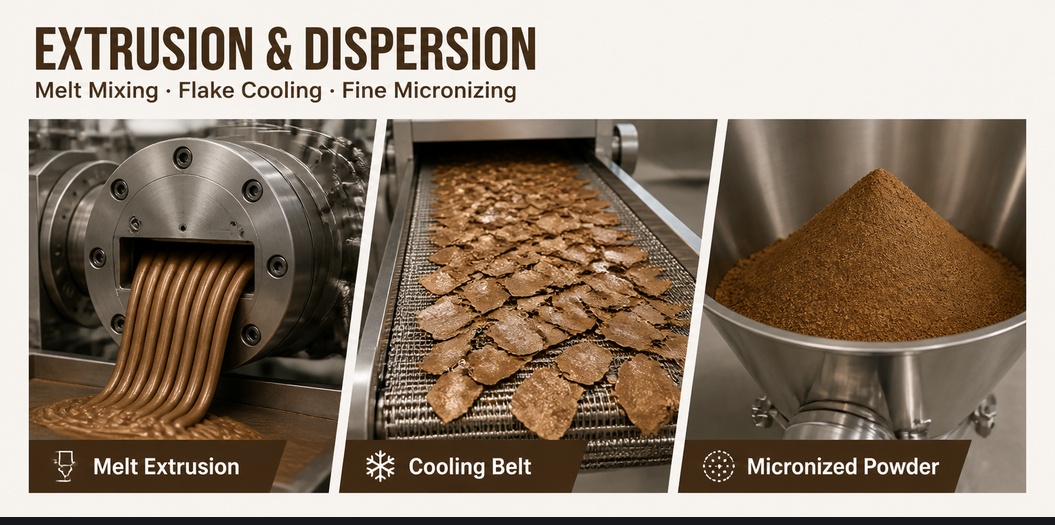
Next comes the extruder, a heated screw that melts the blend and works it into a viscous paste. This is where the pigment is actually broken down and wetted out. The material leaves as a hot ribbon, is cooled on a belt or a chill roll, and then goes to a mill that grinds it into powder of the target particle size.
Application is electrostatic. The powder is charged, sprayed at a grounded part, and held there by the charge until the part enters the oven. Inside the oven the powder melts, flows out, and the resin crosslinks into a hard film. That last step is the cure.
Every one of those stages can change the color you end up with. Only the first two are under your direct control on a day-to-day basis.
If a customer complains about specks, streaks or a drop in gloss, the answer is almost always in the extruder, not in the pigment bag.
An extruder has to do two jobs at once. It has to disperse the pigment into the melt, and it has to do so without degrading the resin or driving the cure reaction forward before the material ever reaches a part. Both jobs are limited by the same variables: barrel temperature, screw speed, feed rate and residence time. Push the screw harder to improve dispersion and you shorten the residence time; slow it down to give the pigment more time and you risk pre-curing the resin.
Iron oxide is abrasive. It is a hard mineral powder, and at high loading it wears screws and barrels faster than an organic pigment would. A plant that runs a lot of iron oxide tonnage should expect to inspect screws on a shorter interval than the OEM schedule suggests. Wear changes the shear profile, and a changed shear profile changes dispersion, which shows up months later as a batch that no longer matches the retained standard.
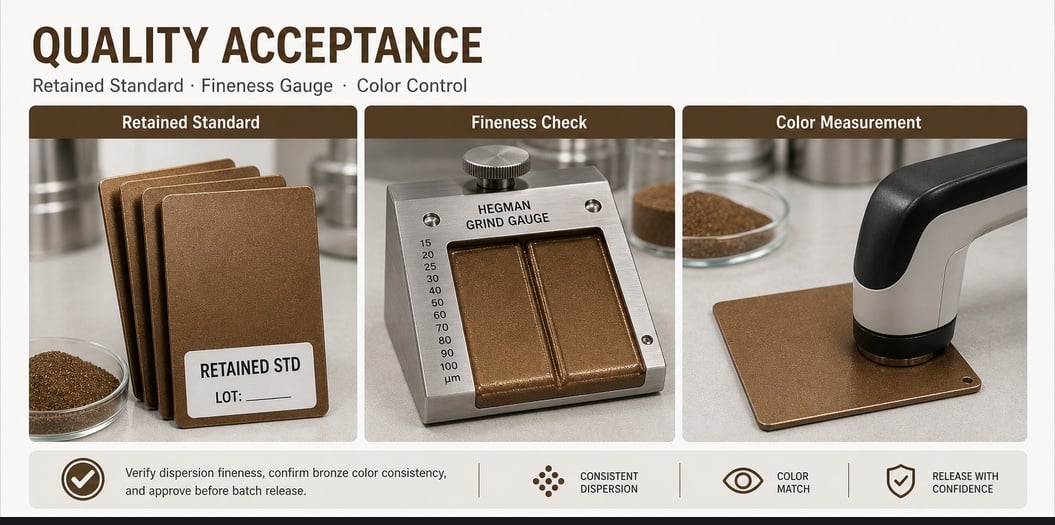
The practical check is a drawdown (a thin film spread on a panel for visual comparison) against a retained standard, made from the finished powder rather than from the pre-mix. If the drawdown shows specks under a low-power microscope, the extruder did not do its job and no amount of pigment inspection will explain it.
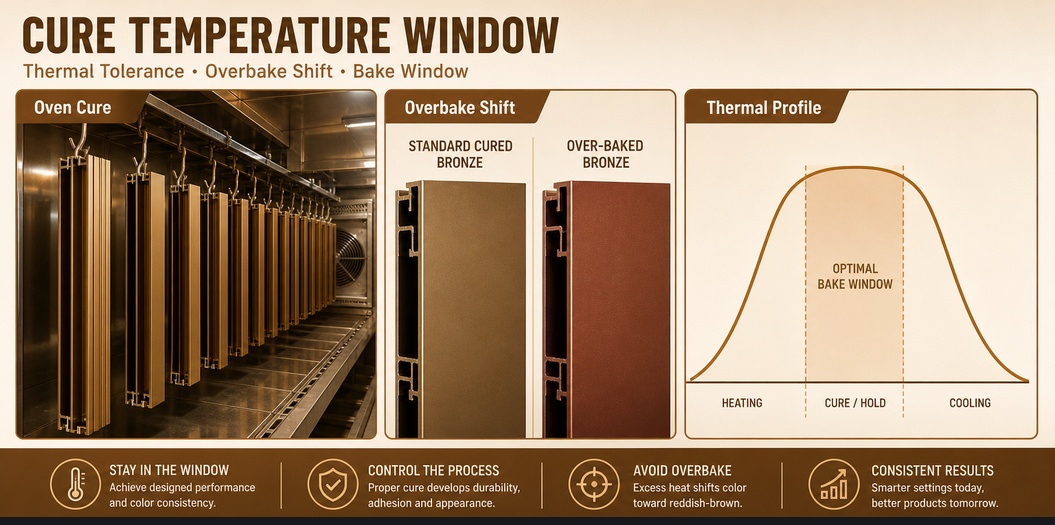
Most architectural powder systems cure somewhere around 180 °C to 200 °C, held for ten to twenty minutes depending on the chemistry. That window is comfortable for iron oxide red (Fe2O3) and iron oxide black (Fe3O4). Both are stable well past the cure temperature.
Iron oxide yellow (α-FeOOH, a hydrated iron oxide) is a different matter. It holds water in its crystal structure, and heat drives that water off. Past roughly 180 °C the change becomes significant and it does not reverse. The pigment shifts toward orange-red, and the shift is permanent. A yellow powder coating that looked right in the lab can come out of a production oven noticeably warmer than the approved panel, and the difference will be blamed on the pigment batch when it was the oven profile all along.
There are two honest ways out. One is to specify a heat-stable yellow grade, which costs more and should come with a stated temperature and time from the supplier rather than a vague claim of heat resistance. The other is to lower the cure temperature and extend the time, which only works if the resin system allows it.
This is also the reason reds and browns dominate architectural powder work. They are not more popular because architects prefer them. They are more popular because the oven is unforgiving and those colors do not care.
Opacity in a powder coating comes from the pigment loading. If a customer wants a solid color over a bright substrate, loading has to be high enough to hide what is underneath.
High loading has a price beyond the pigment invoice. Every extra percent of pigment displaces resin, and resin is what forms the continuous film that gives gloss and DOI (distinctness of image, which is how sharp a reflection looks rather than how bright it is). Push the loading up and the film can start to look flat even when the gloss meter still reads 30 units.
There is a second effect that catches people out. Iron oxide particles are hard and relatively coarse compared with an organic pigment. At high loading and poor dispersion they sit proud of the cured film and scatter light, which dulls appearance without changing the measured color. The panel passes a color check and fails a visual one.
If a job needs both high hiding and high DOI, the honest answer is usually a thinner color layer over a primer rather than a heavier single coat. That decision belongs in the coating design, not in the pigment specification.
Iron oxide has excellent lightfastness. It does not fade the way many organic pigments do, and that is why it turns up in exterior architectural work where the warranty runs for years.
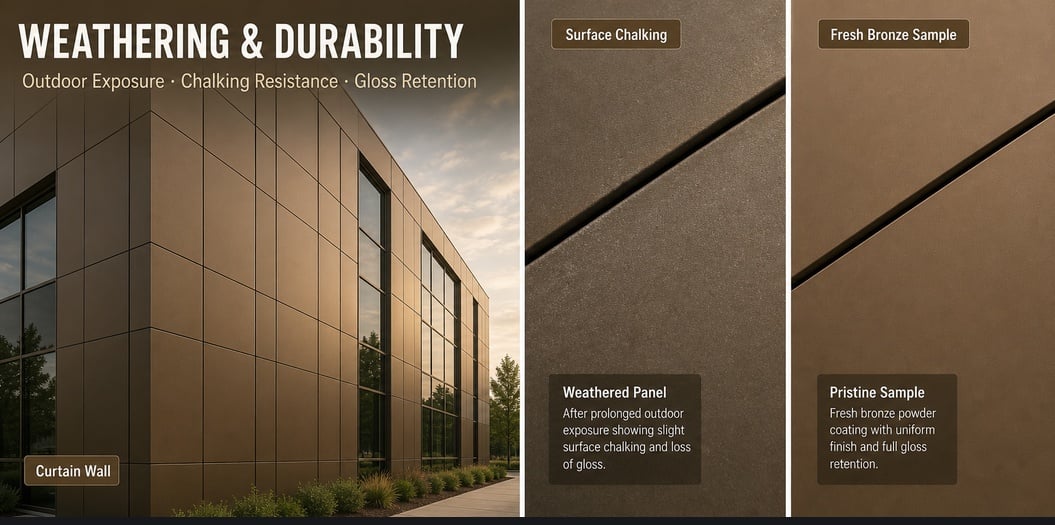
What it does not do is protect the binder. Ultraviolet light attacks the resin, and as the resin breaks down the surface develops chalking (a powdery layer that forms as the binder degrades). Chalking makes a coating look lighter and duller even though the pigment underneath is unchanged. In a pale color the effect is subtle. In a dark brown or bronze it reads as a washed-out, dusty surface and gets reported as color failure.
Architectural aluminum coatings are usually qualified against a published performance specification rather than against a supplier's data sheet. AAMA 2604 and AAMA 2605 are the two that matter most in that market, and both set out test and performance requirements for organic coatings on aluminum extrusions and panels. If your customer is quoting one of those, the pigment choice has to be made against the weathering tests in the specification, not against a general claim of UV resistance.
Most pigment disputes in powder coatings come from a purchase order that specified a color and nothing else. These are the items worth writing down.
| Item | Why it matters | How to check it |
|---|---|---|
| Color against a retained standard, not a name | "Bronze" means nothing across two companies | Sealed, dated panel held by both sides; measure under fixed conditions per ASTM D2244 |
| ΔE limit and the formula used | ΔE is one number hiding three directions, and different formulas give different numbers on the same pair | Named in the specification, agreed before the first lot |
| Tinting strength relative to standard | A weaker lot pushes up loading, which pushes down gloss | Drawdown comparison against the retained standard |
| Heat stability, with a stated temperature and time | The number that decides whether yellow is even an option | Supplier's figure for the specific grade, confirmed by a cure trial |
| Moisture content | Wet pigment pre-mixes badly and can cause pinholes in the cured film | Certificate of analysis per lot |
| Residue on sieve / particle size | Coarse particles show as specks and dull appearance | Certificate of analysis, plus a drawdown check |
| Lot traceability | Makes a repeat order reproducible or makes the change visible | Lot number on the bag and the certificate |
Two of these are worth separating. Color match of the delivered bag and color stability through your oven are different claims. A supplier can be perfectly inside tolerance on the first and still have the second fail, because the oven is doing something the pigment data sheet never covered.
Three mistakes come up again and again, and none of them are about the pigment grade.
The first is approving a color from a sprayed laboratory panel and then running production on a different line with a different oven. The lab oven and the production oven do not have the same thermal profile, and a yellow that passed in the lab can fail on the line.
The second is chasing a color problem by changing pigment supplier. If the retained standard was never sealed, there is nothing to compare against, so the new supplier gets measured against a memory and the argument restarts.
The third is accepting a certificate of analysis as proof of dispersion. The certificate describes the powder that left the pigment plant. It says nothing about what your extruder did with it.
None of this requires new equipment. It requires a sealed standard, a written ΔE limit, a cure trial that uses the real oven, and a drawdown check on every batch. A plant that does those four things rarely has a color argument that lasts more than a day.
Hebei Tianhuibao Technology Co., Ltd. has manufactured iron oxide pigments for 26 years, with an annual production capacity of 50,000 tons, and supplies customers in 150+ countries and regions. The range covers the Iron Oxide Red Series (including grades 110, 130 and 190, plus nano, ultra-fine, easy-dispersing and acid- and alkali-resistant grades), the Iron Oxide Yellow Series (313 and 920 grades), the black and brown series, with factory-direct color matching, particle size adjustment and packaging customisation through Custom Services. Certifications held include REACH, RoHS, CE and ISO. Stock items ship in 3–5 working days; customised items in 7–15 working days. Minimum order is 1 ton (1,000 kg). Color data, including ΔE against a retained standard, is available on request, and cure-temperature guidance is given per grade rather than as a blanket claim.
If you are qualifying a pigment for a powder coating line, send the cure schedule, the resin system, the gloss target and the color you need to hit. We will tell you which grade fits that window and which one will not, and send a sample against your retained standard.
Contact: [email protected] / +86-13400211655.
 Hot News
2026-10-10
2026-10-08
2026-09-17
2026-09-11
2026-09-10
2026-09-04
 EN