EN
EN




Low Oil Absorption Iron Oxide Yellow Pigment Prevents Cracking in Concrete
When you source an iron oxide yellow pigment for concrete or cement tile production, the first number most buyers check is tinting strength. That makes sense — color intensity is visible, testable, and easy to compare across iron oxide yellow pigment suppliers. But the oil absorption value of your iron oxide yellow pigment often determines whether your finished concrete stays intact or develops surface cracks over time, and it is rarely discussed in the first round of supplier conversations.
Working with concrete producers and tile manufacturers across multiple markets, I've seen this pattern repeat. A producer picks a high-tinting-strength iron oxide yellow pigment, gets good color in the trial batch, then spots hairline cracks in cured tiles three or four weeks later. The root cause is usually not the cement blend or curing conditions — it's the extra water demand the iron oxide yellow pigment brought into the mix.
What Oil Absorption Measures in Iron Oxide Yellow Pigment
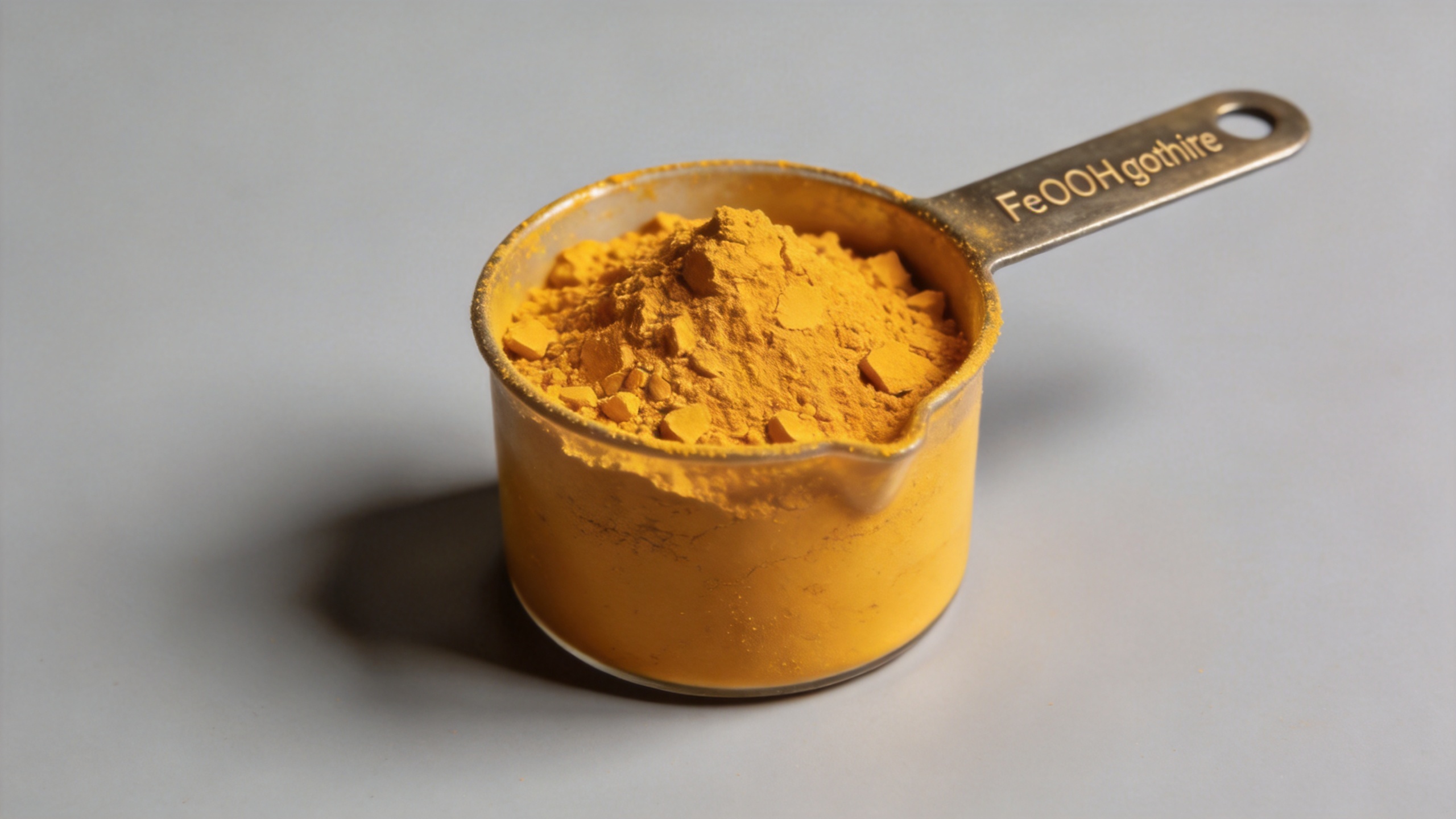
Oil absorption value (OA) is measured in grams of linseed oil required to wet 100 grams of iron oxide yellow pigment — expressed as g/100g. For iron oxide yellow pigment (C.I. Pigment Yellow 42, chemical formula FeOOH, also known as goethite), standard commercial grades typically register between 25 and 40 g/100g. Low oil absorption iron oxide yellow pigment, produced with tighter crystal morphology control, achieves values in the 18–28 g/100g range.
That difference is larger than it first appears. In a cement system, the oil absorption of iron oxide yellow pigment correlates directly with water demand. An iron oxide yellow pigment with high oil absorption binds more free liquid to wet its particle surfaces. When you're coloring concrete or cement mortar with iron oxide yellow pigment, that means either adding more water to maintain workability — which raises the water-cement ratio — or accepting a stiffer, harder-to-compact mix.
How Iron Oxide Yellow Pigment Oil Absorption Causes Concrete Cracking
Concrete cracking during and after curing is primarily driven by two mechanisms: shrinkage stress and tensile strength mismatch. Both are worsened by elevated water-cement (w/c) ratios. Standard practice in concrete technology is to keep w/c at or below 0.45 for structural applications; for decorative concrete tiles, staying below 0.50 significantly reduces shrinkage cracking risk.
When a high oil absorption iron oxide yellow pigment forces additional water into the mix, the effective w/c ratio climbs. That extra water creates larger capillary pores during hydration. As the concrete dries, shrinkage stresses build at weak points — near aggregate interfaces and surface layers especially. The hairline cracks that result are familiar to concrete producers, though the iron oxide yellow pigment rarely gets identified as the starting point.
Low oil absorption iron oxide yellow pigment breaks this chain. Requiring less free water to achieve adequate particle wetting and dispersion, it lets formulators hold target w/c ratios without compromising workability. Color quality is equivalent — and sometimes better, since low oil absorption iron oxide yellow pigment often pairs with finer particle size distribution and more even dispersion through the cement matrix.
Technical Parameters to Request for Iron Oxide Yellow Pigment
When evaluating iron oxide yellow pigment suppliers for concrete coloring, the following parameters should appear on any serious technical data sheet (TDS):
- Oil absorption value of the iron oxide yellow pigment: Request the specific g/100g figure measured by ISO 787-5 or equivalent. For concrete, target below 30 g/100g; for thin-section tiles, below 25 g/100g is preferable.
- Particle size (D50 and D90): Finer iron oxide yellow pigment particles generally provide better color distribution in cement. Ask for both values.
- pH value: Iron oxide yellow pigment should be near-neutral to slightly alkaline (pH 6–8) for cement matrix compatibility. Acidic iron oxide yellow pigment can interfere with cement hydration.
- Water-soluble salt content: High soluble salt content in iron oxide yellow pigment can contribute to efflorescence and surface weakening. EN 12878:2014 sets limits for iron oxide yellow pigment used in concrete and mortar coloring.
- Tinting strength: High tinting strength in an iron oxide yellow pigment reduces the dosage needed, which proportionally reduces the water demand impact from iron oxide yellow pigment oil absorption.
It's also worth clarifying that low oil absorption and high tinting strength don't necessarily trade off against each other in iron oxide yellow pigment. Modern precipitation-controlled manufacturing makes it possible to produce an iron oxide yellow pigment that achieves both. You need less iron oxide yellow pigment to hit your color target, and the iron oxide yellow pigment you do use adds minimal water demand to the concrete system.
Dosage and Mix Design with Iron Oxide Yellow Pigment
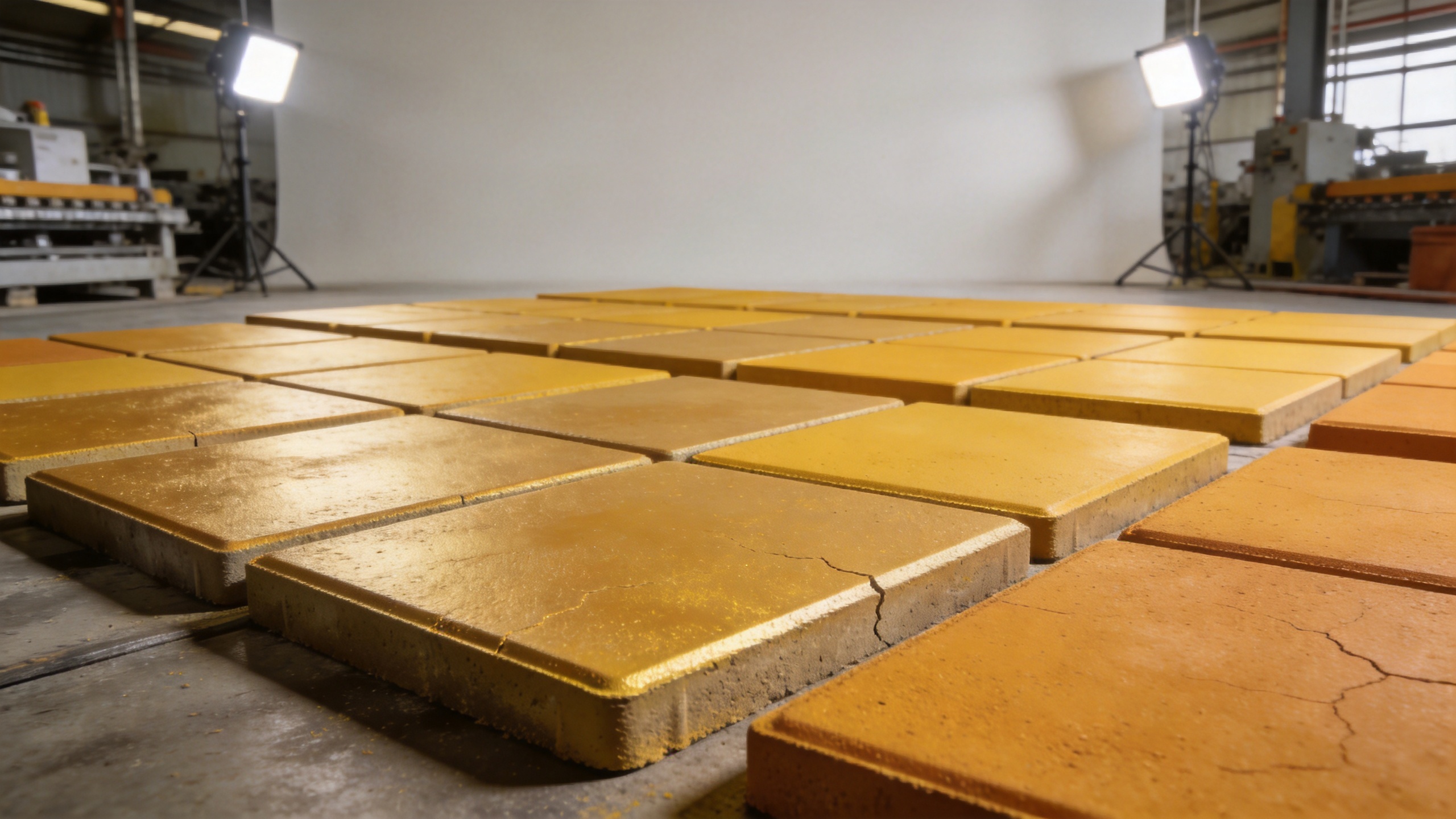
For concrete coloring applications, iron oxide yellow pigment dosage typically runs from 1% to 5% by weight of cement, depending on target color depth. At the upper end of that range — say 4–5% for deep golden or ochre tones — the difference between a 40 g/100g OA iron oxide yellow pigment and a 22 g/100g OA iron oxide yellow pigment becomes significant in mix water demand.
Take a concrete tile mix using 400 kg/m³ of cement. At 4% iron oxide yellow pigment dosage, that's 16 kg per cubic meter. A high oil absorption iron oxide yellow pigment at 38 g/100g demands about 6.1 kg of liquid to wet its surfaces. Switch to a low oil absorption iron oxide yellow pigment at 22 g/100g, and that same 16 kg of iron oxide yellow pigment demands roughly 3.5 kg — cutting approximately 2.6 kg of water per cubic meter of concrete. For high-volume tile producers, the difference between high and low oil absorption iron oxide yellow pigment accumulates across production runs and can measurably reduce rejection rates from cracking defects.
Certifications for Iron Oxide Yellow Pigment in Concrete
For Europe-bound production or customers who export there, EN 12878:2014 ("Pigments for the colouring of building materials based on cement and/or lime") is the applicable standard for iron oxide yellow pigment. It covers alkali resistance, soluble salt limits, and color consistency for concrete coloring iron oxide yellow pigment applications. An iron oxide yellow pigment that meets EN 12878 has been tested against the demanding alkaline chemistry of cement systems.
REACH compliance matters separately for B2B iron oxide yellow pigment exports to the EU. Iron oxide yellow pigment is generally a low-hazard inorganic material, but a complete REACH-compliant safety data sheet (SDS) should be available from any iron oxide yellow pigment supplier you're qualifying. This documentation is not optional if you're importing iron oxide yellow pigment into Europe.
At Hebei Tianhuibao Technology, our iron oxide yellow pigment for concrete applications carries both REACH and CE certifications, and our technical data sheets include explicit oil absorption values measured per ISO 787-5. We produce iron oxide yellow pigment at 50,000 tons annual capacity and export to over 150 countries. Browse our iron oxide yellow pigment product range to compare grades by application and technical specification.
Supplier Evaluation Questions for Iron Oxide Yellow Pigment
Moving from sample testing to full supplier qualification for iron oxide yellow pigment in concrete, a few direct questions separate technically capable iron oxide yellow pigment suppliers from general commodity traders:
- What is the oil absorption value of this iron oxide yellow pigment grade, and what test method do you use? An iron oxide yellow pigment supplier who gives only a wide range without grade differentiation is likely not controlling this parameter systematically.
- What is the batch-to-batch oil absorption variation for your iron oxide yellow pigment? Even a low average OA value causes problems if individual iron oxide yellow pigment batches vary widely. Ask for the control tolerance.
- Can you provide concrete trial results comparing your low oil absorption iron oxide yellow pigment against a standard grade? A technically capable iron oxide yellow pigment supplier should have application test data, not just pigment lab numbers.
- What is the minimum order quantity for iron oxide yellow pigment? For qualification testing, ordering a small trial quantity — such as 25 kg of iron oxide yellow pigment — lets you run mix design trials before committing to production volumes.
Treating iron oxide yellow pigment as a functional concrete ingredient rather than just a colorant is one of the more practical changes a concrete or tile producer can make to their sourcing approach. Low oil absorption iron oxide yellow pigment is the right specification for applications where cracking performance matters alongside color performance.
Summary: Iron Oxide Yellow Pigment Oil Absorption and Cracking
Oil absorption value is the most commonly overlooked property of iron oxide yellow pigment for concrete coloring. It directly influences mix water demand, effective water-cement ratio, and shrinkage cracking behavior in finished concrete and cement tiles. Low oil absorption iron oxide yellow pigment (below 30 g/100g) reduces the water penalty of pigment addition, allowing formulators to maintain target w/c ratios without giving up workability or color depth. When sourcing iron oxide yellow pigment for concrete, request explicit OA values on the TDS, verify EN 12878:2014 compliance for European markets, and evaluate dosage-adjusted water demand — not just tinting strength — as a key selection criterion for iron oxide yellow pigment.
 Hot News