 ×
In short: A pigment trial is an experiment, and most of them fail as experiments before anyone looks at a color card. Ask for a sealed sample from the lot you will actually buy, change one variable at a time, and measure four things: color difference, tinting strength, fineness of grind, and how the batch behaves in your mixer. Size the trial to the decision you have to make. A drawdown answers a color question. Only a production run answers a process question.
Most plants call it a trial when what they mean is "we got a sample and it looked fine." That is not a trial. It is a first impression, and first impressions are exactly what a supplier's best-dressed sample is designed to produce.
What follows is the version that survives contact with a real batch plant.
Start by writing down the question. Every trial answers one of three, and they need different work.
Does this pigment match the color I am already running? That is a lab question, answered with drawdowns against a retained standard.
Can my process disperse it at the loading I want? That is a mixer question, and a lab will not answer it for you.
Will a full shift run at the same rate, the same temperature, the same scrap level? That is a production question, and no sample will answer it either.
Pick one. Plants that try to answer all three from a 1 kg bag end up with a color card, a vague feeling, and no decision.
The question also decides who runs the trial. A color question belongs to whoever owns the shade standard. A dispersion question belongs to the mill or the mixer operator, not to purchasing. If purchasing runs the whole thing, you will get a price comparison wearing a lab coat.
Here is where most trials quietly go wrong, before a single gram is weighed. You ask for a sample, you get a sample, and the sample is not from the lot you will be buying. It came off a bench, or from a retained bag of last year's production, or from a batch the plant made specially because someone asked nicely.
Ask for three things in the same email.
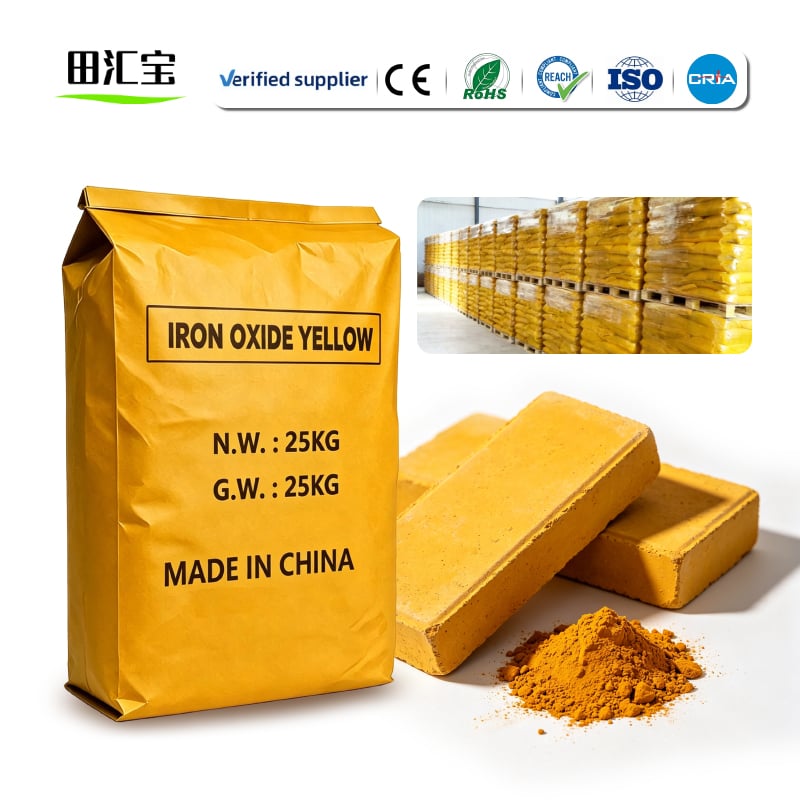
A sealed sample drawn from the production lot that the quotation refers to, with the lot number written on the bag by hand and on the label. A certificate of analysis (the lot-specific test report) for that same lot, not a generic specification sheet. And the packing date, because a bag that has been open in a warehouse for a year tells you about that warehouse.
Then check the sample against the paperwork before you use it. Same lot number. Sealed. Weight close to what was declared. If the bag arrives open, or the lot number on the bag does not appear on the certificate, stop there. You are about to spend two weeks testing something that will never ship to you.
One more request that costs the supplier nothing and saves you an argument later: ask them to keep a retention sample of that same lot. If your results and their results disagree in six weeks, that sealed bag is the only thing that can settle it.
Sample size is not a courtesy. It is the resolution of your answer.
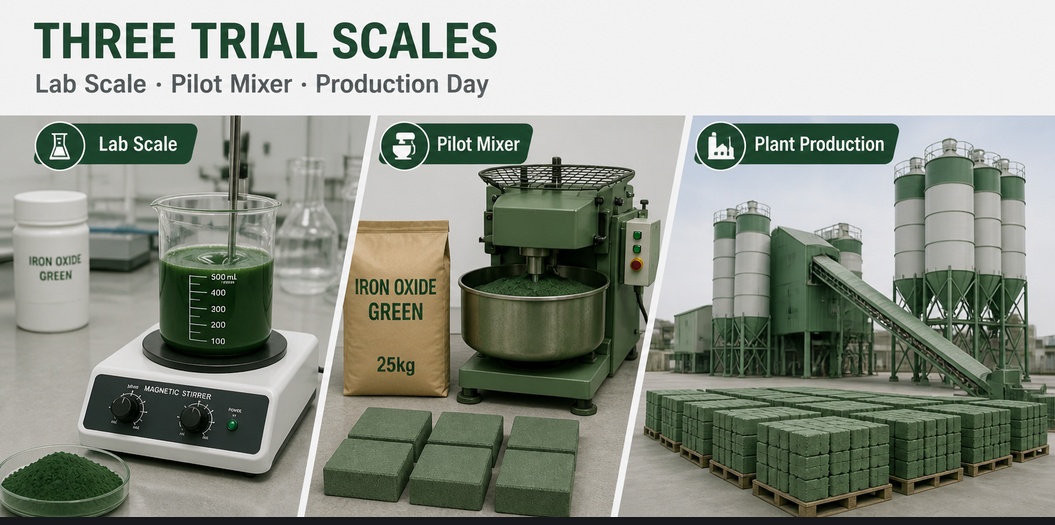
A few hundred grams is enough to pull drawdowns and check shade against a standard. It is not enough to run a mixer, and it will not show you whether the pigment disperses at your loading.
A single 25 kg bag gets you a pilot batch on your own equipment. That is the first point where dispersion, mix time and batch temperature become visible. It is also the first point where a bad lot starts costing you real money instead of lab time.
A full ton, which is the smallest order we ship, is a production day. That is the only scale that answers throughput, scrap and operator acceptance. It is also the only scale where a moisture or caking problem shows up the way it will show up for the next two years.
| Scale | What you need | What it answers | What it cannot answer |
|---|---|---|---|
| Lab drawdown | A few hundred grams, sealed, from the offered lot | Shade against your standard, tinting strength, coarse particles | Dispersion in your equipment, mix time, throughput |
| Pilot batch | One 25 kg bag | Dispersion at your loading, viscosity, batch temperature, operator opinion | Shift-level throughput, scrap rate, long-run consistency |
| Production day | 1 ton (1,000 kg), the minimum order | Throughput, scrap, rework, real consumption per batch | Nothing about the next lot, which is why you keep testing |
The table has an uncomfortable implication. If your decision is worth a production day, a lab drawdown is not evidence, it is a formality. Plenty of purchasing decisions get approved on that formality and then get unwound three months later at the mixer.
The most common trial design in the industry is to change everything and then argue about the result.
New pigment, new loading, new dispersant, new operator, new cure schedule. Something comes out wrong and nobody can say which of five changes did it. You have spent the money and learned nothing you can act on.
Run the candidate against a control, in the same session, with the same operator, the same water, the same substrate and the same cure. Keep the loading identical in the first pass even if the new pigment is cheaper at a higher loading. You are testing whether the pigment behaves, not whether the formulation can be squeezed.
Then, and only then, run a second pass where you change the loading. Two passes, one variable each. That is slower on paper and much faster in practice, because a failed second pass still leaves you with a usable first result.
Write the recipe down before you start. Not after. A trial without a written recipe is a memory exercise, and memories get flattering.
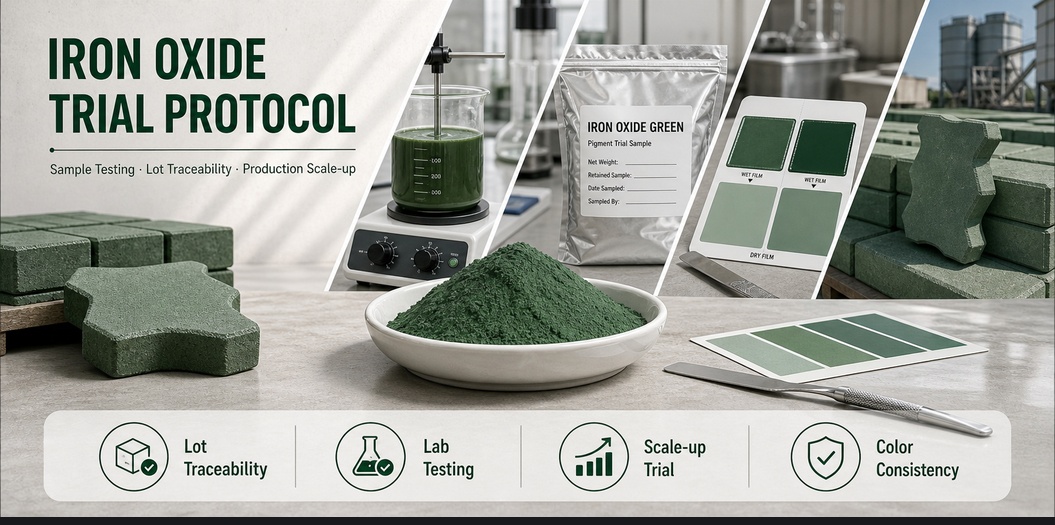
Four measurements cover almost every pigment decision. None of them require a research budget.
Color difference is the first. Pull a drawdown of the candidate next to a drawdown of your retained standard, let both dry, and measure. The number you want is ΔE (the calculated color difference between two samples), read under a specified illuminant and reported with the method, usually ASTM D2244. Under 1 is generally a match, though where your line draws the line is your call, not the pigment supplier's.
Tinting strength is the second. Weigh the same mass of each pigment into the same let-down (the pigmented paste reduced to a working tint) and compare. A weak lot costs you money at the mixer even when the price per ton looks good, because you feed more of it to hit the same depth.
Fineness of grind is the third, and it is the one buyers skip. A Hegman gauge (a tapered groove that reveals the largest undispersed particles) gives you a number in micrometers, run to ISO 1524 or ASTM D1210 depending on which your lab uses. Coarse particles show up as specks in a thin film and as a scratch in a coating. They also eat tinting strength.
Process behavior is the fourth, and it does not fit on a certificate. Record mix time to a clean dispersion, batch temperature rise, and whether the operator had to add anything to make it work. That last column is the one that decides adoption, and it is the one nobody writes down.
Four failure modes account for most of the disappointments I hear about.
The sample was not from the offered lot. Covered above, and still the most common.
The comparison was against a remembered standard rather than a physical one. A standard that lives in someone's head drifts. Keep a sealed drawdown, dated, and compare against that.
The trial ran in the wrong system. A pigment that behaves in a solvent-borne lab mill tells you very little about a cement mortar mixed in a paddle mixer at the yard. Test in the system you actually sell.
The operator was not told it was a trial. If the person running the batch thinks this is normal production, they will fix problems silently, add a little dispersant, extend the mix, and hand you a good result that will not repeat. Tell them. Ask them what they had to do differently. Their answer is often the most valuable data in the whole exercise.
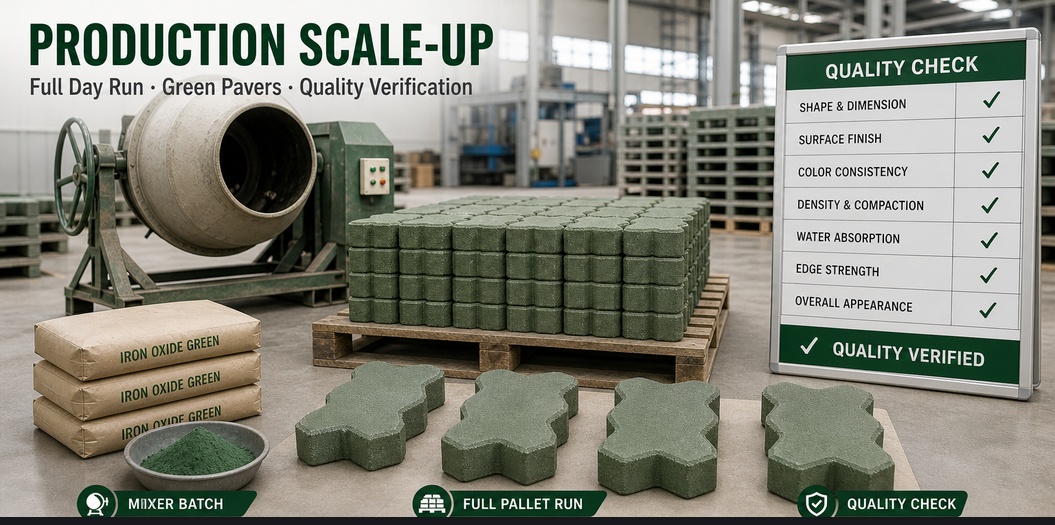
Scale-up is where a good lab result meets a real constraint.
The things that change between a pilot batch and a production day are rarely chemical. Mix time per kilo drops because a bigger mixer shears harder. Batch temperature rises because there is more mass and less surface. Dosing shifts from a balance to a feeder, and feeders are less accurate than balances. Consumption per batch becomes measurable, and it is usually higher than the lab predicted.
The ton itself arrives with its own risks, and we wrote about those separately in iron oxide pigment transit damage.
Watch three things on the production day. Whether the dispersion reaches the same fineness in the time your line allows. Whether the shade holds at the end of the shift, not just the first batch. And whether anyone on the floor quietly went back to the old pigment for the second half of the run.
If the answer to any of those is bad, you have learned something worth the ton. That is the point of spending it.
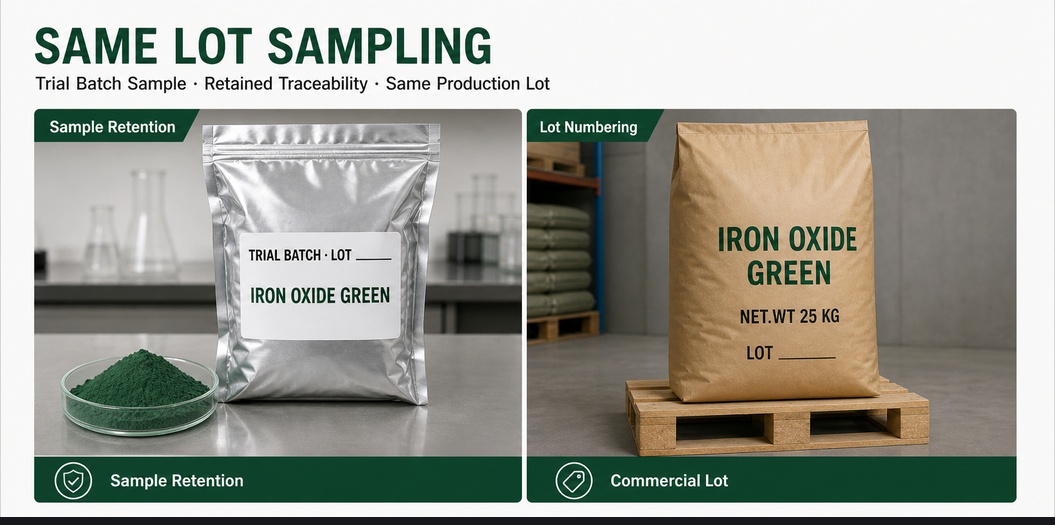
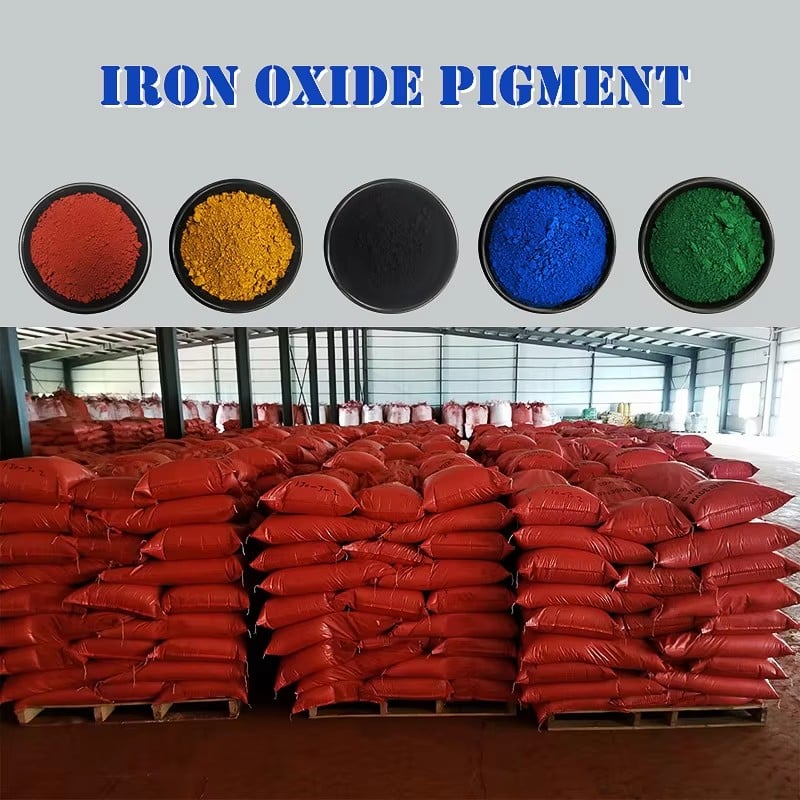
Hebei Tianhuibao Technology Co., Ltd. has manufactured iron oxide pigments for 26 years, producing red (Fe2O3), yellow (α-FeOOH), black (Fe3O4), brown, and composite green and blue grades for concrete, mortar, asphalt, coatings, plastics and rubber. Our minimum order is 1 ton (1,000 kg), and trial quantities can be drawn from the same production lot that the quotation refers to, with the lot number and certificate of analysis supplied together.
Tell us the system you are running and what you need the trial to answer, and we will quote against that question rather than sending a bag and wishing you luck. Send your shade standard and your current consumption per batch, and we can tell you before you test whether the gap is a pigment problem or a formulation one.
Email us with your requirement and the specification you work to. We answer technical questions with the test method attached.
 Hot News
2026-10-10
2026-10-08
2026-09-17
2026-09-11
2026-09-10
2026-09-04
 EN