 ×
In short: Most pigment damage is settled in the first five minutes at your dock, before the driver leaves, and the paperwork you sign in that window decides who pays. Count the pallets, photograph every torn bag before anyone moves it, write the damage onto the delivery receipt, and keep a sealed sample from the damaged pallet. Do that and a claim stays a conversation. Skip it and you own the loss.
A bag of iron oxide arrives torn for boring reasons. The seam was weak. A pallet board underneath had a splinter. The forklift came in at an angle and caught the gusset. Or the stack sat one layer too high and the bottom bags carried load they were never specified to carry. None of that is mysterious, and none of it gets fixed by asking the supplier to pack better next time.
What follows is what actually fails between the plant gate and your silo, how to catch it while the truck is still in your yard, and what a claim needs if you have to file one.
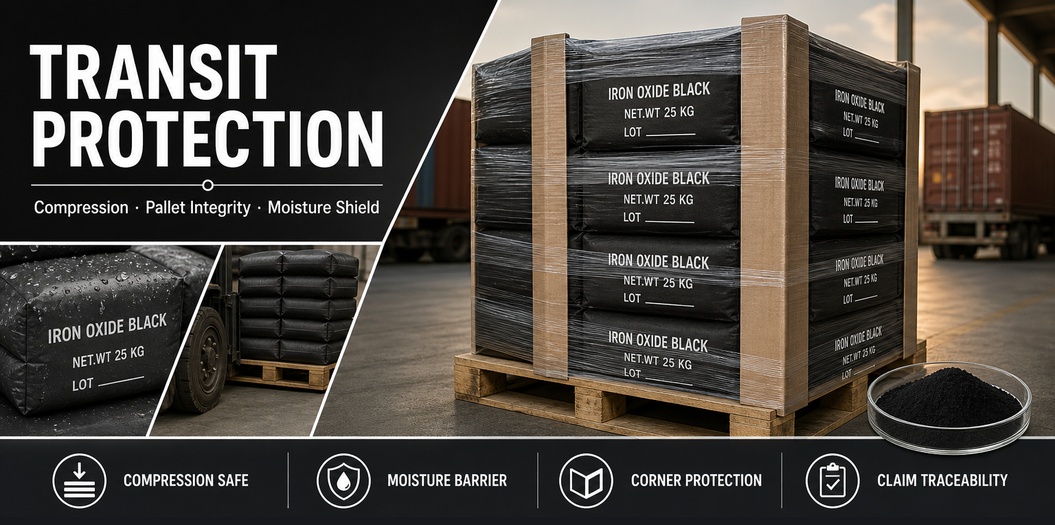
A 25 kg bag of pigment is a flexible container full of powder. Stack enough of them and the bottom layer stops behaving like a bag and starts behaving like a hydraulic press. The powder inside consolidates, the woven fabric takes a permanent set, and the seam at the gusset carries a load it was not sewn for.
You see the result as a bag that looks fine on the outside and feels like a brick when you pick it up. Cut it open and the pigment comes out in chunks, or does not come out at all until someone hits it with a mallet.
This is worse in a sea container than in a warehouse, for a simple reason. A container is a rigid box that transmits every roll and every brake event straight into the stack. Road vibration at the bottom of a nine-high pallet stack does work that nothing in the warehouse does.
The fix is unglamorous. Cap the stack height, put the heaviest pallets at the bottom, and stop treating the container roof as free storage.
Three places, in my experience of unloading these things.
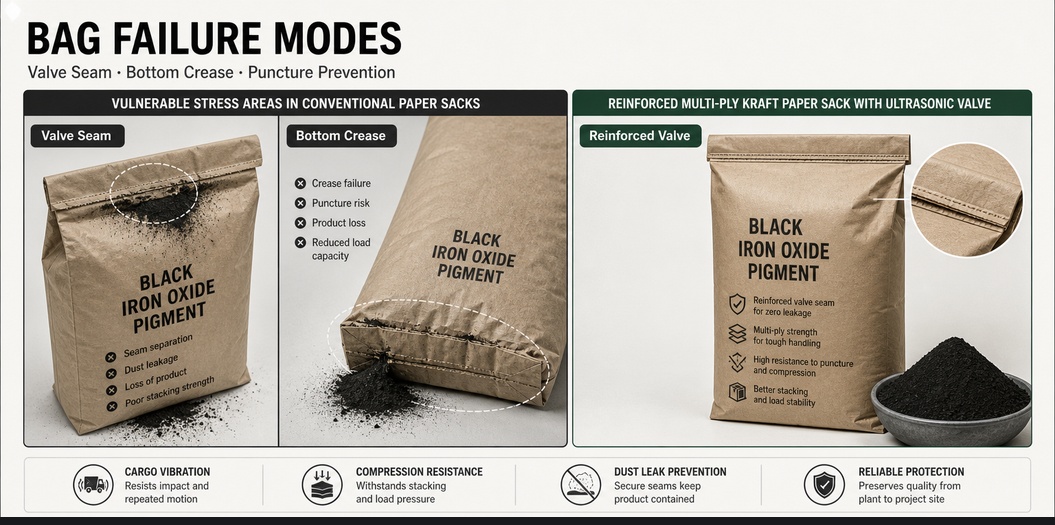
The seam. A woven polypropylene bag (the standard industrial sack, usually with a laminated liner inside) is sewn, not glued. Seam strength depends on thread, stitch density and tension. When a seam fails, it usually fails along a run rather than at one point, and it opens slowly enough that the bag passes inspection at the plant and lets go in the container.
The gusset. The gusset (the folded side panel that lets the bag stand square) is where forklift tines and pallet corners meet the fabric. A tine that goes in high tears the gusset and nothing else. The bag still stands, so nobody notices until the powder starts running on the floor.
The fabric itself. UV exposure on a dock weakens polypropylene. Abrasion from a rough pallet deck scuffs it thin. Neither shows as a hole until the bag is under load again.
None of these are pigment problems. They are packing and handling problems, and they get solved on the packing line, not in the warehouse.
| What you find | Where it usually starts | Cheap prevention |
|---|---|---|
| Bag torn along the side seam | Weak seam, or a stack that exceeded what the seam could hold | Specify seam strength and stitch density, cap the stack height |
| Bag punctured at the gusset | Forklift tine entering high and at an angle | Mark the fork pocket on the pallet, train the unload crew |
| Bottom layer crushed flat | Too many layers above, or double stacking pallets | Single-stack in the container, put heavier grades at the bottom |
| Fine powder coating every bag on the pallet | One bag leaked early and the container vibrated it into everything | Wrap pallets, inspect the top layer first |
| Wet patches on the top layer only | Moisture condensing on the container roof, not a leak in the bag | Container floor and roof protection, and a dry container |
| Pallet deck broken under the load | Deck boards too thin for the load, or a bad repair | Specify deck board thickness and refuse patched pallets |
| Bags caked solid but intact | Compression plus moisture pick-up over a long transit | Shorter transit, sealed liner, do not re-stack heavy on top |
One note on that last row. A bag that looks perfect and pours like gravel has still cost you money at the mixer, and it will not show up in a photo. That is why the dock check has to include a squeeze test on a sample bag from each pallet, not just a visual pass.
The driver wants to leave. Your receiving clerk has three other trucks. This is exactly the moment when the loss gets transferred to you, permanently.
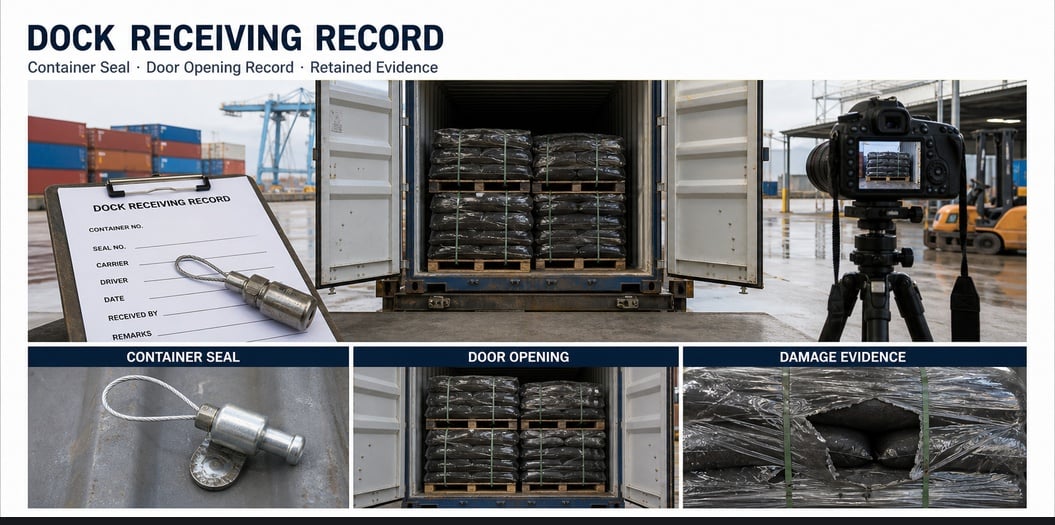
Do these five things before signing anything.
If the damage is severe, the honest options are to refuse the affected pallet or accept it under protest in writing. Accepting under protest keeps production running while preserving the claim. Refusing is cleaner legally and worse commercially, and which one you pick depends on whether you have three weeks of stock or three days.
This is the part buyers get wrong most often, and it has nothing to do with how the container was packed.
Under Incoterms 2020 (the ICC trade rules that define where cost and risk pass between buyer and seller), the term you agreed decides the moment risk moves. Under CIF, the seller pays the freight to your port, which feels like the seller is responsible until the container is on your dock. It is not. Risk passes when the goods are loaded on board at origin. If six bags burst somewhere in the Indian Ocean, the loss is already yours, and the seller's obligation was to arrange the minimum cargo cover the rules require, which is narrower than most buyers assume.
Under FOB, the same thing applies one step earlier in some respects: risk moves when the goods are on board, and you are paying the freight.
So the first thing to do with any damage claim is not to phone the supplier. Read the term and the named place on the contract, then work out whether you are claiming against the carrier, the insurer, or nobody at all. Getting this wrong is how buyers spend two weeks writing emails to a supplier who owes them nothing.
Carriers and insurers pay on documents, in this order of importance.
The delivery receipt with your notation on it. Photographs taken before the pallet moved, showing the tear and the floor. The packing list and the bill of lading so the count can be reconciled. The lot number from the bag, matched against the certificate of analysis for that lot. A weight check if the loss is partial, because "some powder spilled" is not a number and a claim needs one.
One more item that nobody thinks of until it is too late: the container or trailer seal number, photographed intact before you cut it. If the seal was already broken or the number does not match the documents, that single photo changes the shape of the claim.
Two practical notes. Get the container number and the seal into the same frame as the damage, because a photo of a torn bag with nothing else in shot could have been taken anywhere. And file early. Carriers and their agents work to notification windows measured in days from delivery, not weeks, and a well documented claim filed late is still a late claim.
Then decide who is actually filing. On a CIF shipment the insured party is usually the buyer, even though the seller arranged the cover. The claim goes through your insurer, not your supplier's.
If you buy enough pigment to have this conversation, put it in the purchase order rather than in an email thread.
For 25 kg bags, specify the fabric weight and the seam construction, ask for an inner liner on hygroscopic or heat-sensitive grades, and require the lot number printed on the bag rather than on a label that falls off in the rain. For FIBCs (flexible intermediate bulk containers, the big woven bags used from about 1 ton upward), specify the liner, the discharge spout type, and the lift loop configuration, because a crane hook in the wrong loop is a one-ton mess.
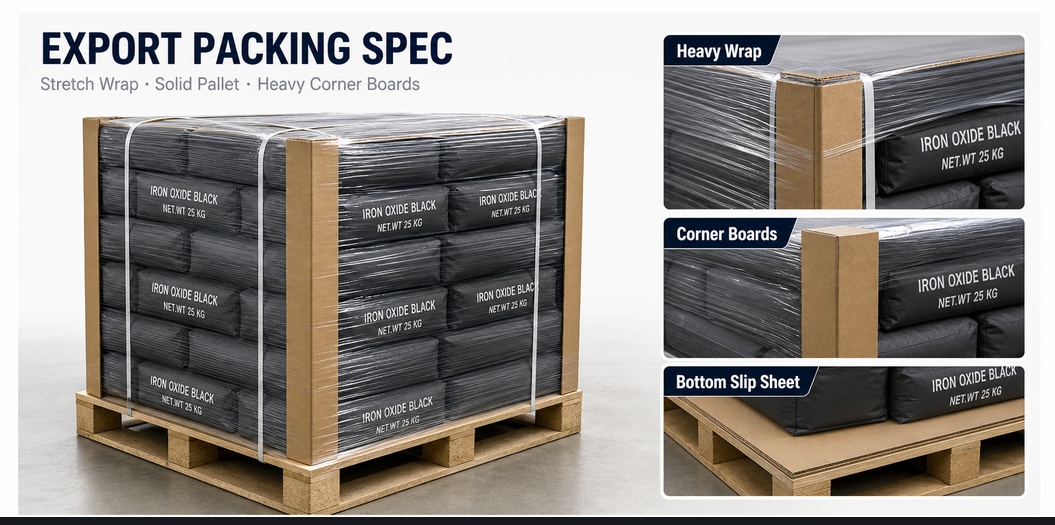
On the pallet, ask for edge boards, and ask for the pallet to be marked with its own weight. Both cost almost nothing and both prevent the two failures I see most: gusset tears from fork tines and crushed bottom layers from optimistic stacking.
Then ask one question that separates a supplier who ships a lot from one who ships occasionally: what do you do about the container floor? A dry container with a moisture barrier on the floor behaves differently from one loaded wet, and the difference shows up three weeks later as caked pigment on the bottom layer. We wrote about that mechanism separately in iron oxide pigment shelf life, because it is a storage problem as much as a shipping one.
If you want the receiving side in more detail, the certificate article covers how to read a COA and why a lot number on the bag matters more than the print quality of the paperwork.
A torn bag is a small loss. A torn bag that nobody documented is a small loss plus an argument, and the argument usually costs more in staff time than the pigment did.
The plant that handles this well is not the one with the best packaging. It is the one where the receiving clerk has a phone, a marker and permission to hold a truck for ten minutes. That is the whole system.
There is a second cost that does not show up in the claim file. Damage that goes unreported goes unfixed. The same weak seam arrives on the next shipment, the same forklift driver takes the same angle at the same pallet, and by the fourth container the receiving crew has quietly accepted that a few burst bags are normal. That is how a packing defect turns into a purchasing habit.
So the value of the dock check is not the money you recover on one pallet. It is the feedback loop it closes with the packing line, three weeks before the problem gets expensive.
Hebei Tianhuibao Technology Co., Ltd. has manufactured iron oxide pigments for 26 years, supplying iron oxide red (Fe2O3), yellow (α-FeOOH), black (Fe3O4, Pigment Black 11), brown and composite green and blue grades to concrete, coatings, plastics and rubber producers. We ship from 1 ton (1,000 kg) upward, in 25 kg bags, FIBCs or customer-specified packing, with the lot number printed on every bag and a certificate of analysis matched to that lot.
If you are working through a transit damage problem on a grade you already buy, or you want packing specified for a long sea route, send us the route, the grade and the quantity. We will tell you what we would pack and what we would not promise.
Contact: custom-services for a quote, or browse the red, yellow and black series for current grades.
 Hot News
2026-10-10
2026-10-08
2026-09-17
2026-09-11
2026-09-10
2026-09-04
 EN