 ×
In short: Iron oxide color holds up in sunlight better than most of what surrounds it. When a colored surface looks washed out after two summers, the pigment is usually still there and something above it has changed. Learn to tell chalking from dirt from wear before you call the supplier, and write the fade clause so a lab test can settle the argument later.
A paver installed three years ago comes back as a phone photo and one sentence: the color has gone. Look at the photo closely. The units under the tree still read close to the approved sample. The ones in full sun look tired. That difference is a clue, and it points at the surface.
Sunlight does not reach into a cured matrix and pull a pigment out of it.
Iron oxide pigments are inorganic. Color sits in the crystal lattice, not in an organic molecule whose bonds ultraviolet light can break. A red iron oxide (Fe2O3) that has already been through a kiln at several hundred degrees is not going to be rearranged by daylight at ground level. Reds and yellows on old masonry still read as red and yellow long after the coating above them has given up.
So when a customer says the color faded, accept the observation and question the cause. Those are two separate jobs, and only one of them is yours.
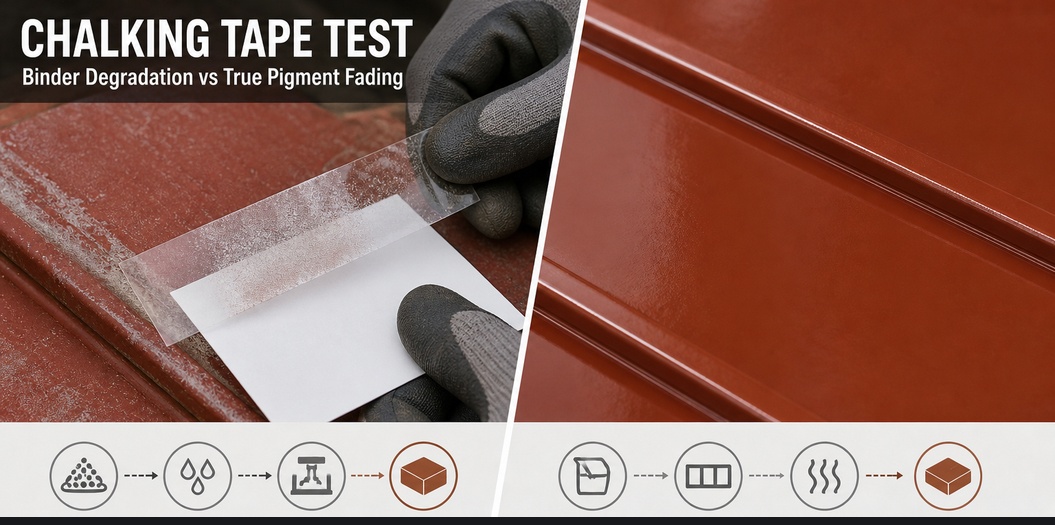
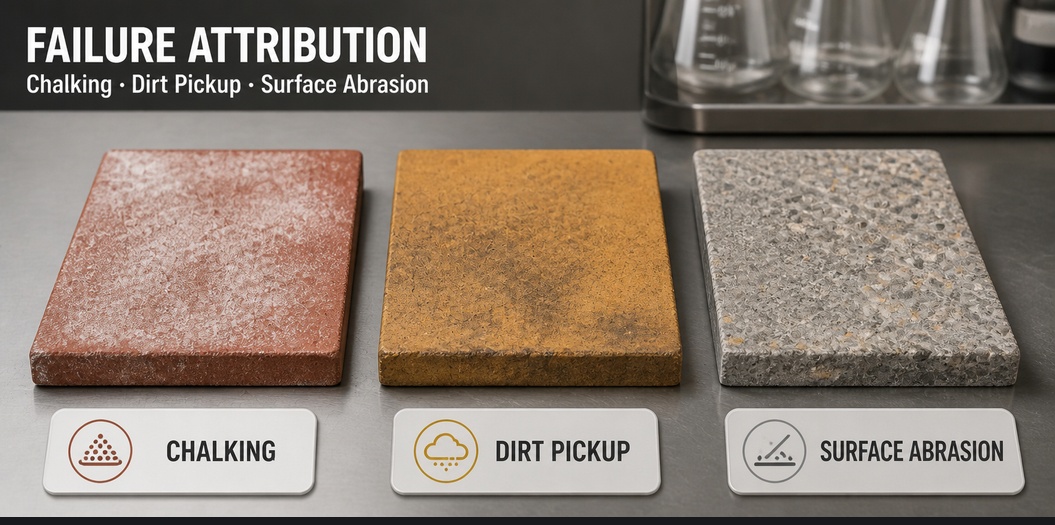
Chalking (a pale powder left behind when the binder itself breaks down) is the most common source of fade complaints in coatings. The binder at the surface takes the UV dose, its polymer chains scissor apart, and what remains is a powdery layer that scatters light back at the viewer. Underneath, the pigment is unchanged. The eye reads a lighter, flatter color and calls it fading.
The tape test settles it in about a minute. Press transparent tape onto the surface, lift it, stick it on a white card. White powder on the tape means chalking. Almost nothing on the tape means look somewhere else. Degree of chalking is rated against pictorial scales in ASTM D4214 and ISO 4628-6.
Dirt is the second impostor. Traffic film, pollen, tire rubber and airborne dust pack into the surface profile, and a red that has gone brown-grey is often a red with a film on it. Wash a small patch with mild detergent and a soft brush before forming any opinion. Half the complaints that reach a pigment supplier die at this step.
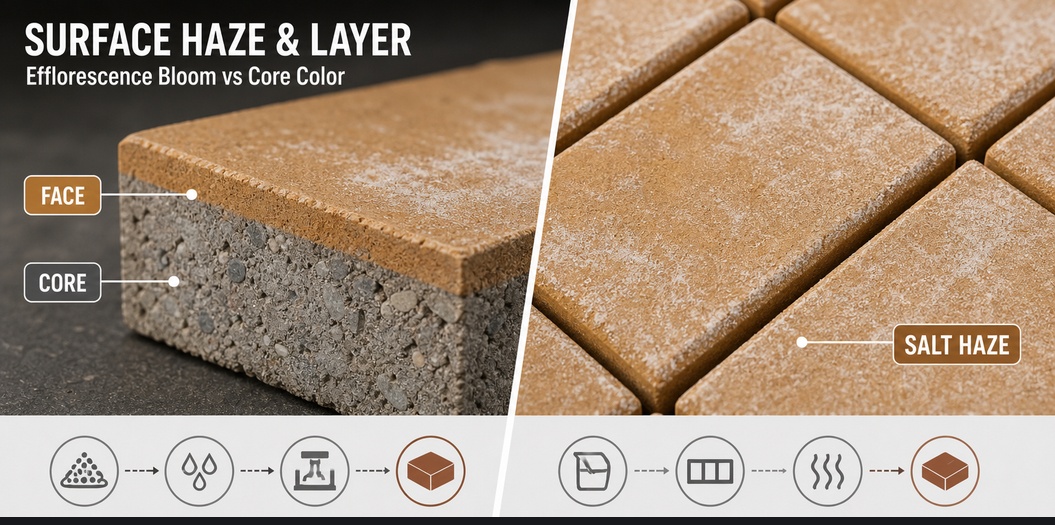
Pigment in a concrete paver is locked inside cement paste. It cannot migrate, rain will not leach it out, and it does not sit on the face waiting to be attacked. Once the unit has cured, the color is part of the stone.
What does change sits in the top fraction of a millimetre:
None of these is a pigment failure. All of them get reported as one, usually with a photo taken at four in the afternoon with the sun behind the camera.
The white bloom is its own subject and has its own countermeasures, set out in efflorescence in colored concrete. The press side of the same problem is covered in dry-cast versus wet-cast.
Black iron oxide (Fe3O4) is the exception worth naming out loud. Under long outdoor exposure it can oxidize toward the red-brown oxide, and a black that has drifted brown after several seasons has done chemistry rather than cheated. If the black has to stay black, that is an argument for a topcoat or a different route, and it is better said before the order than after the first summer.
Yellow has a ceiling of a different kind. Its limit is temperature rather than light, and the numbers are set out in iron oxide yellow heat stability. Keep processing temperature in mind when a yellow part comes back brown, because the oven is a more likely culprit than the sun.
Three methods cover most of the requests that arrive with a fade claim:
All of them compress time. None predicts years outdoors with useful precision. A 1,000-hour result ranks two formulations against each other reasonably well. Turn that figure into "twelve years in Florida" and you are reading a sales document rather than a test report. Any lab offering that conversion is guessing, and the guess tends to lean toward whoever paid for the work.
What a test does give you is a comparison you can defend, provided both samples went in together, on the same substrate, at the same film thickness, and came out with a ΔE (a single number for total color difference) read to ASTM D2244.
| What you see | Usual cause | How to confirm | Whose problem |
|---|---|---|---|
| Pale, powdery film on a coating | chalking of the binder | tape test, ASTM D4214 or ISO 4628-6 | coating formulator |
| Color gone grey or brown | dirt and traffic film | wash a patch, look again | maintenance |
| Haze on a dark paver | efflorescence | water and a brush, watch whether it returns | mix design, curing, detailing |
| Aggregate showing through the face | wear of the face layer | break a unit and look at the section | mix and process |
| Black drifted brown | oxidation of Fe3O4 | color against the retained standard | grade choice, topcoat |
| Uniform shift across a whole run | dosage or lot | batch cards, retained sample | supplier or plant |
Most purchase orders say "color fast" or "non-fading", and that is where the trouble starts, because neither phrase can be tested. Four lines do the real work:
For concrete, add a fifth: the approval sample is a plaque cast from production mix and cured the way the plant cures. A cube poured in a lab will not reproduce a press face, and a ΔE measured on the wrong sample is worse than no number at all. If the limit itself is still being argued about, setting a ΔE tolerance works through how to pick one you can defend in front of a customer.
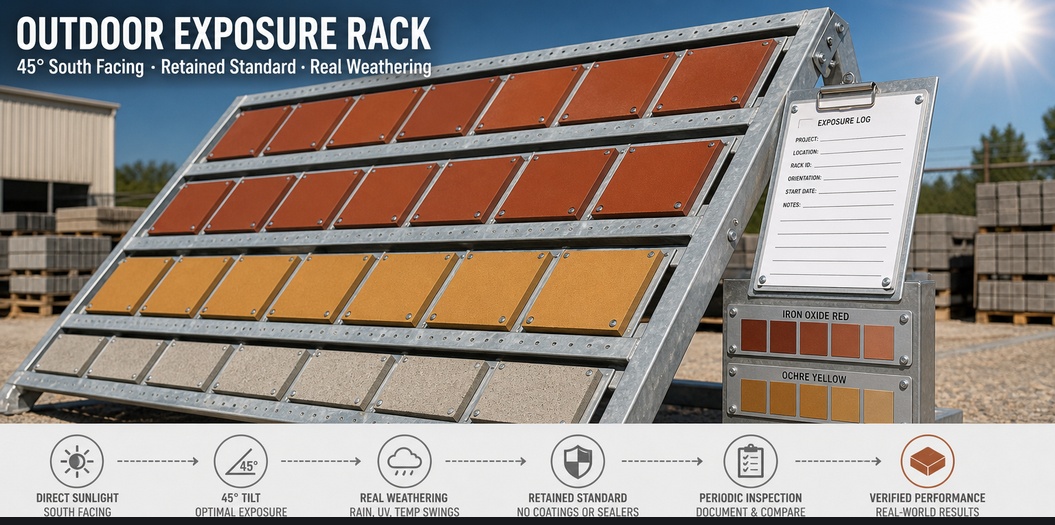
Accelerated testing belongs to suppliers and disputes. A rack behind the plant belongs to you, and it costs almost nothing to run.
The first year on that rack teaches you more than any datasheet, because it is your sand, your cement and your weather. It is also the cheapest evidence you will ever own when a customer sends the photo with one sentence.
Hebei Tianhuibao Technology Co., Ltd. has been making synthetic iron oxide pigments for 26 years, covering red (Fe2O3), yellow (α-FeOOH, a hydrated iron oxide), black (Fe3O4), brown and composite green and blue grades for concrete, coatings, plastics and ceramics. Minimum order is 1 ton (1,000 kg). We supply retained standards, lot marking and test data that a fade clause can actually use, and we will tell you when the complaint in front of you is sitting on the surface of your product rather than in our bag.
Email [email protected] or call +86-13400211655 to start a trial against your own mix and your own weather.
 Hot News
2026-10-10
2026-10-08
2026-09-17
2026-09-11
2026-09-10
2026-09-04
 EN