 ×
In short: Most color disputes are settled with a sample nobody planned. A scoop from the top of a bag, sent to a lab three weeks later, is not evidence of anything. This article covers where pigment separates inside a bag, how to take increments instead of a scoop, how to split the sample before testing, and what a 200 g jar can and cannot prove. Get the sampling right and the argument gets shorter.
Two labs tested the same delivery and disagreed by one full ΔE unit. Neither lab made a mistake. One got a scoop from the open top of the bag. The other got a composite pulled from three depths, split down, and tested the same day.
Nothing is perfectly mixed at the moment it leaves a blender, and nothing stays mixed through a lorry ride.
Fine particles migrate downward under vibration while the coarser fraction works its way up. In a 1,000 kg bag stacked four high in a container crossing two climate zones, that movement has weeks to happen. The top of the bag and the bottom of the bag are then two different materials, and both are legitimate parts of the lot.
This is why a top scoop is so dangerous. It is easy to take, it looks like the product, and it over-represents exactly the fraction that has floated up.
A sample that represents a lot is built from increments (small portions taken at defined places and depths, combined before anything is tested). Nine or ten increments from one bag will beat one careful scoop every time.
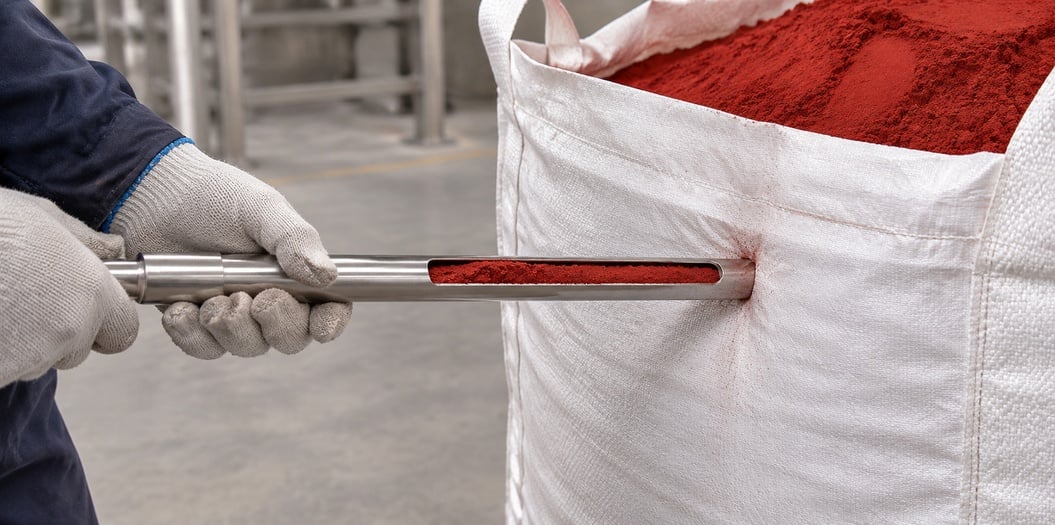
With a bag standing upright, a sampling spear goes in at the top third, the middle, and the bottom third, on two opposite sides. With a bag lying flat, sample along its length rather than at one end. If the bag has been standing for months, do not sample the cone that has formed under the filling spout; that cone is the coarsest part of the lot.
Combine the increments in a clean container, mix them, and only then take the test portion. The composite is the sample. The individual increments are not.
A silo is not a bag. Material drawn from the discharge cone at the start of a run is not the same as material drawn at the end, and a silo that has been sitting will deliver its fines first. Sample across the discharge, not from a single point in time.
Drums and 25 kg sacks are small enough that one increment per container is defensible, provided you take several containers from the pallet rather than several scoops from one sack.
For a small trial quantity, the sample is often the whole bag. That is fine, and it removes the question entirely.
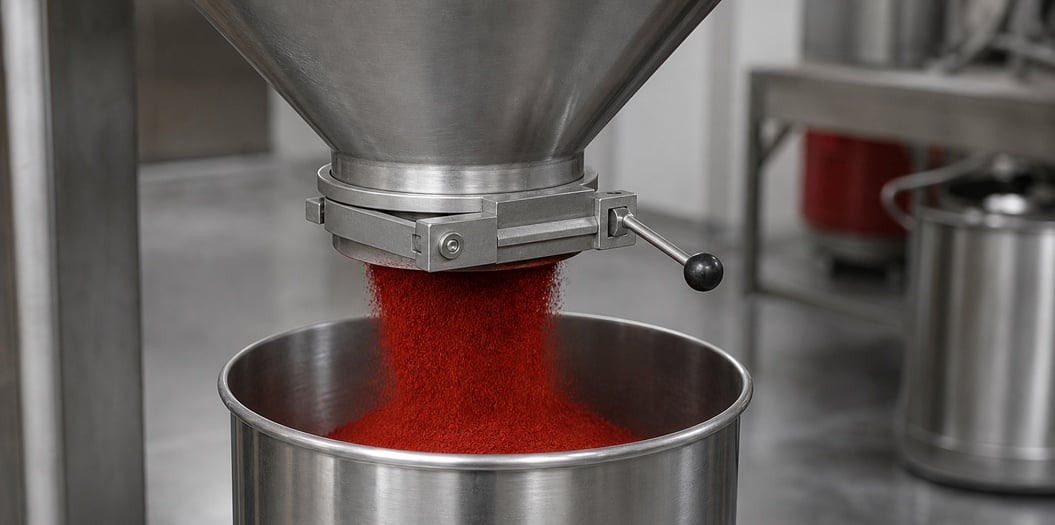
A composite straight from the mixer is still not a test sample. Two things go wrong if you skip splitting. The portion you test may not be the portion you keep, and the retained sample may not match what the lab saw.
A sample splitter (a riffle box that divides a poured stream into two equal halves) does this in one pass and is the least arguable method. Quartering on a clean sheet works if you have no splitter. Either way, split down to a test portion and a retained portion, seal both, and label both with the same lot number, the date, and who took them.
Keep the retained sample for the life of the lot, in the dark, sealed. It is the only object in the entire dispute that nobody can re-interpret.
| Question | Can a 200 g sample answer it? | Why |
|---|---|---|
| Does this lot match the approved standard? | Yes, if it was split from a proper composite | Color comparison is a small-scale test |
| Is the whole delivery like this? | Only as far as the increments went | A composite represents the places it came from |
| Is this bag the same as that bag? | No | One composite cannot separate bag-to-bag variation |
| Why did the customer's batch come out wrong? | Rarely | The plant's dosage, cement and water are not in the jar |
| Has the product changed since approval? | Yes, against the retained sample | Provided both were stored the same way |
The table has an uncomfortable implication. A sample proves what it was built to prove and nothing more, and most disagreements are about what it was built to prove. If the two numbers that disagree are fineness figures rather than color, the confusion is usually a different one, covered in fineness of grind versus sieve residue.
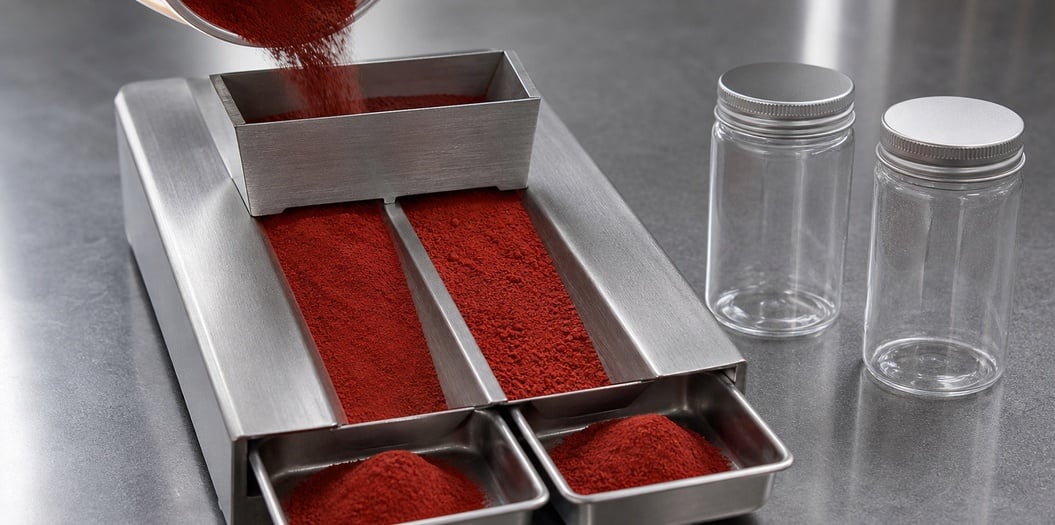
Iron oxide picks up moisture from humid air, and the amount depends on how long the material sits open, how warm it is, and how fine it is. A sample left in an open dish on a bench overnight is not the same sample in the morning, and a test result taken from it is not the lot's result.
Seal the sample within minutes. If the receiving plant measures volatile matter, weigh the sealed jar on arrival and record it. That single number catches the most common handling fault in incoming inspection, which is a sample that dried out in a tray before anyone got to it.
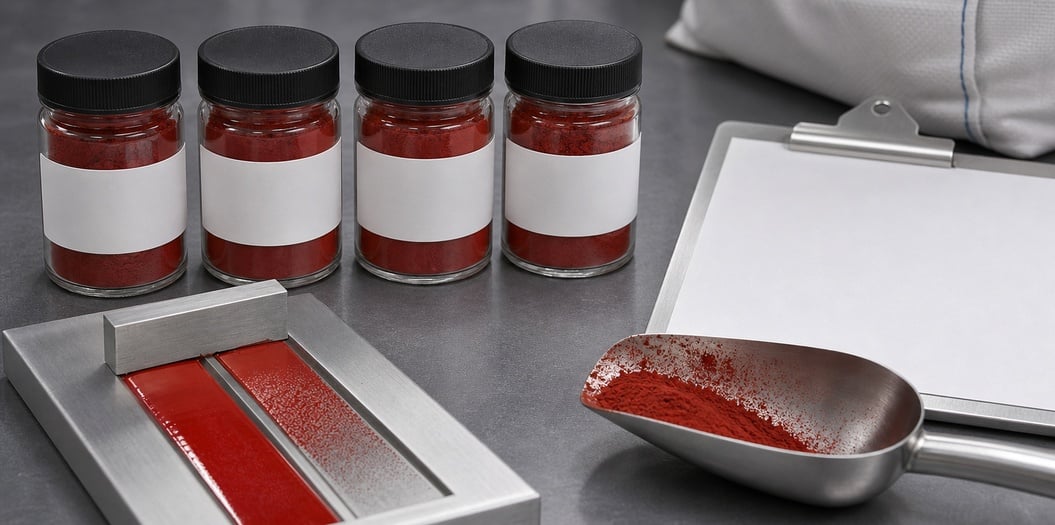
A sample without a label is a rumour. Six fields are enough: lot number as printed on the bag, date and time taken, who took it, the depths and sides the increments came from, the container it went into, and the weather or storage condition at the moment of sampling.
Write them on the jar before the jar is filled, not afterwards from memory. A photograph of the open bag with the lot label visible takes ten seconds and answers the question that always comes up three weeks later, which is whether this jar came from that bag.
Most purchase specifications describe the product and say nothing about how it will be sampled, which leaves the sampling to whoever arrives first. Four lines close that gap:
That last line matters more than it looks. Without it, two honest labs with two honest samples will produce two numbers, and the argument will be settled by whoever is more persistent rather than by evidence. What arrives on the certificate, and what it leaves for you to check, is laid out in reading a COA without over-reading it.
When the sample has to feed a real decision rather than settle a complaint, the same material is better used through a structured lot trial than through a single comparison against a standard.
Hebei Tianhuibao Technology Co., Ltd. has produced synthetic iron oxide pigments for 26 years, supplying red, yellow, black and brown grades to concrete, coatings, plastics and ceramic plants. Every lot ships with a certificate that states the lot number, and a retained sample is held at the plant so a dispute can be settled against the same material that was shipped. Minimum order is 1 ton (1,000 kg). Sampling instructions for incoming inspection are available on request, written for the bag size and packing you actually receive.
Contact: [email protected] / +86-13400211655.
 Hot News
2026-10-10
2026-10-08
2026-09-17
2026-09-11
2026-09-10
2026-09-04
 EN