 EN



Description
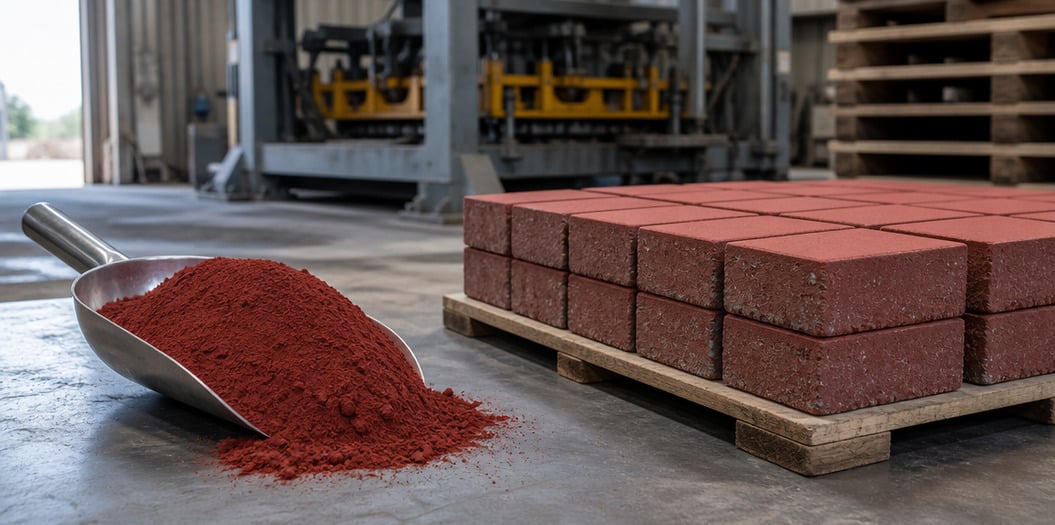
Iron oxide red 130 is the grade to specify when a precast paver is meant to read as a brick or terracotta red rather than a deeper, bluer red. It is a synthetic iron oxide — alpha-Fe2O3, Colour Index Pigment Red 101 (CI 77491), CAS 1309-37-1 — dosed into the colored face mix and carried through the full depth of the wear layer instead of being applied to the surface afterwards. This page covers what the grade is, how it behaves in a paver face mix, the addition rate a plant can expect to weigh out per cubic meter, and what to verify before a production run is committed to it.
Get Sample — small quantities are supplied for testing and evaluation, do not count toward the minimum order quantity, and the buyer covers freight. Ask for a specification sheet and a trial sample.
What iron oxide red 130 is — and where it sits in the red band
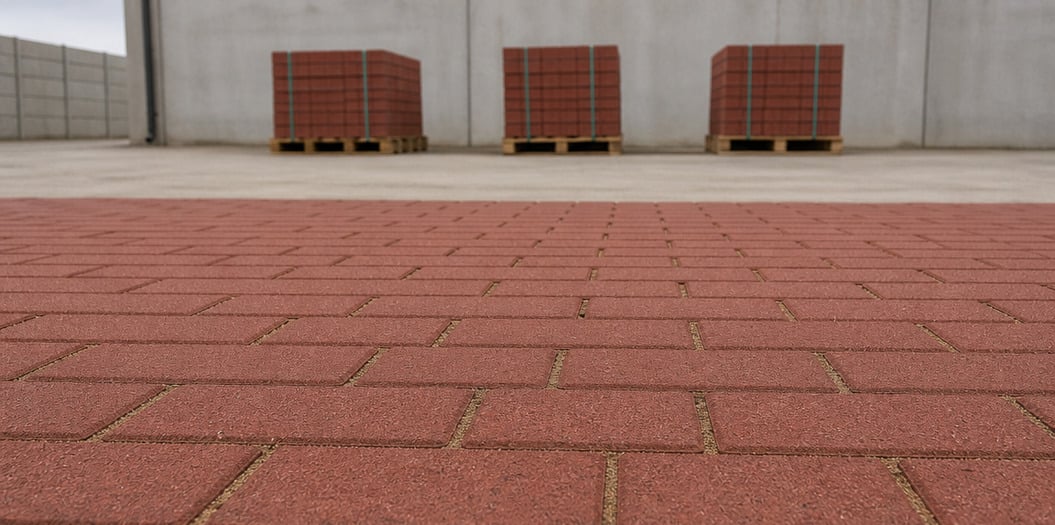
A paving block is a flat, continuous, integrally colored surface, and that is what makes the grade choice matter more here than in most applications. The pigment is mixed through the face layer, compacted with the mix and cured in place, so the color is a property of the concrete itself. A hue that sits slightly off is not a cosmetic detail: laid in a continuous field, a small tone difference becomes obvious, because the eye compares neighbouring units rather than remembering a loose sample.
Red 130 and red 190 are the same chemistry and the same Colour Index reference. The grade number is supplier shorthand rather than an international designation — no ISO or ASTM classification defines a "130" — and within one manufacturer's family the numbers mark a position on a shade axis. In the commonly reported sequence for synthetic iron oxide red, grades 110, 130 and 190 run from a yellowish red toward a bluish red, with 130 in the middle. Because the numbers are a position marker inside a family rather than a global scale, a 130 from one factory and a 130 from another can still differ, which is why grade numbers are not transferable between suppliers without a fresh certificate of analysis.
The mechanism behind the sequence is particle size, not strength alone. In synthetic alpha-Fe2O3, commonly reported behaviour is that finer primary particles read warmer and more yellow, and larger particles read deeper and bluer. So a 130 and a 190 are not one color at two strengths — they are two hues that also differ in strength, and substituting one for the other shifts the hue first and the depth second. A grade change is a mix redesign, not a like-for-like swap.
| Parameter | Red 130-type, as commonly reported | Note |
|---|---|---|
| Chemical class | Synthetic iron oxide, alpha-Fe2O3 | CI Pigment Red 101 (77491), CAS 1309-37-1 |
| Fe2O3 content | 95% min (130-type) | Read the certificate of analysis for the lot |
| Tinting strength | 95–105%, quoted against a supplier standard | Established per lot, not per family |
| Oil absorption | 15–25% | Sets the wetting demand in the face mix |
| Shade position | Mid-tone red within the 110 / 130 / 190 sequence | Warmer than 190, deeper than 110 |
These are ranges commonly reported on published technical data sheets for 130-type grades. They are a procurement benchmark, not a specification for any one supplier's product, and the lot certificate governs.
Why dispersion decides the face color more than the dose does
Red iron oxide colors by absorbing and scattering light, so what the eye reads on a finished paver is the spatial distribution of pigment particles in the surface layer. Pigment that de-agglomerates evenly is distributed evenly and the face reads as a single tone. Pigment that stays agglomerated sits in local clusters; those clusters read as mottling on the face, and as tone drift between production runs even when the weighed dose was identical.
Three factors on the plant side decide how much of the pigment actually de-agglomerates: the wetting and shear the pigment sees during mixing, the water content of the face mix, and the point in the batch sequence at which the pigment is added. Compaction then fixes the result. The face mix is pressed under vibration and pressure in the mold, and the pigment travels with the fines fraction, so an unevenly dispersed mix cannot be recovered at the press.
This is also where the honest boundary of the pigment argument sits. Sand and cement base tone, water-cement ratio, compaction setting and curing regime all shift the cured color, and all of them are on the customer's side of the line. A grade that matches a target on one plant's cement and sand will not automatically match it on another plant's.
| What shifts the cured paver color | Where it sits | How it acts |
|---|---|---|
| Base tone of cement and sand | Customer side | Sets the floor and ceiling of achievable depth; a dark, iron-rich sand shifts the cured tone regardless of grade |
| Water-cement ratio | Customer side | Changes surface density and color depth; a high ratio raises surface porosity |
| Pigment grade and dose | Pigment side | Sets the shade position and the depth reached at a given cement content |
| Dispersion in the face mix | Shared | Decides whether the pigment is spread evenly at all; poor dispersion reads as mottling and batch-to-batch drift |
| Compaction and curing | Customer side | Decides how much of the pigment-rich surface layer survives to handover |
| Face finish and joint fill | Customer side | A ground, shot-blasted or washed face and a smooth face present the same mix differently |
Dosing Red 130 into a paver face mix
Integrally colored concrete is normally dosed as a percentage of the cement content in the mix rather than as a percentage of total batch weight. A commonly reported band for architectural, paving and precast work is about 2% to 5% by weight of cement. Because the dose is tied to cement content, the same percentage produces a different mass of pigment per cubic meter from one mix design to the next.
| Cement content | 2% of cement | 3% of cement | 5% of cement |
|---|---|---|---|
| 250 kg/m3 | 5.0 kg/m3 | 7.5 kg/m3 | 12.5 kg/m3 |
| 300 kg/m3 | 6.0 kg/m3 | 9.0 kg/m3 | 15.0 kg/m3 |
| 350 kg/m3 | 7.0 kg/m3 | 10.5 kg/m3 | 17.5 kg/m3 |
| 400 kg/m3 | 8.0 kg/m3 | 12.0 kg/m3 | 20.0 kg/m3 |
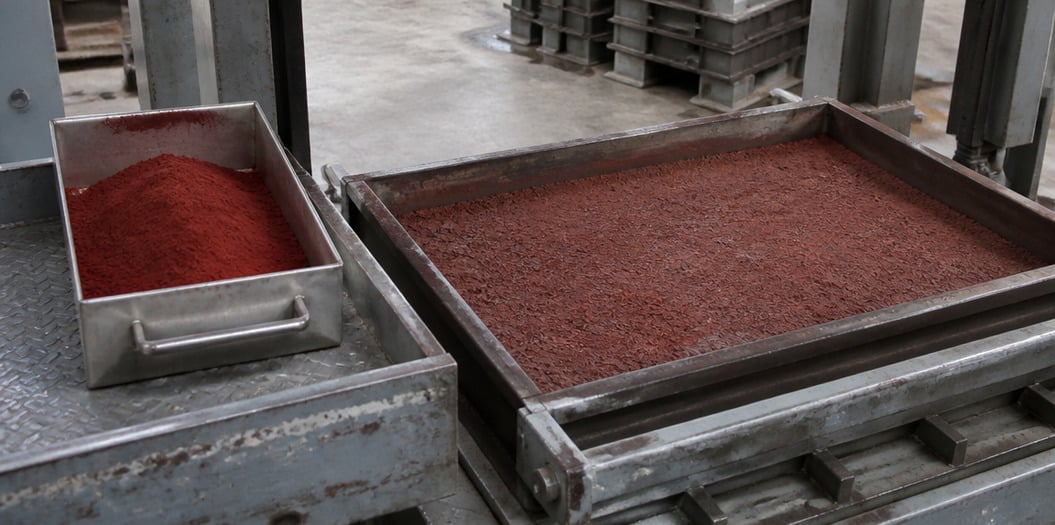
A paving block is usually produced as two layers: a colored face mix compacted over a base mix. The pigment is dosed into the face mix only, so the addition rate is quoted per cubic meter of face mix, and the face mix is batched separately from the base. One further distinction belongs in the specification: integral coloring and a surface-applied dry-shake hardener are dosed on completely different scales. An integrally colored face mix carries the pigment through the depth of the layer at a rate per cubic meter; a dry-shake hardener is broadcast onto the fresh surface at a rate per square meter, substantially higher per unit of material. Specifications that mix the two units produce either an under-colored surface or a hardener budget unrelated to the work.
The rate above is a starting point, not a setting. The number a plant should actually run is the one its own cement, sand, aggregate and admixture return in a trial, because the base tone of the cement is the single largest influence on how much pigment a given depth of color costs. The upper end of the band is not free capacity either: exceeding the pigment loading is generally reported to reduce the mechanical strength of the mix, so a face that is not deep enough is normally answered by changing grade or re-checking the cement and sand, not by adding more powder.
Applications
- Segmental paving blocks and interlocking pavers — integrally colored face over an uncolored base mix; brick-red and terracotta targets are the usual application for this grade.
- Kerbs, edging and channel units — same dosing logic, with the colored face left exposed to traffic and weather.
- Patio, driveway and pedestrian slab paving — installations where a uniform field color across a large laid area matters more than maximum depth.
- Cobble and sett-type units — smaller units with a larger joint-area fraction, where the sand-filled joints themselves contribute to the perceived tone.
- Architectural precast with a red face — facades and cladding panels where the pigmented layer is the visible finish.
Two limits are worth stating for this set of applications. First, the pigment cannot set the depth of color by itself: the base tone of the cement and sand fixes the achievable range, and a dark iron-rich sand shifts the cured tone no matter which grade is used. Second, on a red face, a white surface bloom from efflorescence reads as a color defect even when the pigment performed correctly, so prevention belongs in the water-cement ratio, the compaction and the curing regime rather than in a pigment substitution.
Product Specifications and Supply Information
| Item | Detail |
|---|---|
| Model | Iron Oxide Red 130 (concrete and paving grade) |
| Colour Index | Pigment Red 101 (CI 77491), CAS 1309-37-1 |
| Form | Dry powder |
| Fe2O3 content | 95% min (130-type); the lot certificate of analysis governs |
| Tinting strength | Quoted per lot against supplier standard |
| Color | Mid-tone red in the brick / terracotta direction within the 110 / 130 / 190 sequence |
| Solubility | Insoluble in water |
| Heat behaviour | Iron oxide red is the dehydrated form of iron oxide and, unlike iron oxide yellow, carries no lattice water to lose at process temperatures |
| Pigment testing | Pigments for integrally colored concrete are commonly tested for water wettability, light fastness, alkali resistance and weather resistance under the schedule in ASTM C979 / C979M-16 |
| Volatile matter | Determined at 105 °C per ISO 787-2 |
| Certifications | REACH, RoHS, CE, ISO; IATA DGR for air transport and IMDG Code for sea transport |
| MOQ | 1 metric ton; samples supplied for testing do not count toward the MOQ |
| Packing | 25 kg woven bags, available ex-stock |
| Supply capacity | 50,000 tons annual production capacity |
| Lead time | Stock items 3–5 working days; customized items 7–15 working days |
| Customization | Color matching, particle size adjustment and packaging customization on request |
| Quality control | Raw material testing through finished product inspection; multi-batch color consistency data (ΔE) available on request |
Frequently Asked Questions
Should I specify Red 130 or Red 190 for paving blocks? Decide from the target color, not from the price per kilogram. A 130-type grade is the usual starting point for brick, terracotta and pottery reds, which sit mid-band in the shade sequence; a 190-type grade is the usual starting point when the target is a deeper, bluer, more saturated red. The two are different hues as well as different strengths, so a straight substitution moves the hue as well as the depth. Where a project uses light or white-tinted mixes, the two separate most clearly.
How much Red 130 goes into a cubic meter of paver face mix? Working from a commonly reported band of 2% to 5% by weight of cement, a face mix with 350 kg of cement per cubic meter takes roughly 7.0 to 17.5 kg of pigment per cubic meter of face mix, and one with 400 kg of cement per cubic meter takes roughly 8.0 to 20.0 kg. The final rate has to be set by a trial on your own cement, sand and admixture, because the base tone of the cement is the largest single influence on how much pigment a given depth of color requires.
Will the color fade outdoors? Iron oxide pigments are inorganic and are characterized by light fastness and weather resistance rather than by fading on exposure, which is why they are the default colorant for integrally colored concrete. Those two properties are among the items covered by the test schedule in ASTM C979 / C979M-16 for pigments intended for integrally colored concrete. What changes the appearance of a paving field over time is usually not the pigment: it is surface wear, dirt pick-up, joint sand loss and any efflorescence bloom on the face.
Does the pigment reduce the strength of the paving block? Pigment added to a mix is extra dry solids in place of part of the cementitious matrix, and exceeding the usual addition band is generally reported to reduce mechanical strength. Within the commonly reported 2% to 5% band, the practical consequence is that depth of color should be sought by selecting the right grade or by reviewing the cement and sand base, not by increasing the dose past the band. Strength itself has to be confirmed on your own mix design and curing regime.
What do I need to provide for a color match? Send the cement and sand you actually run, the target color as a master sample or a cured reference unit, and the addition rate or depth you are trying to reach. Because the cured color is a function of the pigment plus the cement base tone, the aggregate color, the water content and the compaction and curing regime, a grade quoted without those inputs is an estimate rather than a match.
Related reading
The addition-rate table above and the full three-stage verification protocol are set out in more detail in our article Iron Oxide Pigment Dosage for Concrete: kg per m3 Guide for Ready-Mix & Precast Producers, filed under the News section of this site. The shade-axis reasoning that separates a 130-type from a 190-type grade is covered in Iron Oxide Red 130 vs 190: Which Grade to Specify and Why, and a documented production example of grade matching in a concrete tile plant is described in our case study Iron Oxide Red 190 for a Concrete Floor Tile Producer in Pakistan.
Contact
Iron oxide red 130 for precast pavers is supplied by Hebei Tianhuibao Technology Co., Ltd., which has produced iron oxide pigments for 26 years, with an annual production capacity of 50,000 tons, and supplies customers in 150+ countries and regions. The red series covers grades 110, 130 and 190, plus nano and ultra-fine grades, easy-dispersing rubber grades, acid- and alkali-resistant grades, food-contact grade and factory-direct color matching. Certifications held include REACH, RoHS, CE and ISO, together with IATA DGR for air transport and IMDG Code for sea transport. The minimum order quantity is 1 metric ton in 25 kg woven bags available ex-stock; small samples are supplied separately for testing and do not count toward the MOQ. Stock items ship in 3–5 working days and customized items in 7–15 working days. Quality control runs from raw material testing through finished product inspection, and multi-batch color consistency data is available on request.
If you are specifying iron oxide red 130 for a paving block line, send us your cement and sand details, your target color and the addition rate you are working to. We will supply a specification sheet, the lot certificate of analysis, and a trial sample so the grade can be checked in your own face mix before it goes into production. Contact: [email protected] / +86-13400211655.