 ×
This page records a real project. It is written from the information the customer supplied about their own operation, and it deliberately separates what the customer reported from what was not measured. Where a figure is not available, no figure is given.
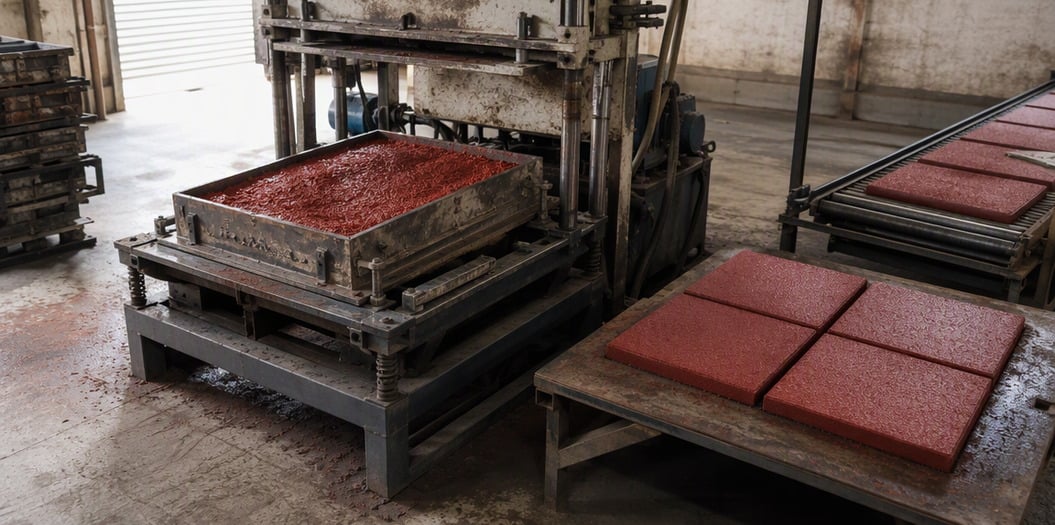
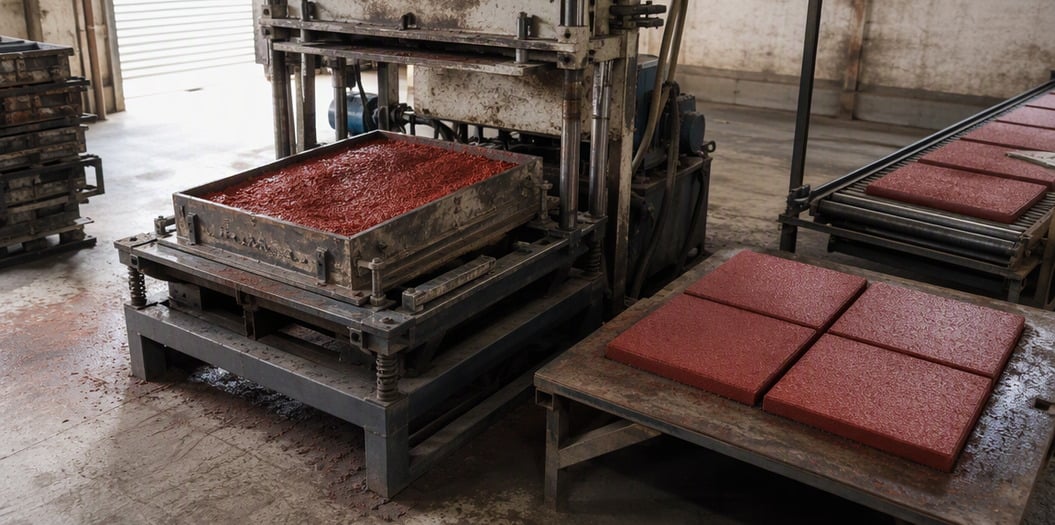
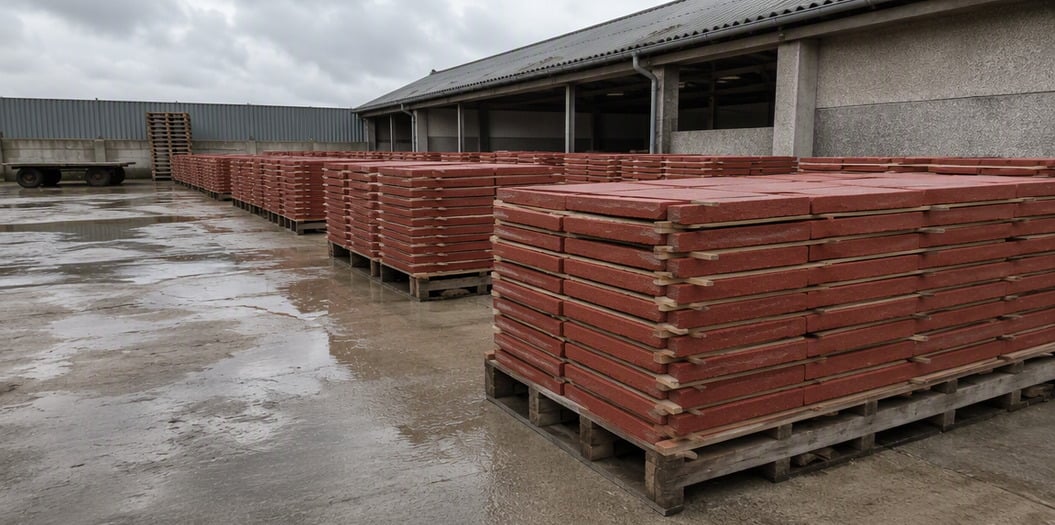
The customer operates a concrete floor and paving tile production facility in Pakistan. Their process is the standard dry-cast / wet-cast tile line used across the region: cement, sand and aggregate are batched and mixed, pigment is dosed into the mix, and the coloured face mix is compacted in a mould under vibration and pressure before curing.
The problem they brought to us was not strength, not surface finish and not delivery. It was colour. Tiles from their production runs were reading inconsistently — the intended red was arriving on the tile surface with visible shade variation, so that tiles produced at different times, and in some cases tiles from the same production run, did not present as one uniform colour.
For a tile producer this is the expensive kind of defect. Tiles are laid in large continuous fields, so a shade difference that would be invisible on a single unit becomes obvious the moment a few hundred square metres are laid together. The complaint the customer described was a colour-uniformity problem, and their working assumption was that the pigment was the place to look.
The engagement started with the mix, not with the catalogue.
Step 1 — Establishing what the target red actually was. Rather than quoting the grade the customer was already using, we started from the target: the colour the customer was trying to reach on their own cement and their own sand. Because the cured tile colour is a function of the pigment plus the cement base tone, the aggregate colour, the water content and the compaction and curing regime, a grade quoted in isolation from those conditions is only a guess. The pigmented face mix, the base mix and the cure were reviewed together.
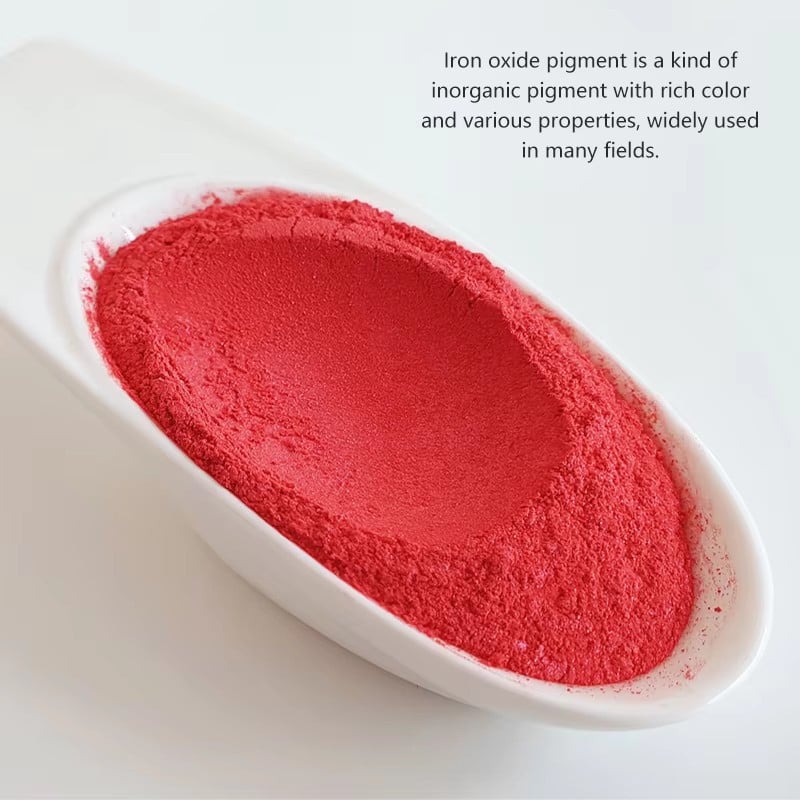
Step 2 — Grade matching. On that basis we recommended Iron Oxide Red 190 as the pigment for the coloured face mix. The reasoning is a hue-and-strength match rather than a strength upgrade: within the synthetic iron oxide red family, the grade number marks a position on the shade axis, and the 190 position sits toward the deeper, bluer end of the band. For a concrete tile line where the target was a consistent, uniform red field, matching that hue position to the customer's cement and sand base was the specific change made.
Step 3 — Supply consistency. A single well-matched sample solves nothing if the next shipment sits at a different point on the shade axis. The supply arrangement therefore treats batch-to-batch consistency as the operative requirement, with multi-batch colour consistency data (ΔE against the agreed standard) available as a check rather than as a marketing statement.
Step 4 — Documentation. The pigment is supplied against a lot-specific certificate of analysis covering the parameters that drive colour in a cement system: Fe2O3 content, tinting strength, oil absorption, residue on screen, water-soluble content, volatile content and colour difference against standard. Certifications held include REACH, RoHS, CE and ISO, together with IATA DGR for air transport and IMDG Code for sea transport; for a Pakistani buyer shipping classified pigment by sea, the IMDG documentation is part of the practical ordering process, not a formality.
This section normally carries measured outcomes. For this project no measured figures were supplied, so none are quoted here. What was recorded is qualitative, and it is presented as qualitative:
What would be needed to quantify this project properly. A tile producer measuring the same improvement would track: ΔE of production tiles against the retained master sample, per production run; the percentage of tiles rejected or downgraded for colour reasons, before and after; yield per mould; and the change in addition rate needed to reach the target depth. Those four numbers would convert the qualitative outcome above into a commercial figure. They were not captured here, and this page does not estimate them.
What the customer attributed the improvement to. In the customer's own account, three things: better dispersion behaviour of our pigment in their mix, our recommendation of a shade that matched their cement and sand base more closely than the grade they had been running, and stable quality across shipments. It is worth stating plainly that the first of those three — dispersion — is the mechanism that most directly governs surface colour uniformity, because pigment particles that de-agglomerate evenly are distributed evenly through the matrix, while agglomerates sit in local clusters that read as patches on the finished face. It is equally worth stating that the sand and cement base tone, the water content and the curing regime sit on the customer's side of the line and also shift the cured colour. Pigment selection is one variable in the result, not all of it.
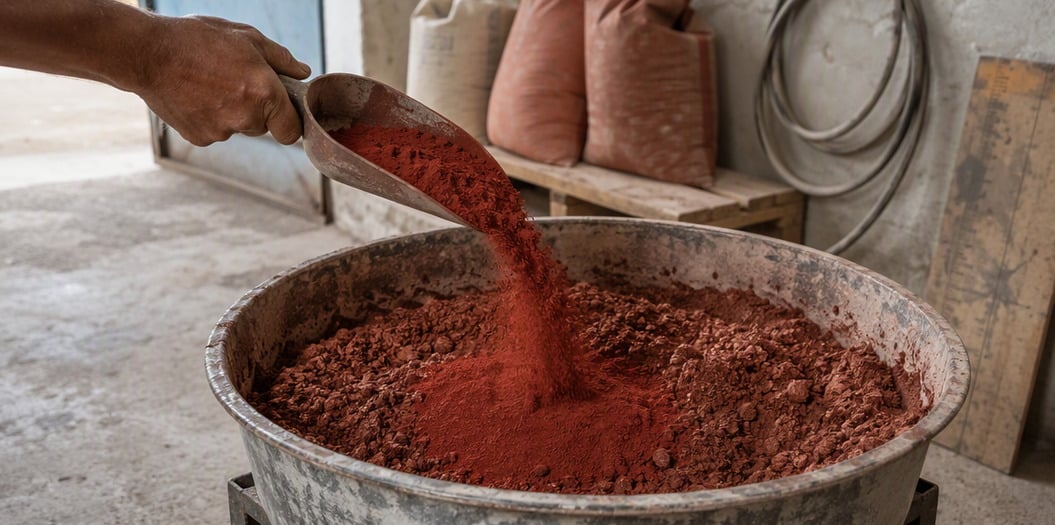
No verbatim quotation was provided for publication with this project, so this page does not reproduce one. The following is an objective summary of the feedback the customer gave, as recorded: they confirmed that the tile colour variation they had raised as a problem was resolved after switching to Iron Oxide Red 190, and they attributed the improvement to the pigment's dispersion behaviour, the grade recommendation, and consistent quality across shipments.
The project is presented anonymously at the customer's level of disclosure: country and industry are stated, and no customer name, plant name, order quantity, price or project date is published.
The grade-selection reasoning behind this project — how grade 130 and grade 190 differ in hue and strength, and how to specify either one so the choice is testable — is set out in our article Iron Oxide Red 130 vs 190: Which Grade to Specify and Why, filed under the News section of this site.
Hebei Tianhuibao Technology Co., Ltd. has produced iron oxide pigments for 26 years, with an annual production capacity of 50,000 tons, and supplies customers in 150+ countries and regions. The iron oxide red series covers grades 110, 130 and 190, plus nano and ultra-fine grades, easy-dispersing rubber grades, acid and alkali resistant grades, food-contact grade, and factory-direct colour matching. Certifications held include REACH, RoHS, CE and ISO, together with IATA DGR and IMDG Code. Minimum order quantity is 1 metric ton in 25 kg woven bags, available ex-stock; small samples are supplied for testing and do not count toward the MOQ. Stock items ship in 3–5 working days, customised items in 7–15 working days. Quality control runs from raw material testing to finished product inspection, and multi-batch ΔE data is available on request.
If you are working on a coloured concrete tile or paver line and want the grade matched to your own cement and sand, send us your target colour or master sample, and request a specification sheet and a trial sample. Contact: [email protected] / +86-13400211655.
 EN