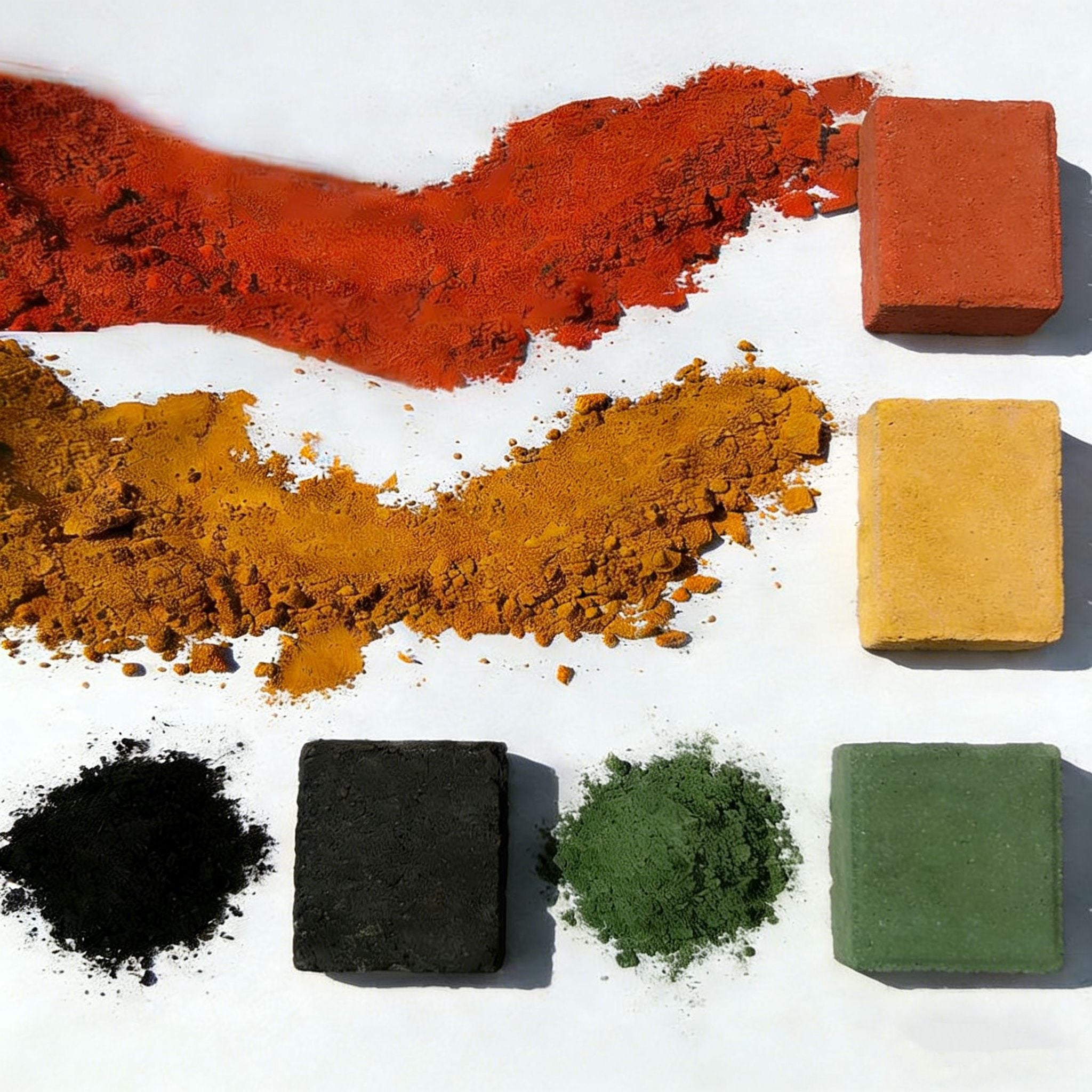
 ×
In short: A paver does not have to be red all the way through. Most colored units are a gray body with a thin colored face, and the difference in pigment cost is real. This article covers how thick that layer needs to be, what it actually gets asked to survive, why thickness varies across a single pallet, and the one measurement worth making before you accept a delivery.
Two pavers look identical on the pallet. One is red throughout. The other is red for the first few millimeters and gray underneath. The buyer who signed the approval plaque often does not know which one he bought.
Pigment is the most expensive dry ingredient in a colored concrete unit by a wide margin. Coloring the full body of a 60 mm paver means paying for color in the bottom 50 mm, where nothing will ever see it.
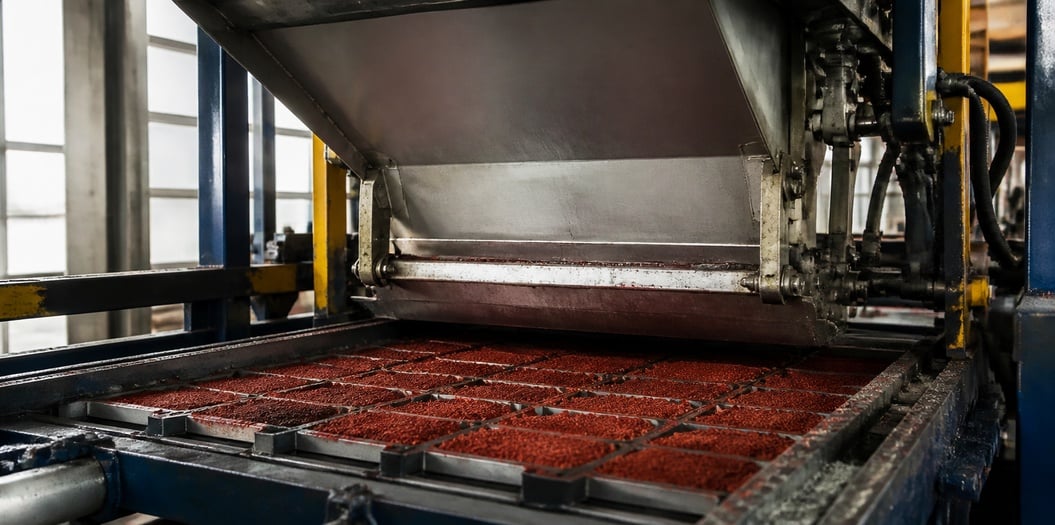
So many plants split the operation. The machine fills the mold with a base mix (the uncolored body of the unit) that has no pigment in it, then delivers a measured layer of colored face mix (the pigmented top layer) on top before compaction. The two layers bond during vibration and curing into one unit. Cut it with a saw and you can see the line.
There is nothing dishonest about this. It is standard practice and it is in the drawings for a lot of commercial paving. The problem starts when the buyer assumes full-body coloring and the plant assumes face mix, and nobody writes the word down.
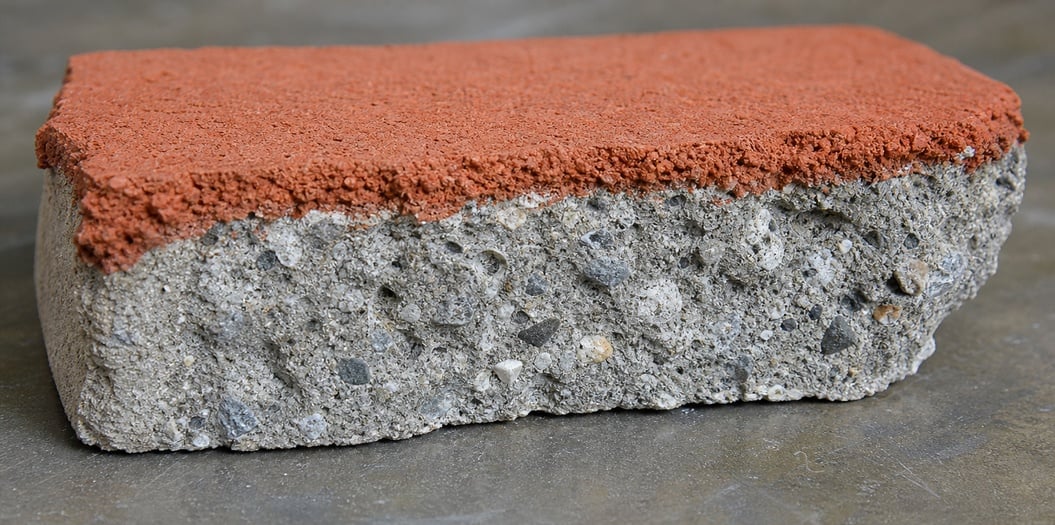
The face layer is a wear surface. On a driveway it takes tire scrub, grit, and the occasional dragged object. On a public footpath it takes foot traffic and cleaning. On a loading yard it takes point loads and steel.
Three things shorten its life. Abrasion (wear by rubbing and grit) removes material slowly, and a layer specified too thin reaches the base in a few years. Freeze-thaw cycling at the surface can spall (flake off) small pieces if the mix is not air-entrained (dosed so the paste keeps tiny air bubbles after setting). And deicing salt with repeated wetting attacks the paste at the surface, which is where the color lives.
That last one is worth pausing on. A colored layer that loses its paste loses its color, because the pigment is bound in that paste. The aggregate underneath is gray whatever you dosed.
Abrasion resistance of horizontal concrete surfaces has test methods, and ASTM C779 is the one usually named in specifications. Whether your project actually needs the test is a separate question. Most paving specifications lean on the product standard instead. EN 1338 is the European product standard for concrete paving blocks and covers the requirements and test methods, and ASTM C936 covers solid concrete interlocking paving units in the US.
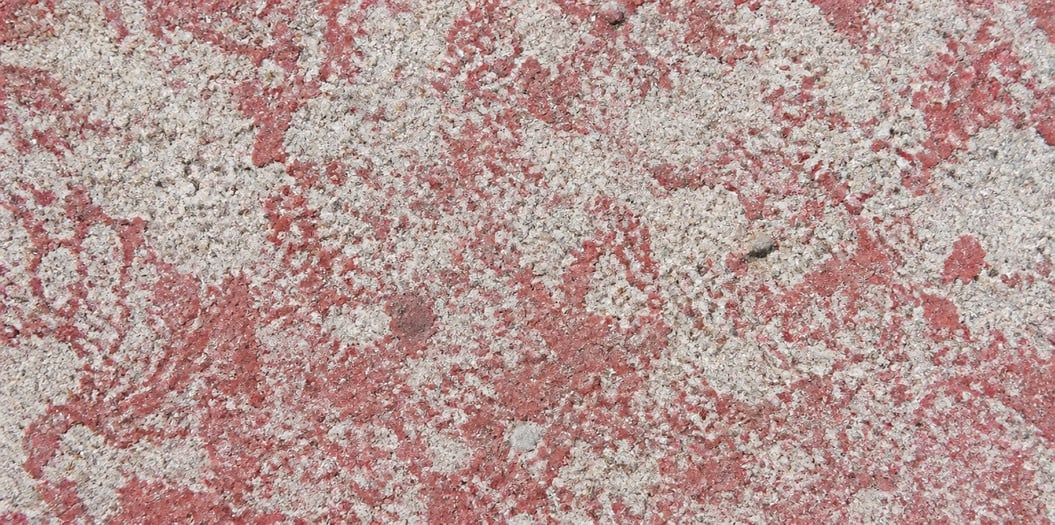
Say a paver is 60 mm deep and the colored face is 6 mm. That face is a tenth of the unit's volume. The pigment that would have gone into the whole body now goes into that tenth.
So the pigment bill per square meter falls by roughly that ratio, before you count the extra handling, the second mixer, and the silo for the face mix. The saving is not the full 90 percent, and any plant that quotes you the full 90 percent is not counting its own costs.
Here is the other side of the ledger. Face mix usually runs a richer cement content and a finer aggregate than the base, because the surface has to look good. That costs money too. On a small run the setup can eat the pigment saving entirely, which is why some plants refuse face mix below a certain order size.
Ask for both numbers as cost per square meter, not as cost per tonne of pigment. The per-tonne number always looks like a win and tells you nothing.
| What you are comparing | Face-mix unit | Full-body unit |
|---|---|---|
| Pigment consumption | Only the wear layer is colored | Every millimeter is colored |
| Cost per square meter | Lower on long runs, close on short ones | Flat, no second setup |
| Chip and repair | A deep chip exposes gray base | Chip stays the same color |
| Cut edges | Cut face shows a line | Cut face is uniform |
| Color after heavy wear | Reaches base when the layer is gone | Color persists with depth |
| Plant complexity | Two mixes, two silos, tighter control | One mix, simpler batch |
| Best fit | Standard paving, paths, driveways | Premium, exposed-aggregate, cut-to-size work |
The chip row is the one buyers underestimate. On a face-mix paver, damage that goes through the layer is a gray scar, and it cannot be touched up convincingly with pigment paste. If the application will see impact, or if the units will be cut on site for edges and curves, full body removes an argument before it starts.
Uneven thickness across a pallet. The face mix is delivered by a hopper or a belt, and if the distribution box is not set evenly the layer runs thick at one end and thin at the other. Nobody notices because the top surface looks the same.
Contamination at the interface. Base mix stuck to the mold wall can be dragged up into the face, leaving gray streaks. On a red unit they read as dirt.
Thickness drift over a shift. Face mix in the hopper settles and compacts, so the delivered volume per unit falls as the hopper empties. A unit made at the start of the shift and one made at the end can differ by a visible margin.
None of these show up on a color reading. A spectrophotometer on the top surface will say both units match, because both surfaces are red. The difference is underneath.
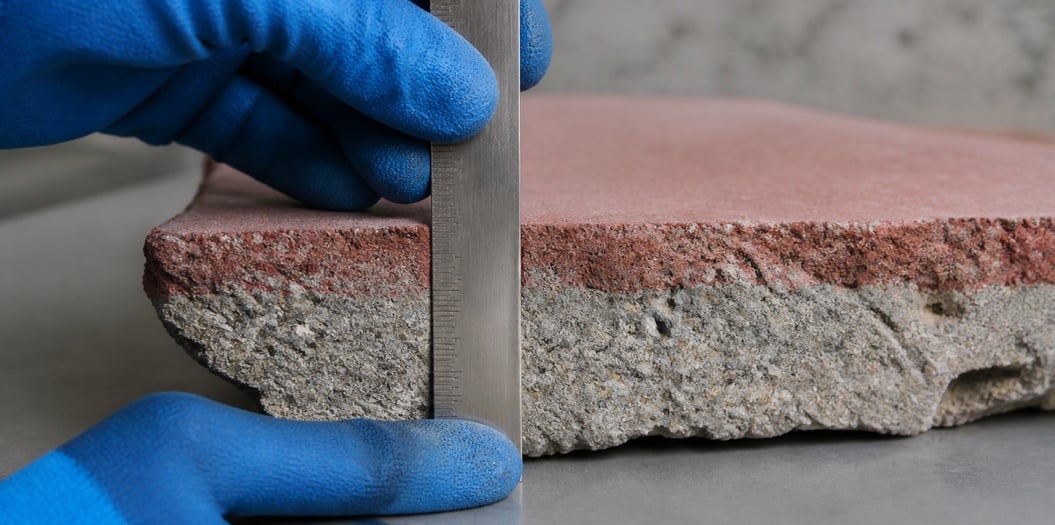
Break a unit. Not cut it, break it. A cut face smears and hides the line; a break runs along the weakest plane and shows the layer plainly.
Then measure the layer at four points around the broken edge with a steel rule, and write the four numbers down. If they disagree by more than a small margin, the distribution is uneven regardless of what the surface looks like.
Do this on units from the first pallet and the last pallet of a delivery, not just the one the driver hands you. If you have a retained standard from the approved trial, break one of those too and compare. A face that has thinned from the approved sample to the production run is a supplier conversation, and you want it before the units are laid.
For the pore structure and the way the base and face bond, the dry-cast and wet-cast comparison covers how the two processes differ in compaction and where delamination starts.
Four lines do most of the work.
State the coloring method in words: full body, or face mix with a stated minimum thickness. Not "colored throughout" when you mean the surface.
State where the thickness is measured, and after what: on a broken unit, at four points, on first and last pallet.
State what happens if a unit measures below the minimum. Reject the pallet, or accept with a price adjustment? A minimum with no consequence is a suggestion.
State the color reference and keep it. The retained plaque from the trial is the only thing that lets you prove the face changed. The trial protocol sets out what belongs beside that plaque.
If the pigment dose is what you need to recalculate for a face mix, the dosage figures for ready-mix and precast are stated per cubic meter of colored material, so apply them to the face volume and not to the whole unit.
Hebei Tianhuibao Technology Co., Ltd. has made synthetic iron oxide pigments for 26 years, supplying red, yellow, black and brown grades to block and paver plants, ready-mix producers, coatings and plastics manufacturers. Face-mix work is a dosing question more than a pigment question, and our technical team will work through the layer thickness and the dose with your batch plant before the first pallet is cast. Minimum order is 1 ton (1,000 kg).
Contact: [email protected] / +86-13400211655.
 Hot News
2026-10-10
2026-10-08
2026-09-17
2026-09-11
2026-09-10
2026-09-04
 EN