 ×
This page describes a typical application configuration, not a named customer project. No customer, plant or order is identified, because no project-specific material was released for publication. What follows is the configuration normally applied when a dry-mix mortar, tile adhesive or tile grout producer needs a colour that holds from batch to batch: which pigment grades are involved, where in the process the colour is actually decided, and the conditions under which the result can move. Because the scenario is typical rather than measured, no before-and-after figures appear here — Section 3 states exactly what a plant would have to measure to produce them.
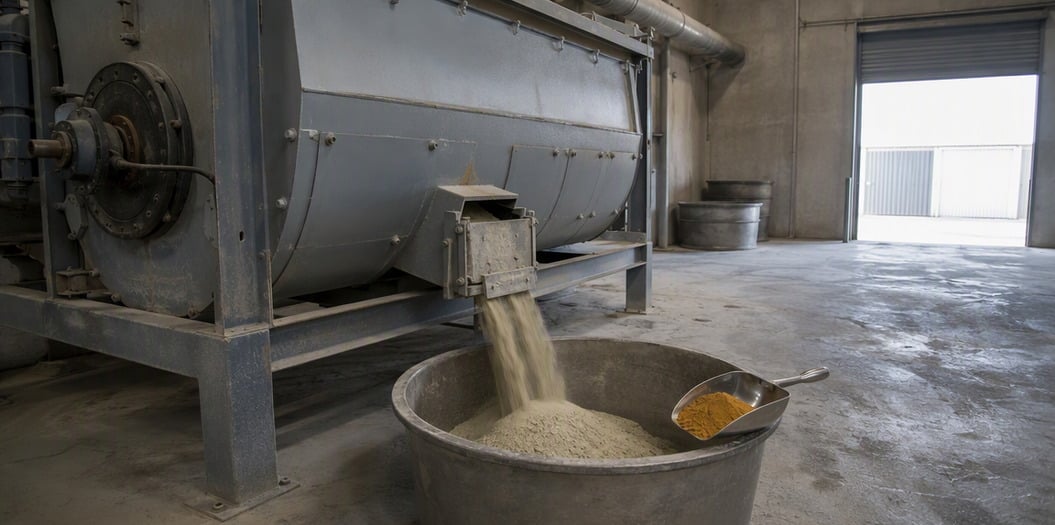
A dry-mix mortar or tile grout is a factory-blended powder — cement plus a graded filler (silica sand, limestone powder, or a blend of the two), plus additives such as cellulose ether for water retention and a redispersible polymer for adhesion. It is bagged dry and gauged with water on site. Because there is no water in the blender, the pigment is added as a dry powder and blended with the other solids. That is a different operation from dosing a colour slurry into ready-mix concrete, and it is the reason the failure modes below show up in dry-mix plants rather than in a concrete batching plant.
The colour complaints that dry-mix producers commonly report fall into four groups:
Step 1 — Pin the target to the customer's own base. The cured colour of a cement-bound joint is the pigment plus the base: the greyness of the cement, the tone of the filler, the water added on site, and the curing. A grade quoted without those inputs is a guess, so the starting point is the target shade or a retained master sample plus a sample of the customer's own base powder.
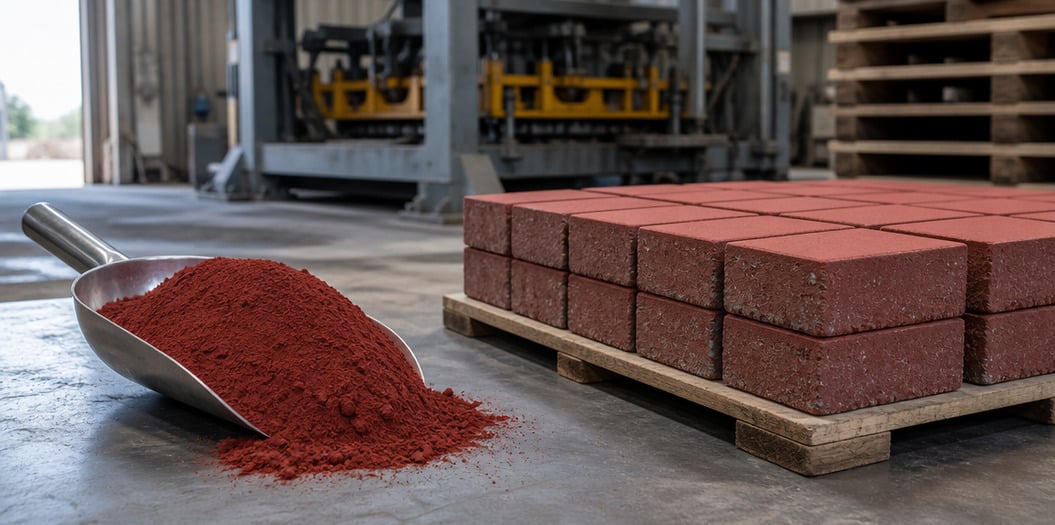
Step 2 — Choose the grade by hue position, not by habit. Within one manufacturer's family the grade number marks a position on the hue axis. The synthetic iron oxide reds — grade 130 and grade 190, for example — are the same chemistry (alpha-Fe2O3, Colour Index Pigment Red 101, CAS 1309-37-1); the number is supplier shorthand, and no ISO or ASTM classification defines what "130" means. Hue moves with primary particle size, so replacing one grade with another is a recipe change, not a like-for-like substitution.
| Grade | Hue family | Where it is normally used in dry-mix products | Note when specifying |
|---|---|---|---|
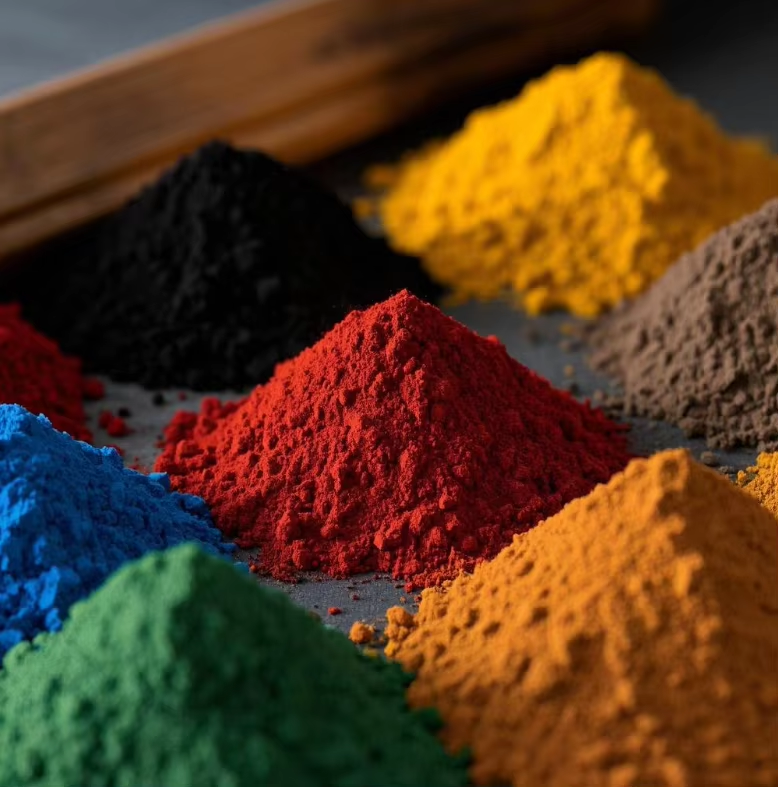
| Iron Oxide Yellow 313 | Warm ochre to sand | Coloured renders, pointing mortar, sand-toned grout | Reads olive on grey cement; bright pastel tones need a white or light base |
| Iron Oxide Red 130 | Terracotta to brick red | Terracotta-effect grout, coloured screed, paving mortar | Sits mid-band in the 110 → 130 → 190 sequence; check against the master sample after curing, not wet |
| Iron Oxide Black 330 | Neutral grey to black | Grey grout, dark shading, tone-down of warm mixes | Small additions shift the tone quickly — batch by weight, not by volume |
| Iron Oxide Brown 630 | Earthy brown | Brown and beige grout, exposed-aggregate bedding mortar | Mixed with yellow to reach mid-browns; the ratio has to be fixed in the recipe |
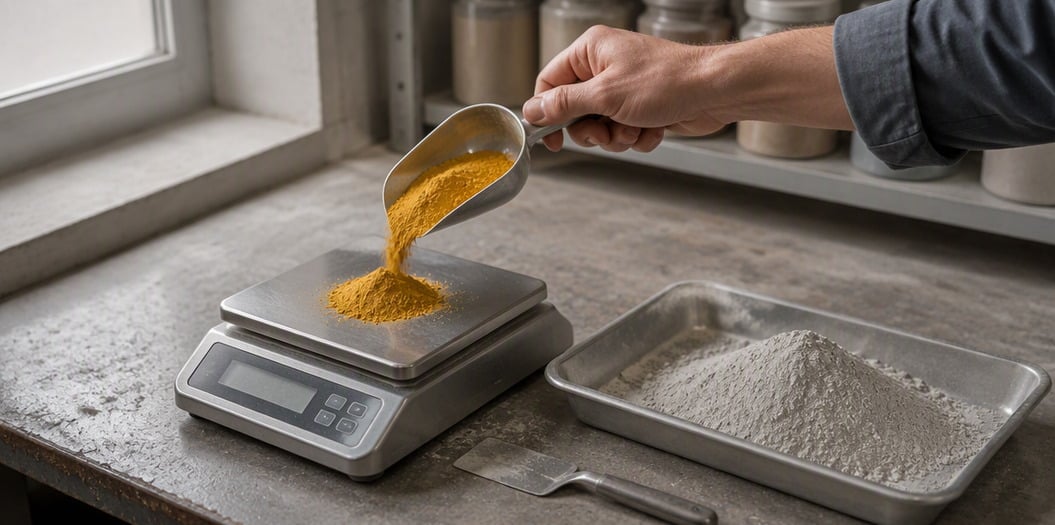
Step 3 — Set the addition rate on binder weight, not on volume. Dry-mix products are batched by weight, so the pigment is specified as a percentage of the cement (binder) weight. In integrally coloured cement-based mixes the addition rate is commonly reported in the low single digits as a percentage of cement weight; the working value is fixed by the target shade and by how dark the base already is. The arithmetic is direct:
| Pigment as % of cement weight | Pigment per tonne of cement |
|---|---|
| 1% | 10 kg |
| 2% | 20 kg |
| 3% | 30 kg |
| 5% | 50 kg |
Above the commonly reported band, the hardened mortar — not the colour — becomes the limiting factor, because pigment loading competes with the binder fraction that carries mechanical strength. When a shade is not reached inside the band, the correct response is to change grade or to review the base materials, not to keep adding pigment.
Step 4 — Control the dry-blend distribution. Pigment that is dumped on top of a full batch has to be carried by the blender into every part of the mix, and it does not always get there. Typical practice is to pre-blend the pigment with a portion of the filler first, to keep the mixer fill level inside the range the blender was designed for, and to sample the finished batch at three points — top, middle and discharge — to confirm that the tint is uniform before the batch is packed. The reason this matters is optical: undispersed agglomerates behave as a few large dark particles rather than as many small evenly spread ones, so they read as specks and streaks even when the pigment weight in the batch is exactly right.
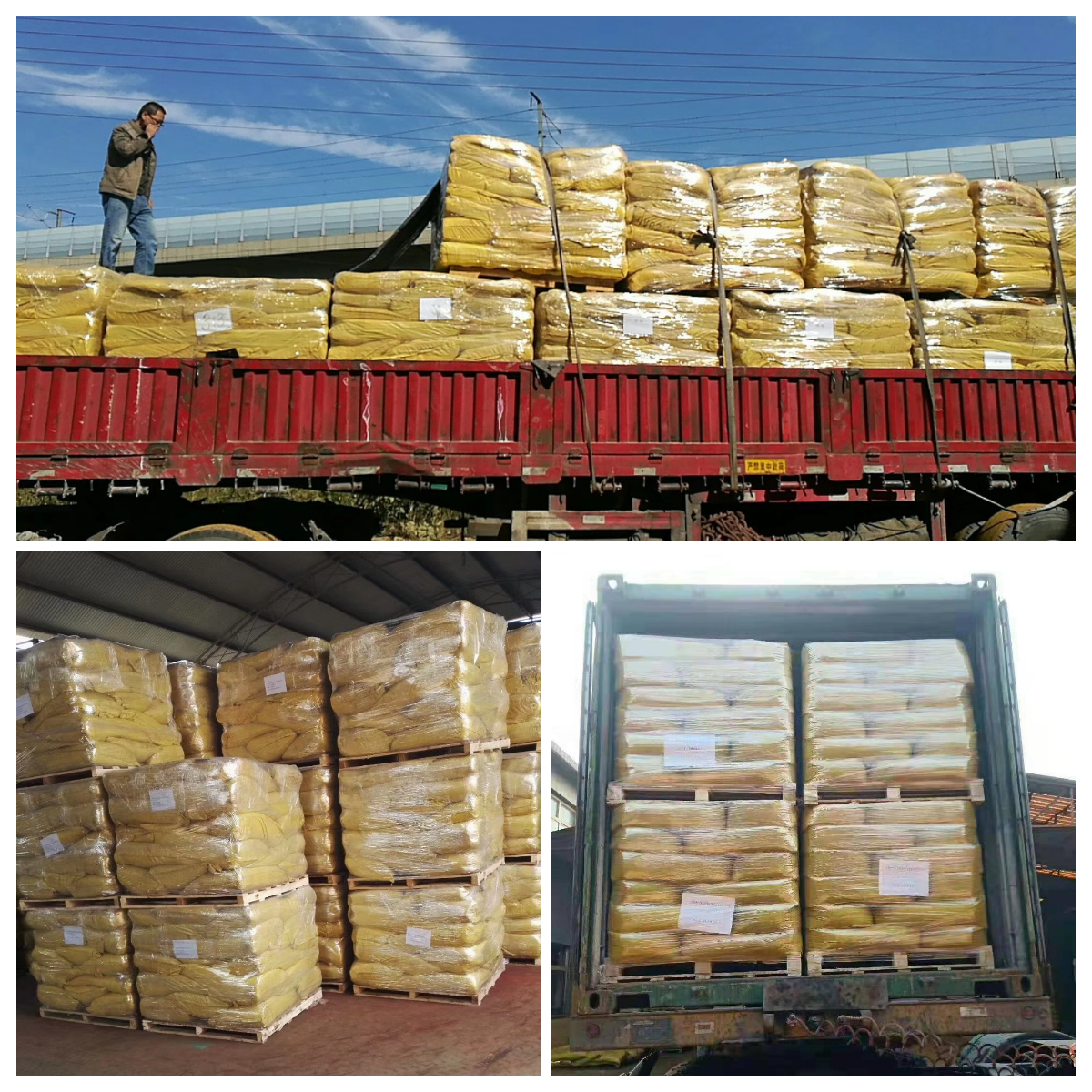
Step 5 — Fix the supply side. The parameters that carry colour in a cement system are the ones to write into the purchase specification: Fe2O3 content, tinting strength, oil absorption, residue on screen, water-soluble content, volatile matter (ISO 787-2, General methods of test for pigments and extenders — Part 2: Determination of matter volatile at 105 °C), and colour difference against an agreed standard. Where a buyer works to a framework document, the relevant ones are ASTM C979 / C979M-16 (Standard Specification for Pigments for Integrally Colored Concrete) and EN 12878 (pigments for the colouring of building materials based on cement and/or lime). Certifications held are REACH, RoHS, CE and ISO, together with IATA DGR for air transport and IMDG Code for sea transport; for a mortar plant importing classified pigment by sea, the IMDG documentation is part of ordering, not a formality. Minimum order quantity is 1 metric ton in 25 kg woven bags, available ex-stock; small samples are supplied for testing and do not count toward the MOQ.
This page carries no measured figures, because it describes a typical configuration rather than a delivered project. Presenting percentages, colour-difference values or rejection rates here would mean inventing them.
What can be stated is which variables decide the outcome and who holds each one:
| Variable | Controlled by | Effect on the cured joint colour |
|---|---|---|
| Cement base tone and its variation between deliveries | Mortar producer | Sets the depth and the neutral-warm balance of every shade in the mix |
| Filler tone and iron content | Mortar producer | A darker or iron-rich sand shifts the whole mix; a yellow can read olive without any change in pigment |
| Pigment grade and addition rate | Mortar producer, with supplier grade matching | Positions the hue and the depth |
| Dry-blend distribution | Mortar producer | Uniform dispersion gives one colour field; agglomerates give specks and batch drift |
| Gauging water added on site | Tile fixer | More water means a more porous, lighter joint and a higher risk of surface bloom |
| Curing and ambient humidity | Site | Drying rate affects surface density, and with it how the joint reads |
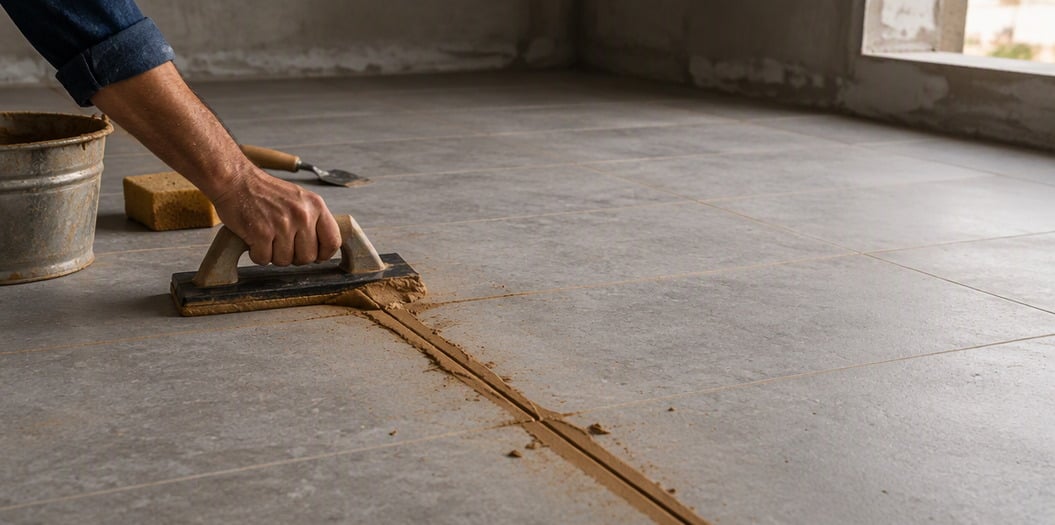
| Joint width, depth and tooling | Site | Narrow joints show a thin section of mortar, so the same mix can read lighter |
| Cleaning after installation | Site | Acid-based grout haze removers attack the cement binder at the joint surface, so colour is best assessed after cleaning, not before |
A mortar plant that wants numbers rather than a qualitative statement would track four of them per batch: the colour difference (ΔE) of cured mortar against the retained master sample; the pigment weight actually dosed per tonne of binder against the target; the number of batches that had to be re-tinted; and the joint-to-tile colour match assessed after curing rather than on the wet mix. Those four convert the table above into a commercial figure.
It is worth separating two problems that look the same on site. Efflorescence — the white carbonate bloom that appears on cement-bound surfaces — is not a pigment defect and cannot be cured by changing pigment. It comes from soluble salts carried to the surface by water and carbonated there; the controls are the water content, the curing and the drying of the substrate. That mechanism is set out in more detail in our article on efflorescence in coloured concrete.
Hebei Tianhuibao Technology Co., Ltd. has produced iron oxide pigments for 26 years, with an annual production capacity of 50,000 tons, and supplies customers in 150+ countries and regions. The iron oxide red series covers grades 110, 130 and 190, plus nano and ultra-fine grades, easy-dispersing rubber grades, acid and alkali resistant grades, food-contact grade, and factory-direct colour matching; the yellow, black, brown, green and blue series cover the remaining shade families used in dry-mix products. Certifications held include REACH, RoHS, CE and ISO, together with IATA DGR and IMDG Code. Quality control runs from raw material testing to finished product inspection, and multi-batch colour consistency data (ΔE against an agreed standard) is available on request.
If you are producing coloured dry-mix mortar, tile adhesive or grout and want the iron oxide pigment for mortar and tile grout matched to your own base powder, send us your target shade or a retained master sample, together with the cement and filler you use, and request a specification sheet and a trial sample. Contact: [email protected] / +86-13400211655.
 EN